First published July 2026
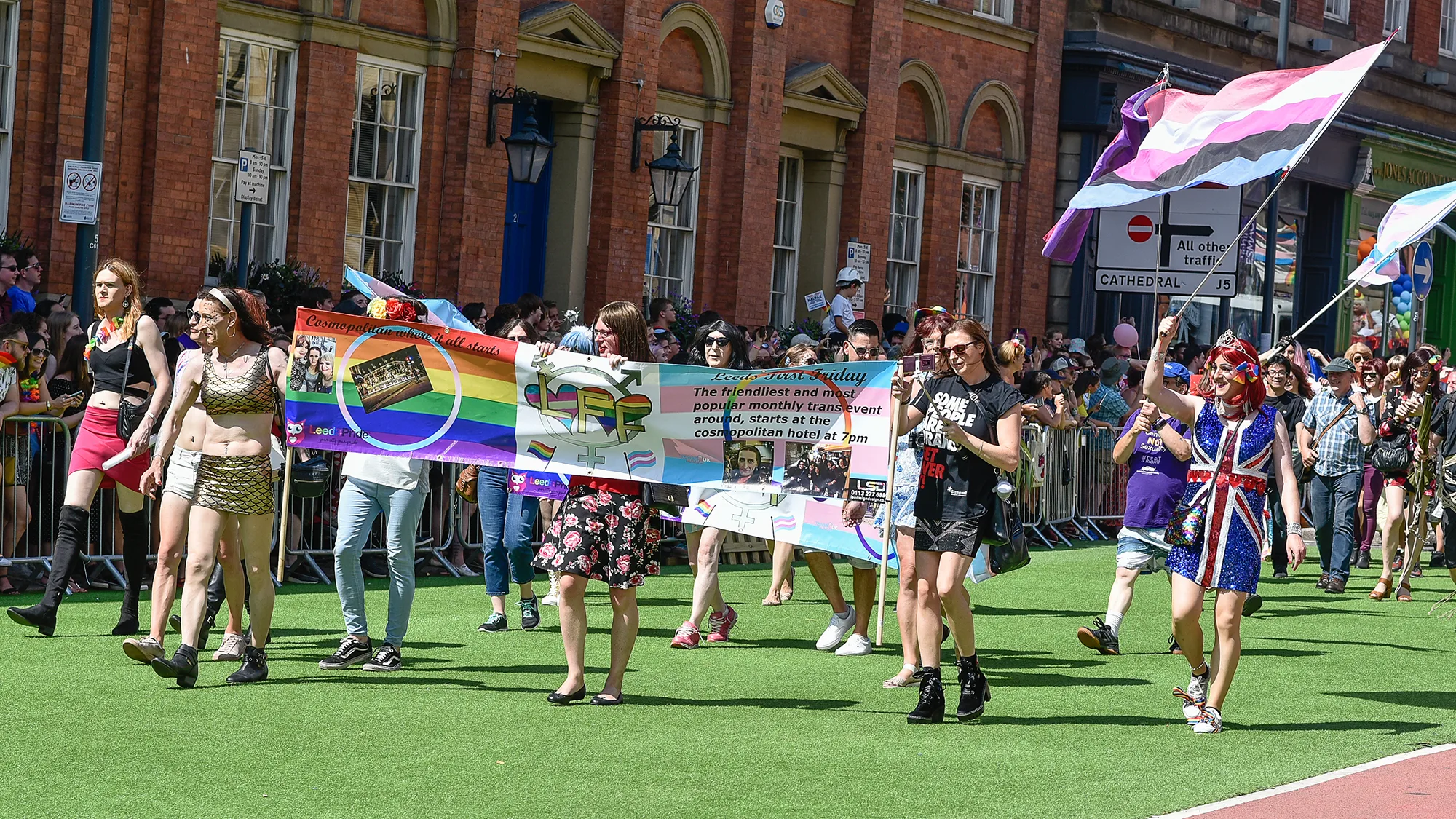
This year Leeds celebrates four hundred years since its first Royal Charter, granted by Charles I in July 1626. The record of trans lives in Yorkshire runs longer: seventeen centuries, thirteen of them before Leeds had a charter at all.
This history comes in two parts. The first follows the most recent hundred years, and how trans social life in Leeds has adapted and endured. The second sets Leeds First Friday against that longer past. You will notice a pattern: the venues change names, the people running them come and go, but the thing itself never does. Somewhere to be yourself, be welcomed, and be among friends.
Leeds First Friday is the latest name for that thing. Here is how it happened.
 Part One
Before
Leeds First Friday
Trans people were in Yorkshire seventeen centuries before Leeds First Friday had a name. This is how our community existed before.
The oldest evidence is in the ground. At Catterick, forty miles up the A1, in 2002, and again at Hungate in York in 2023, archaeologists opened late Roman graves to find a skeleton identified as male laid to rest in the jet and shale jewellery that Roman culture kept for women. The Catterick burial, dated to the fourth century, included a necklace, bracelets and an anklet of a sort never recovered from a man in any other late Roman cemetery in Britain.
Archaeologists read the Catterick grave as one of the Galli, the priesthood of the goddess Cybele (SIB-uh-lee), the Great Mother whose cult Rome imported from Asia Minor in 204 BC; the York burial, with less surviving evidence, points the same way. Assigned male at birth, the Galli wore bright dresses and jewellery, painted their faces and grew out their hair, and, following Cybele's beloved Attis, many though not all underwent ritual castration. Roman writers gave them their own names, media genus and tertia sexus, the middle gender and the third sex. This was no brief curiosity: the cult of Cybele outlasted the worship of Jupiter and the emperors and very nearly outlasted paganism itself, its last recorded rites performed in 394 AD.
What the Romans filed under those names, the present has a clearer word for. English Heritage, which looks after the northern forts where altars to Cybele have turned up, reads the Galli as occupying a place in Roman gender that trans and non-binary people today recognise as their own. At Catterick, the body was buried in its necklace, bracelets and anklet, exactly as they had lived.
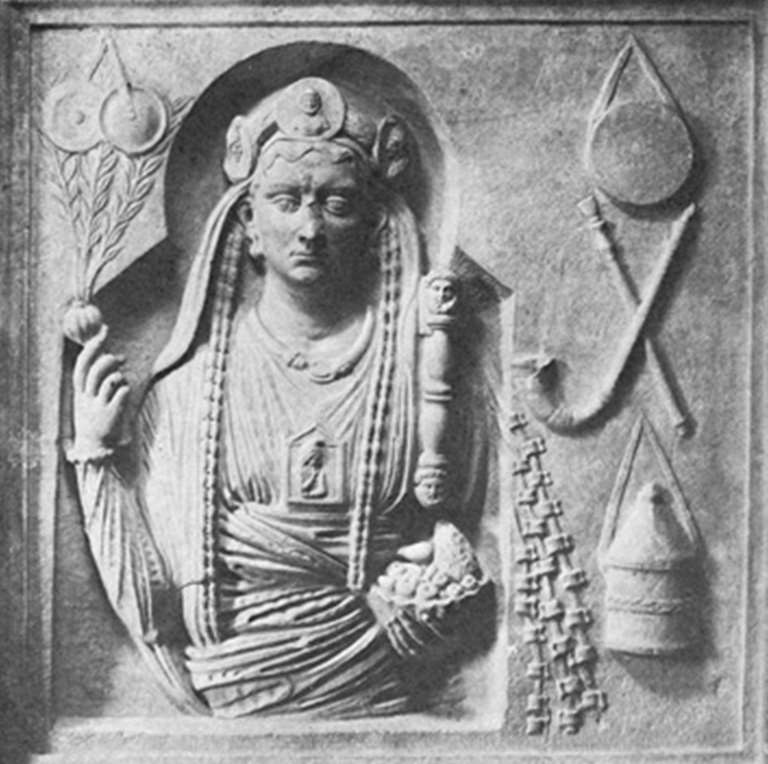
A Roman relief of a Gallus, priest of Cybele, second century AD.
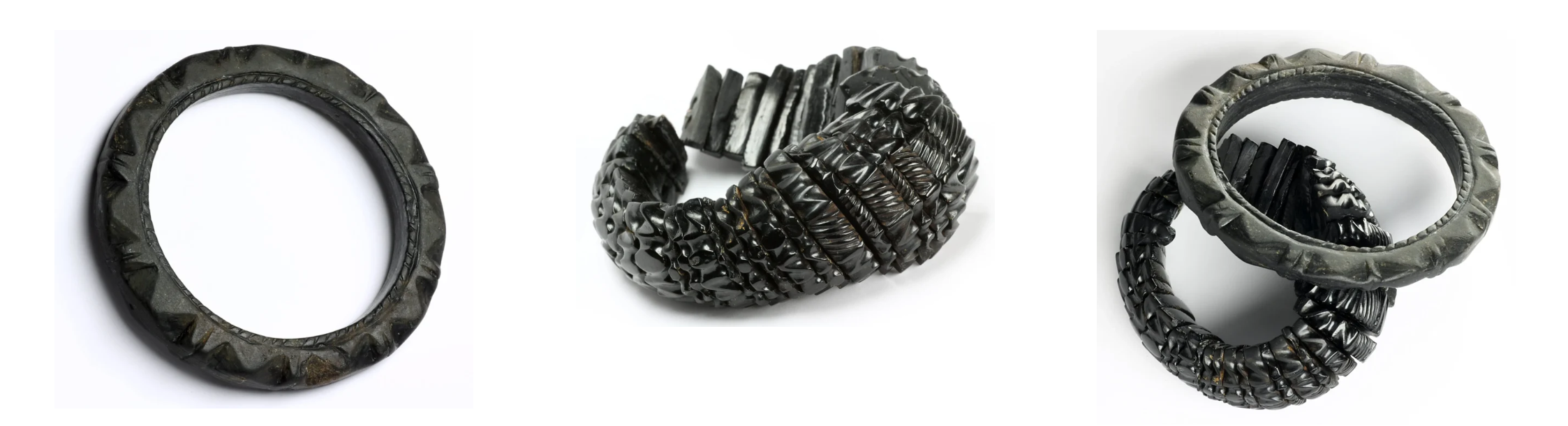
A jet bracelet from the Catterick burial, fourth century AD. In Roman culture jet jewellery belonged to women; the skeleton was male. The body is now in the Yorkshire Museum.
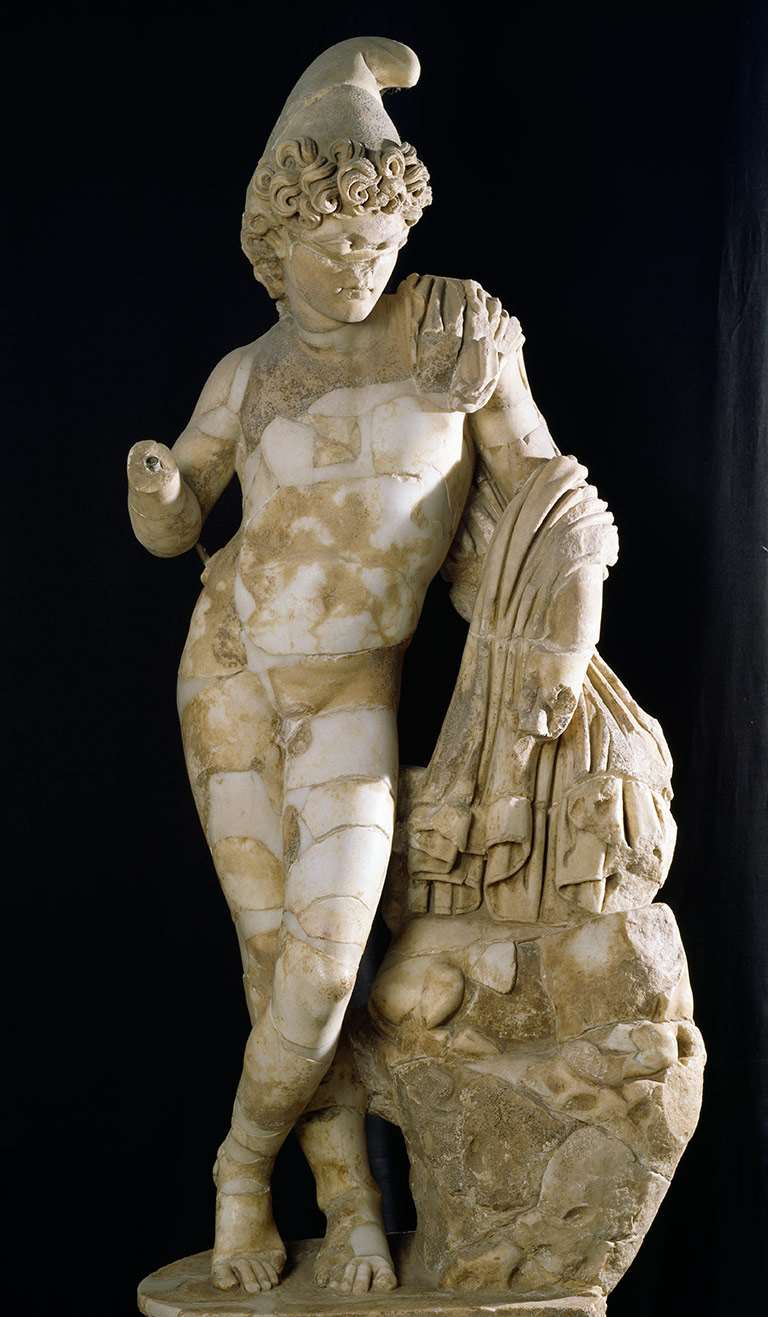
Attis, Cybele's castrated consort, in his Phrygian cap. The Galli followed his example. Marble, Spain.
The seventeen centuries that follow are not empty, only quiet: trans lives surface for a moment whenever the authorities thought to write something down, an arrest, an obituary, a person passing as a man for a decade before the press exposed them as a female husband
. The record tilts the way the Victorians tilted it, patronising trans men and prosecuting trans women, but the people behind it were real, and they were here. Whether they found one another in those centuries, and where, is mostly lost rather than truly absent: the record simply falls silent between the moments the authorities chose to write something down.
What follows, then, is not where trans Leeds began to find one another. It is only where the record grows dense enough to watch it happen.
Sources: Cool, in Wilson (ed.), Cataractonium, CBA 2002; York Archaeology, International Transgender Day of Visibility: The Galli in Yorkshire
, yorkarchaeology.co.uk, 2023; English Heritage, The Galli
, english-heritage.org.uk; Historic England, Pride of Place; British Newspaper Archive.
Off Lower Briggate, in a narrow passage called Blayd's Yard, there was a club in the 1930s where, if you knew to look, you could find people like yourself. The Pelican Social Club was frequented by effeminate men who called each other by female Christian names and two of whom wore women's clothing
, and once you strip away the contempt in the period prose, what is actually being described is plain enough: people gathering under chosen names, dressed as themselves, a few doors from where Leeds First Friday meets now. The night had been running on that street for the better part of a century before it found a name to run under.
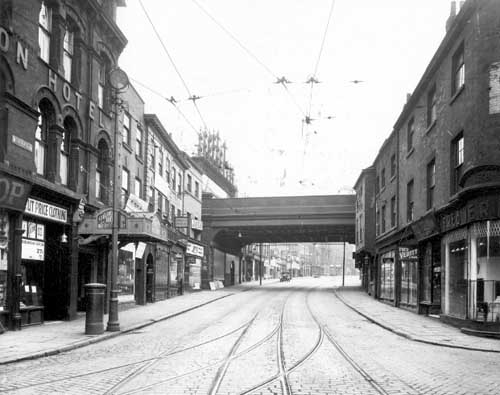
Lower Briggate in the 1930s, looking towards the entrance to Blayd's Yard.
Sources: Leeds Pride LGBT History Month features; Welcome to Leeds; West Yorkshire Queer Stories archive.
In 1953, a late Victorian pub on Call Lane called the Hope and Anchor began quietly letting the community in. It was a refuge before the decriminalisation of homosexuality in 1967, and though the building saw interruptions and a change of name in the years that followed, the welcome kept finding its way back to the same address. Reopened as The New Penny in 1982, it is now one of the longest-running LGB and T venues in the country, with a Leeds Civic Trust blue plaque that says out loud what the community had known for decades and a cabaret stage that has hosted some of the great names of British drag, Lily Savage among them.
Around it, a discreet queer Leeds had been meeting for years, on terms the rest of the city barely noticed: a scattering of pubs that tolerated their regulars until last orders, and the coffee bars that kept the evening going once the pubs shut. The Mitre on Commercial Street, the Royal Hotel on Lower Briggate, and the Golden Lion at the bottom of the street each kept the same quiet welcome. The clean categories of the present had not yet pulled apart; gay and lesbian, drag, cross-dressing and what we would now call trans all shared the same few addresses, because those were the only ones going. For anyone whose gender did not sit easily with the street outside, this half-hidden circuit was the closest thing to cover. None of it was advertised; you found your way by knowing someone who already had.
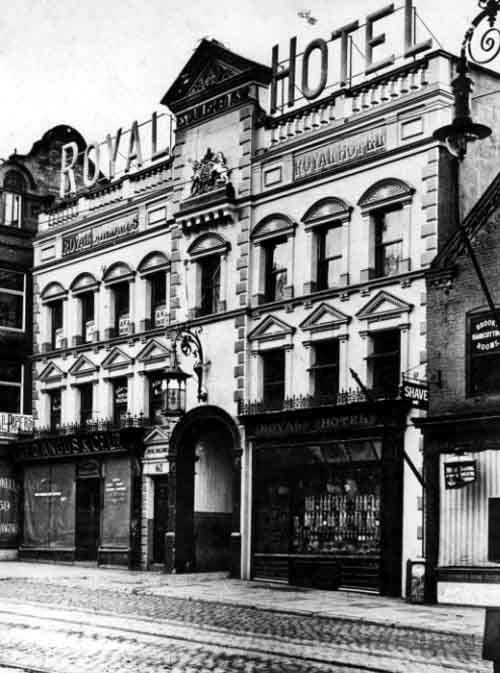
The Royal Hotel, Lower Briggate, 1908. Royal Buildings, nos. 159–162, established 1692. Half a century on it was one of the city's quiet queer haunts, and it stands today as Westrow House, with Janie's bench outside. Photograph by Alf Mattison, courtesy Leeds Libraries, leodis.net.
In 1968 the People, a national paper that ran on manufactured scandal, sent a reporter to the pub, who came back appalled that men heavily made up and smelling of perfume were dancing cheek to cheek
while the rest of the bar watched without a murmur
, and that women in collars and ties were dancing together too. Read today, the exposé is an accidental love letter, an itemised list of everything the New Penny was getting right two decades before the rest of the country managed it. Its landlady, Cathy Wilson, was magnificently unbothered. About 90% of my customers are queer or lesbian,
she told them. They come here because they regard it as their pub and I get no trouble. I would rather run a pub like this for these people than have a pub full of some of the normal types we have in Leeds.
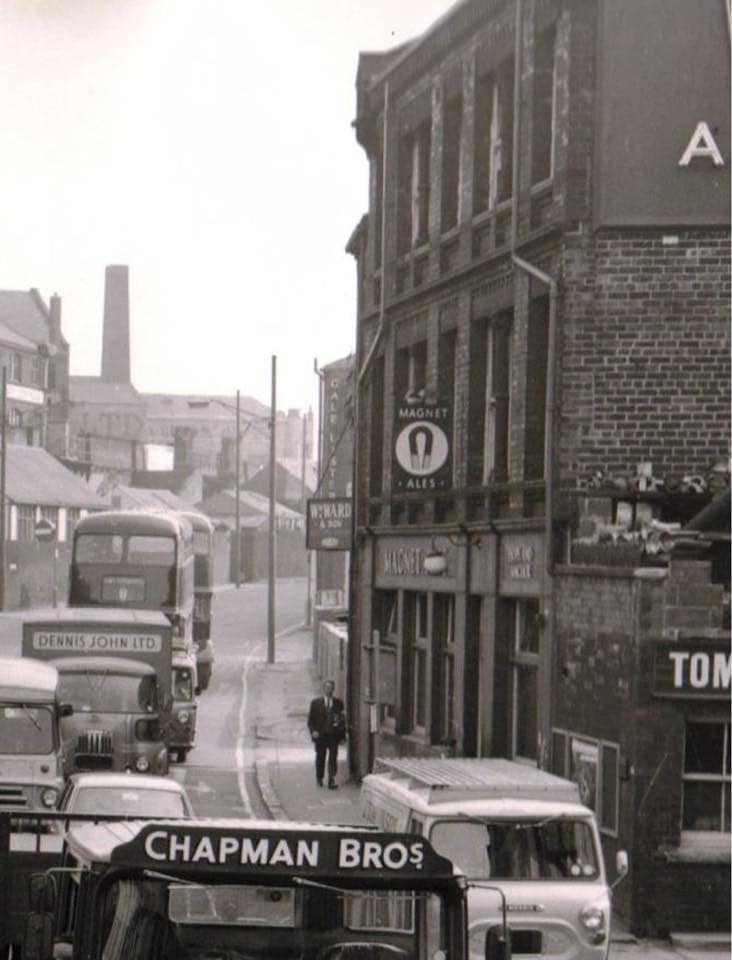
The Hope and Anchor on Call Lane. The pub that would become The New Penny, as it stood in the 1960s.
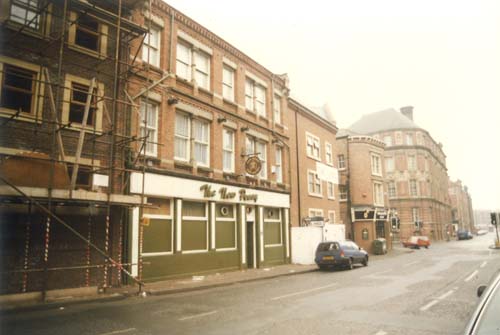
The New Penny in 1989.
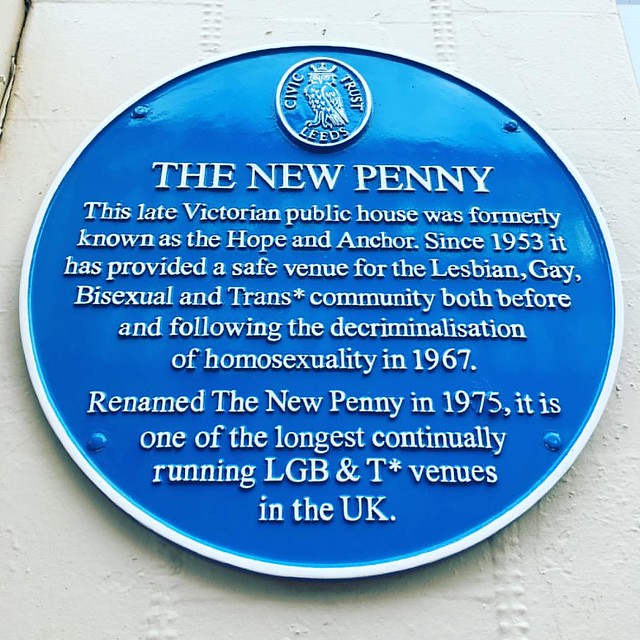
The Leeds Civic Trust blue plaque. The wording is precise: a safe venue for the Lesbian, Gay, Bisexual and Trans* community both before and following the decriminalisation of homosexuality in 1967.
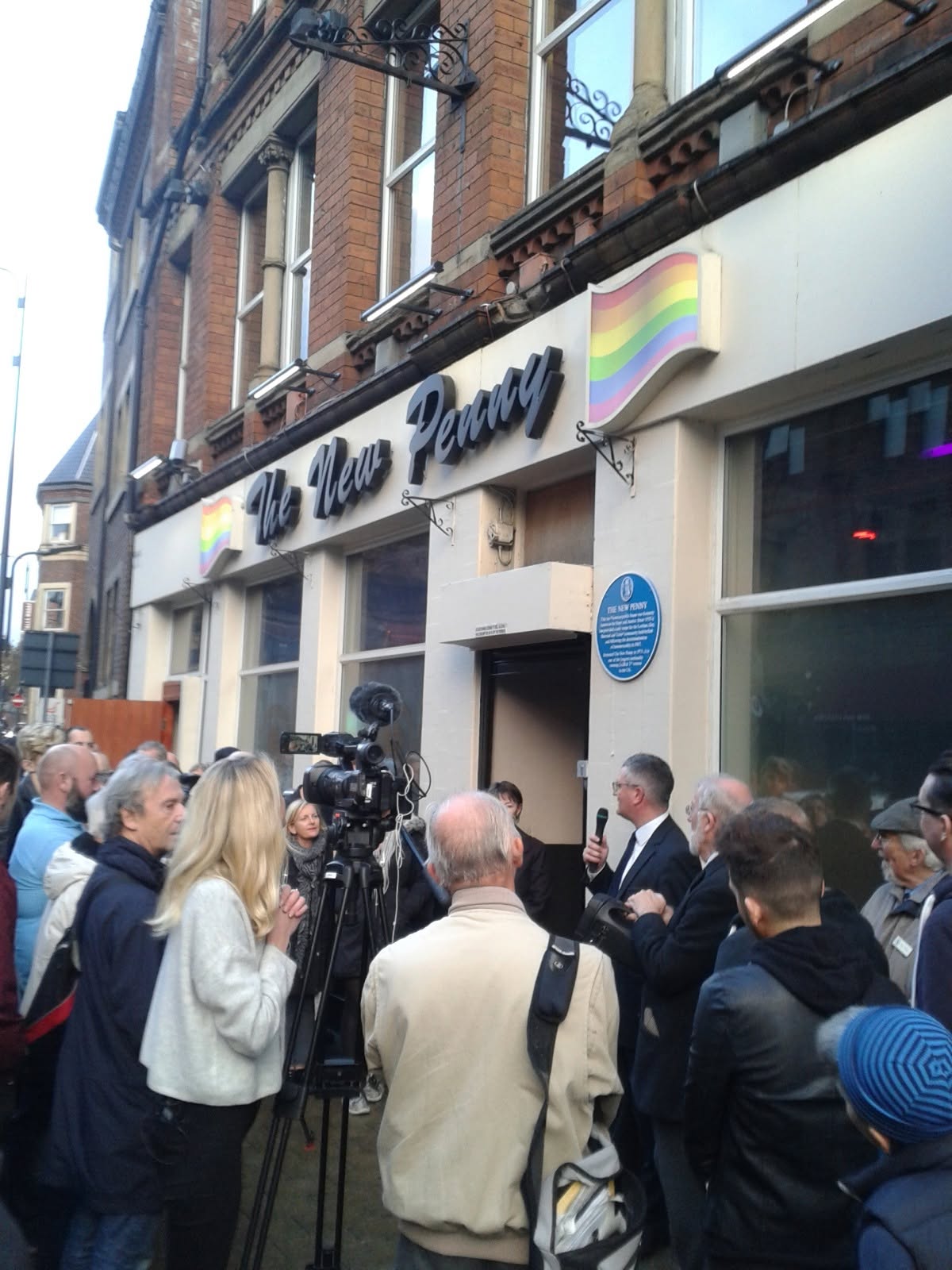
Unveiling the plaque, 2016, the Civic Trust's 160th. Councillor Lewis does the honours.
The plaque went up in 2016, Leeds Civic Trust's 160th, unveiled by Councillor Lewis, a name worth remembering, because he returns to this story in 2023 on the same street, at Janie's bench.
And it is still there. Seventy years on, the New Penny is a stop on the Leeds First Friday circuit: the same stage, the same floor, a Friday crowd several generations deep, dancing as themselves in a pub that let them do it before the law allowed it. Almost every other place in this history has to be remembered. The New Penny can simply be visited.
Sources: Leeds Libraries, Male Homosexuality in Britain, 1954–70: The Leeds Link
, secretlibraryleeds.net, 2020; the People, 1968; Leeds Civic Trust; Leeds Gay History (@LeedsGayHistory).
In March 1974, Leeds hosted the first national conference on trans issues in the UK, and the first run by trans people rather than convened to study them. A London symposium five years earlier had gathered clinicians to discuss their patients. The Leeds weekend dispensed with the clinicians' framing entirely.
The work behind it belonged to the Leeds University TV/TS Group, a local organisation that was already meeting and already had a mailing list when the idea came up. June Willmott of the Beaumont Society and Caroline Robertson, a postgraduate at the University of Leeds, drove it forward, posting more than two hundred personal invitations over a single weekend, with Willmott going on BBC Radio Leeds to explain to the city what was coming. The Yorkshire Post duly sent a reporter to the reception at the Guildford Hotel, who filed a piece that contrived to be astonished and condescending and, despite itself, the first press record of the thing.
What the weekend also exposed was that trans Leeds had never been a single community. Willmott and Robertson stood for opposite answers to the same question. Willmott spoke for the Beaumont Society, founded in 1966 on respectability and a careful distance from homosexuality; she held its heterosexual-only line, and was on record calling its gay members embarrassing and detrimental. Robertson, who attended as Caroline, had no patience for any of it, dismissing Beaumont as a tea and lace curtains society and arguing for radical feminism over respectability. The practical running of the event, the coffee trolley and the Saturday disco that drew a hundred and eighty-five people, fell to Leeds GLF, the gay liberationists Beaumont had spent eight years keeping at arm's length. Previewing the conference, the Guardian saw it plainly: the conservative and radical wings of one movement, booked into the same building for the weekend.
A hundred and two delegates came at the peak, spread across the Guildford, the University and Leeds Polytechnic. They heard Margaret Williams of the Beaumont Society, Julia Tonner of the Transsexual Action Organisation, Della Aleksander, lately seen on the BBC's Open Door, and Dr. Elizabeth Ferris from the Charing Cross Gender Identity Clinic; somewhere in the schedule sat a screening of The Queen, the 1968 documentary about a New York drag pageant. Between the sessions on law and medicine, the disco and the stalls selling clothes and large-size women's shoes amounted, for a good number of those present, to the first occasion in their lives to travel as themselves and be dressed for it among people who needed no explanation. The programme also contains the earliest written use yet found of the phrase "trans people"; the vocabulary, like the rest of it, was being worked out as they went.
It is, on the page, a Leeds First Friday in everything but the name, fifty-two years before anyone thought to give it one.
The weekend has been marked twice since: a rainbow plaque in 2018, and in 2024, fifty years to the day, a permanent blue plaque on the steps of Leeds University Union.
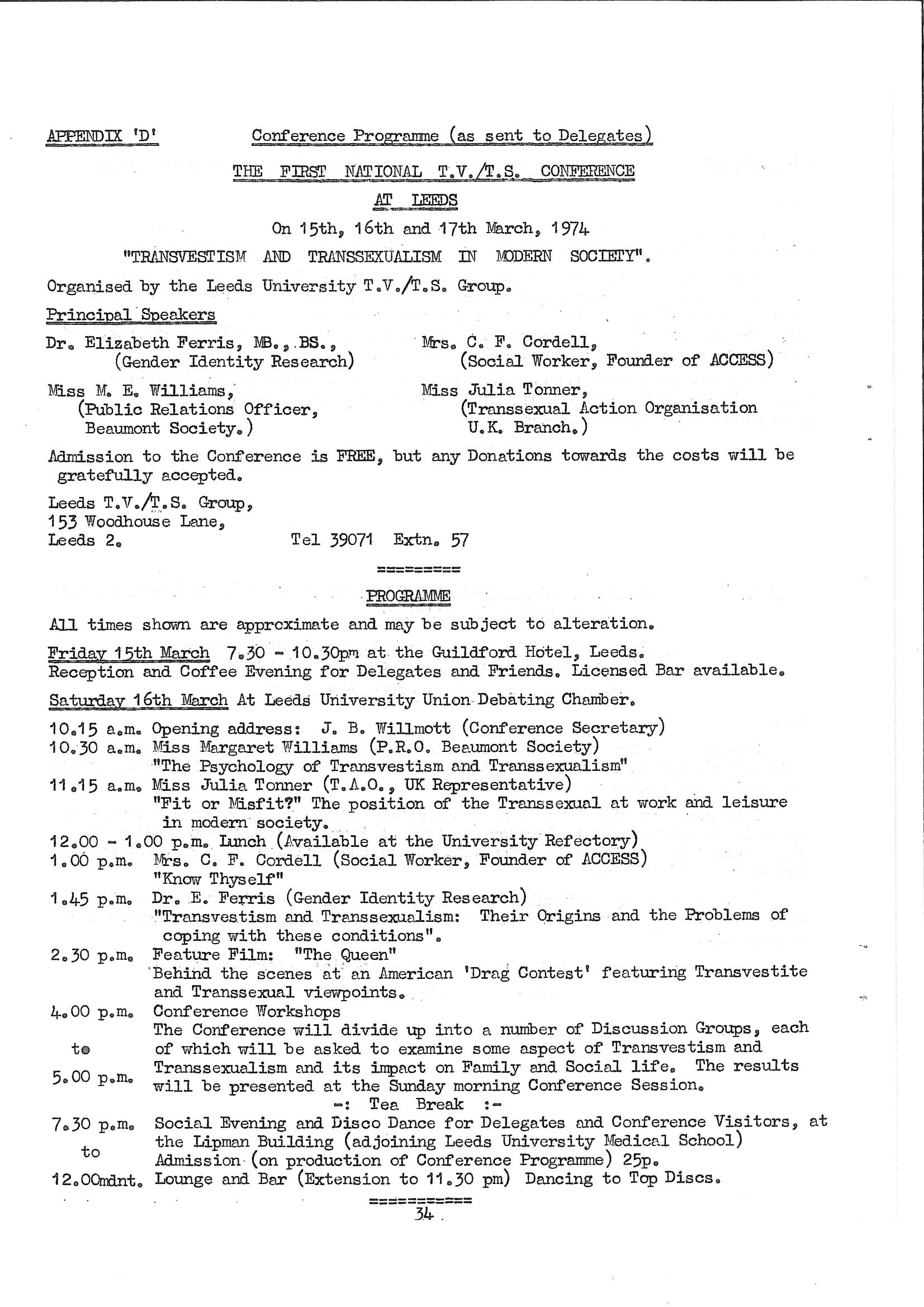
The original conference programme sent to delegates. 15–17 March 1974.
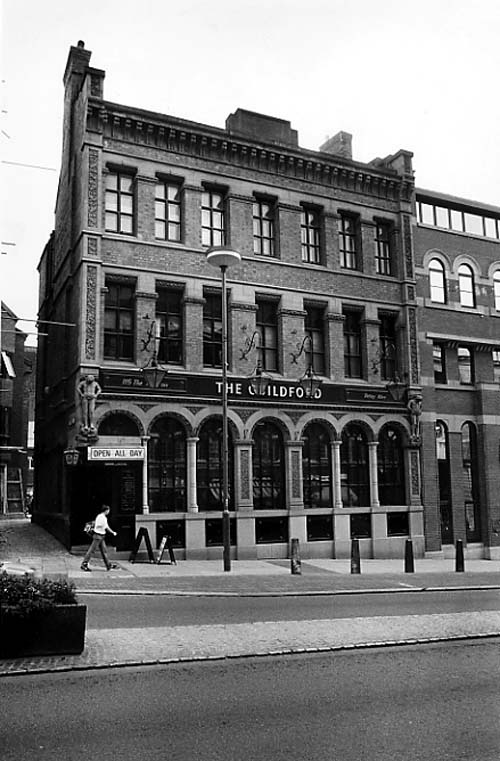
The Guildford Hotel, which hosted the conference reception on the evening of 15 March 1974.
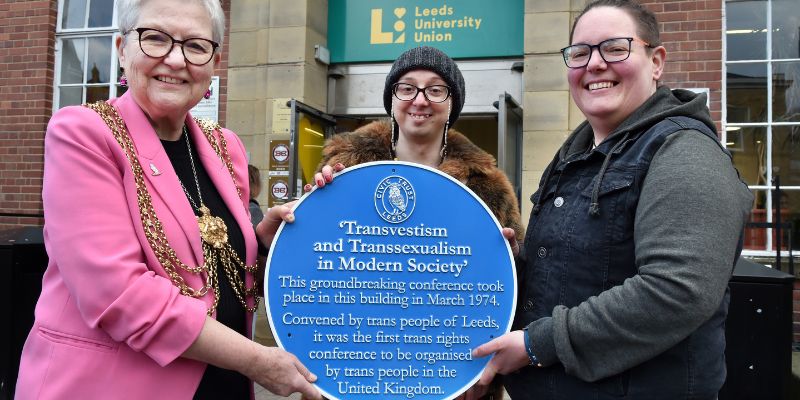
The blue plaque unveiled on the steps of Leeds University Union, 19 March 2024. Fifty years to the day. The ceremony and a day of recognition at Leeds City Museum were curated by GossipGrrrl, Leeds artist and activist.
Sources: West Yorkshire Queer Stories; Leeds Civic Trust; University of Leeds; conference report via Beaumont Society / Bishopsgate Institute; transcription at transphilez.netlify.app; Yorkshire Post, 16 March 1974, via WYQS; Guardian preview (Michael Parkin), 4 March 1974; Beaumont Society history via Trans Britain (ed. Christine Burns); Leeds GLF context via Secret Library Leeds.
By the 1980s, queer Leeds no longer had to be found by knowing someone who already had. It had a cluster of its own, the same few streets it occupies today: the Bridge Inn on Bridge End, now Bridge Bar; Charlie's Club and Bananas Bar at Lambert's Yard, today's Queens Court; the Old Red Lion at the Meadow Lane end; and, older than any of them, the New Penny on Call Lane, which had been letting the community in since before the law allowed it. It was the fullest the scene had ever been, and the decade was about to test all of it.
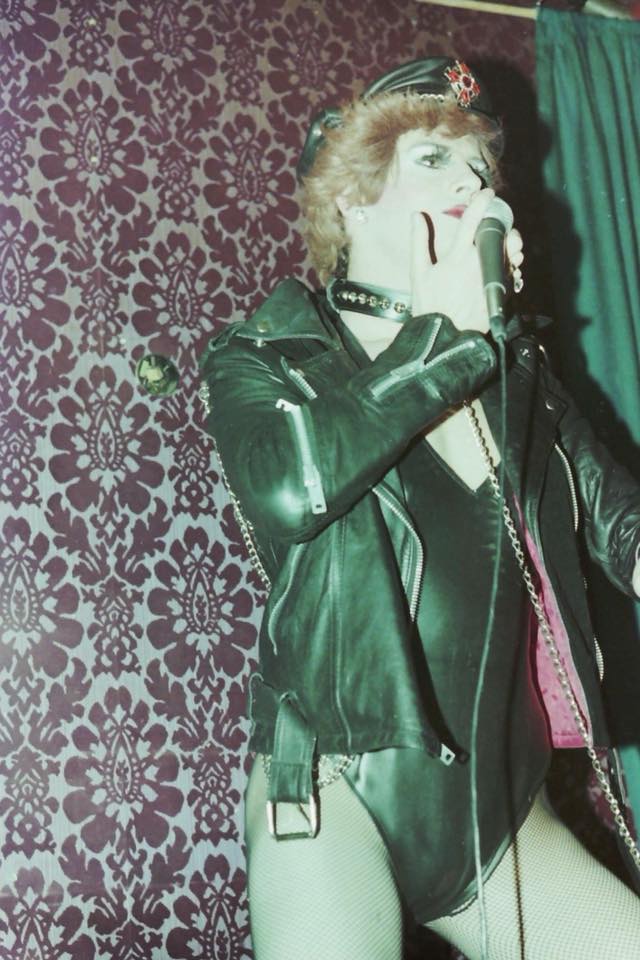
Adrella (Peter Searle) on stage at the New Penny, 1980s.
Half a mile west of Lower Briggate, The Warehouse opened in 1979, three years before Manchester's Hacienda, the work of Mike Wiand, a Nebraskan who had come to Yorkshire in 1969 to work at the Menwith Hill monitoring station and who had never set foot in a discotheque before he built one. He filled it with a sound system he designed himself and a DJ mixing twelve-inch records with no compère, which in a city still playing seven-inch singles to a talking MC was close to revolutionary. That DJ, Greg James, watched the crowd change under him: They really did attract an off-the-wall crowd. First it was Saturday Night Fever and Farrah Fawcett lookalikes complete with flicked hair and rollerboots and later new romantics and gender-bending fashionistas, many of whom became famous regulars.
Soft Cell formed on its dancefloor; Marc Almond worked the cloakroom until Tainted Love
went to number one and Wiand moved him to the decks. The door worked backwards by the standards of 1979: it turned away the too-mainstream and anyone who could not live with the tolerance the place ran on, and let in the cross-dressers other Leeds venues barred at a glance. Wiand ran it from the start on a creed the decades since keep rediscovering: that a club has to hit you with something the moment you walk in, and that none of it works unless everyone inside, however outrageously dressed, is free to be themselves and safe enough to stay.
The building that is now Revolucion de Cuba began its queer life in 1980 as Belinda's, a commercial disco with a neon-lit glass dance floor at the bottom of Briggate, and by the mid-eighties had become Rockshots 2, the gay superclub some called the Studio 54 of the North, playing Hi-NRG and disco and early house through the years when the city outside was at its most dangerous. Divine performed there. Neil Curry, who now hosts Leeds Pride, remembers both sides of its door: the night within, and then the walk out past the skinheads who waited on the pavement for someone to hit. The place worked as a sanctuary because the street would not, and the walk home was the part nobody printed on a flyer.
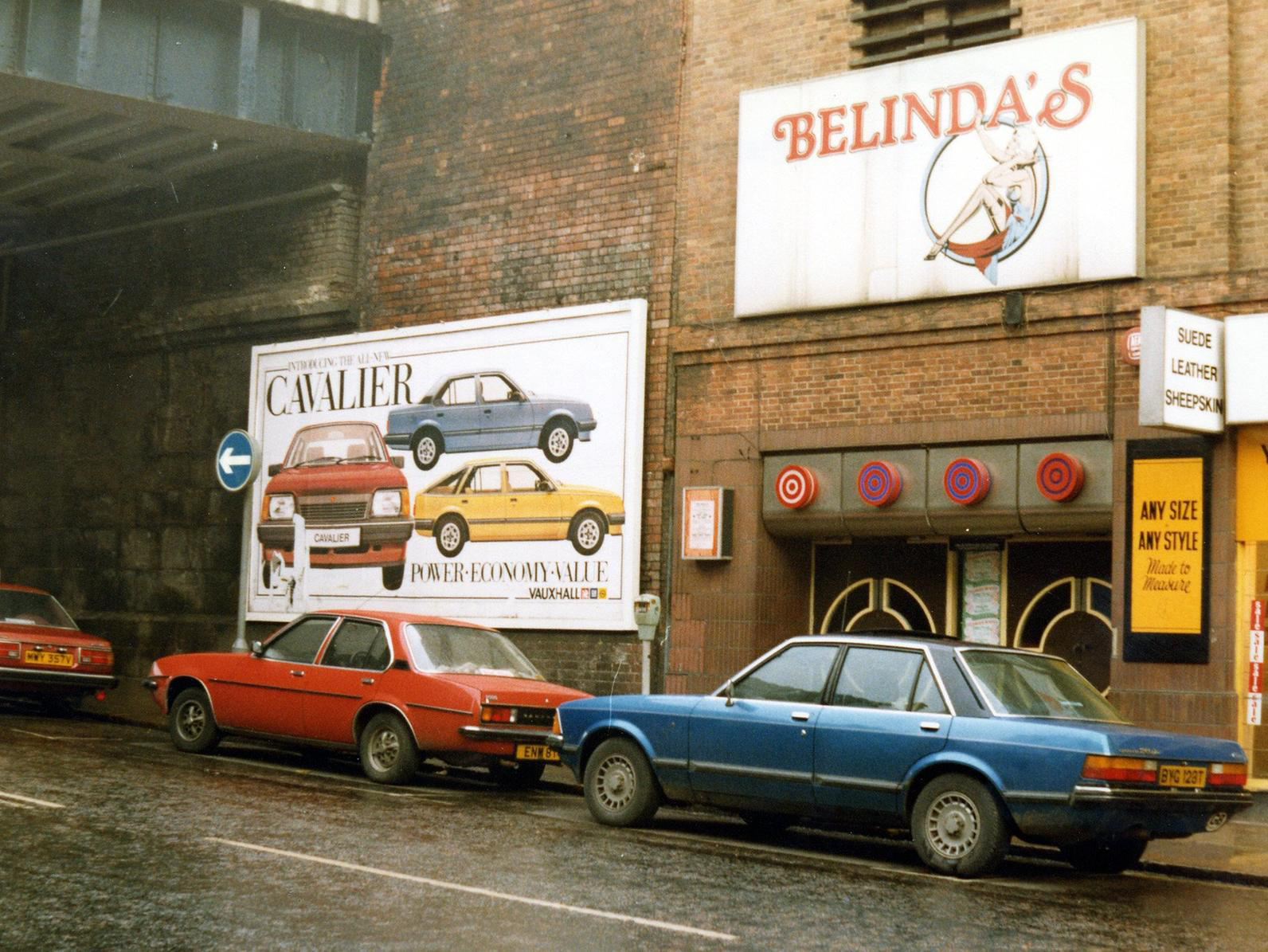
Belinda's, the bottom of Briggate, around 1980. The commercial disco that became Rockshots 2.
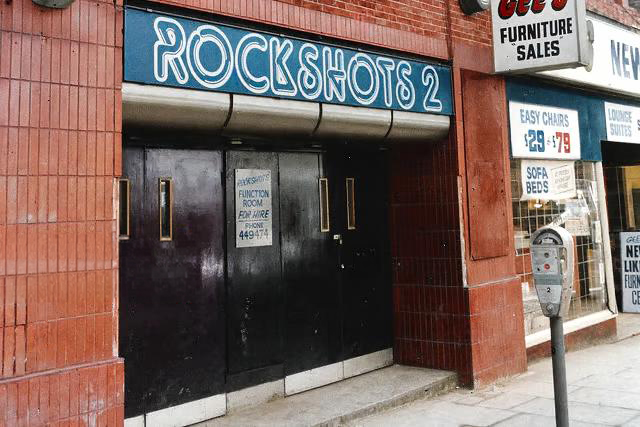
Rockshots 2, Lower Briggate, 1986. The Studio 54 of the North, and the building that would become The Chocolate Factory, The Music Factory, and the birthplace of Back II Basics.
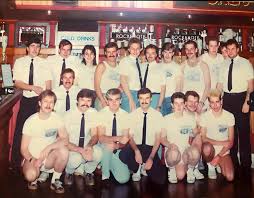
The Rockshots 2 team, 1986.
Underneath the decade's noise ran something no flyer ever mentioned. One Leeds resident first read the word around 1981, in a magazine picked up at the bookshop in Blayds Yard, a few doors from where Leeds First Friday drinks now; the article filed AIDS under distant news, gay men in California, a thing as rare, they were assured, as rocking horse shit. It did not stay rare, and it did not stay in California. When the film star Rock Hudson died of it in October 1985, the first famous name the disease had claimed, his wasted face across every front page, it could no longer be filed under distant news. The people on these dancefloors started going to funerals, and then to more of them.
The city outside met the sick with fear dressed up as procedure: ambulance crews at the door in biohazard suits, and, after a single call-out to a house in north Leeds, council workers torching the grass verges the length of the street, as though the virus lived in the ground. So the scene did what it had always done and looked after its own. The drag performers who worked the New Penny's cabaret, Adrella among them, turned their nights into benefits for the sick and the dying; the Gay Switchboard answered through the night; the prevention work that would grow into Yorkshire MESMAC, now among the oldest AIDS charities in the country, began in these same few streets; and friends learned that the kindest thing you could offer someone newly diagnosed was not said through tears. One person never forgot why a friend kept coming round after the diagnosis: You didn't burst into tears. You just said, are we going for a drink then? Cos you're not dead yet.
Trans women were part of that scene too, and part of its grief, even as the story being written around them left them out. Trans people had been in the fight from early on, and were written out of it just as fast. Michelle Ross, a trans woman who took her first shift on the Terrence Higgins Trust helpline in 1988, has spent the decades since watching it happen: We are erased all the time, even today.
For trans people across the North in these years, organised life ran on a different map. The Beaumont Bulletin still arrived through letterboxes each month with its notices of where it was safe to meet. The Gemini Club in Huddersfield had been the largest gay club in the north by the late seventies, known across the country, until West Yorkshire Police took against it, branded it a cesspit of filth
and harried it into closure; London Pride decamped to Huddersfield in 1981 in protest at the campaign. The bigger draw for trans people was Manchester. A TV/TS group had been meeting there since 1975, and in 1986 it gave rise to the Northern Concord: a self-help and social group running Wednesday evenings that regularly drew forty to sixty members and friends, wives and girlfriends welcome at no charge, with make-up demonstrations, fashion nights and organised social events alongside. Word of it passed the same private way, one person telling another, and you got there by train or car, commonly from Leeds. It was active and organised; it was just not here.
Then, in 1988, Section 28: the law forbidding the promotion
of homosexuality in schools. A young Leeds DJ called Terry George had just been given a gay night of his own, Confettis, at the Merrion Centre, and it grew from three hundred a night to more than twelve hundred, coaches arriving from Nottingham and Manchester and Derby and Sheffield and Liverpool, Boy George and Take That on the bill. The month Parliament voted to make them smaller, those twelve hundred packed sweating onto the floor and got bigger, lit up and deafening on the exact nights the law wanted them invisible. Nobody called it protest; it did not need calling anything, it just needed the floor. That the north would travel for a night that truly wanted them is the same wager Leeds First Friday places now.
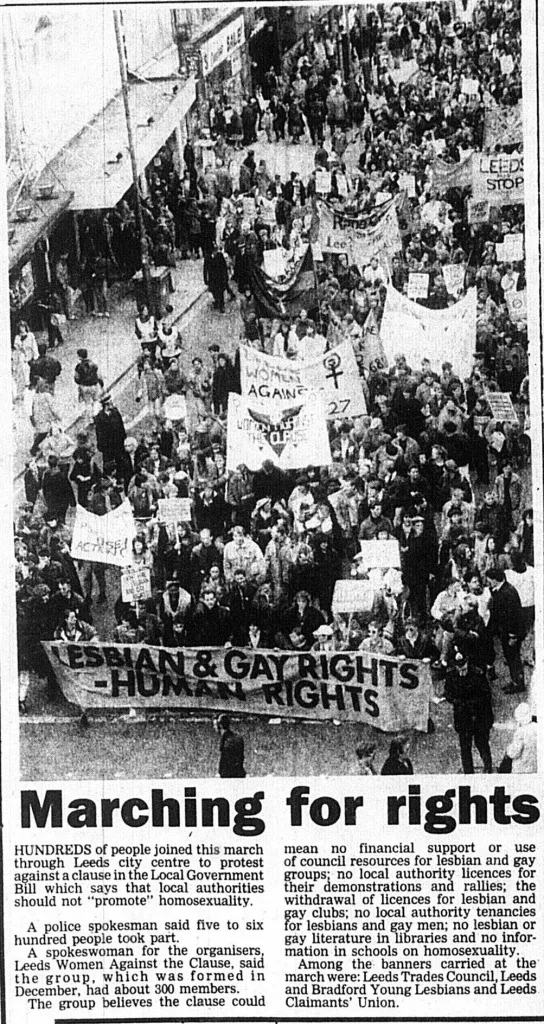
Yorkshire Evening Post, 7 March 1988. Two thousand people marched through Leeds against Clause 28 two days earlier.
The same years saw a bisexual community form at the edges of the gay scene. Four friends who met at BiCon 1988 founded the Leeds Bisexual Group, which gathered at the Adelphi Hotel from 1989 until it wound down in the mid-nineties, misunderstood by a gay scene that kept its distance and a straight city that kept its suspicions. A new Leeds Bi Group has met at Yorkshire MESMAC since 2014, and marches in Leeds Pride.
Sources: Leeds Libraries heritage blog; West Yorkshire Queer Stories; SecretLeeds; terrygeorge.co.uk; West Yorkshire Queer Stories, Terry George full interview, wyqs.co.uk; West Yorkshire Queer Stories, World AIDS Day 1990, wyqs.co.uk; Neil Curry, direct correspondence; Mike Wiand and Jim Albentosa, The Warehouse: Hype, Lies & Gossip
, iVoice / The Leeds Warehouse, 2012; Leeds Libraries, LGBT+ History Month Research Guide
, secretlibraryleeds.net, 2022; Leodis LGBT+ Leeds custom gallery, leodis.net; Northern Concord history, Gender Identity Research & Education Society (GIRES), gires.org.uk; Warehouse clubbers' recollections, vvwi.forumotion.com; West Yorkshire Queer Stories, The Shadow of AIDS
, wyqs.co.uk; Thackray Museum of Medicine, The Community That Cared
, thackraymuseum.co.uk; Yorkshire MESMAC, mesmac.co.uk; National AIDS Trust, Celebrating the role of trans people in the fight against HIV
, nat.org.uk; Shine, Never Forget
, theshinemag.com.
On 23 November 1991, Dave Beer and art college peer Alistair Cooke launched Back II Basics on the top floor of The Chocolate Factory on Lower Briggate. The building had been Rockshots 2, the Studio 54 of the North; half a decade on it had come down to a seedy three-storey gay club
at the bottom of Briggate. Eighty people came to the first night, every one greeted personally by Dave. Within weeks the queue ran the length of the street.
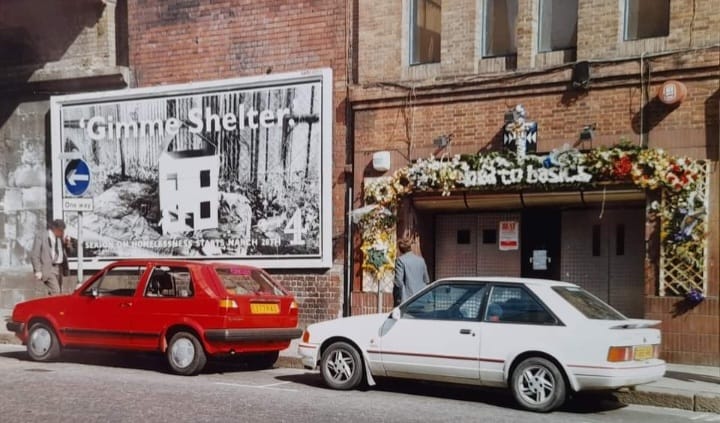
The Back II Basics entrance on Lower Briggate. The sign above the door, the flowers, the street.
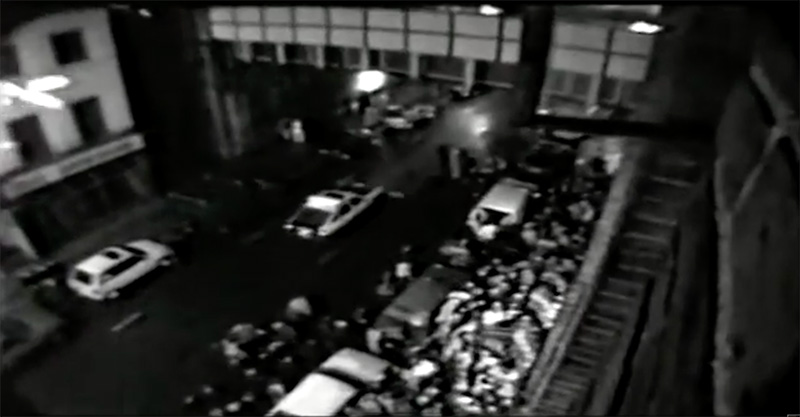
The queue, Lower Briggate. The Freedom Bridge visible above, the street blocked.
The same few streets off Lower Briggate kept turning over their venues, as they had since the thirties. Queens Court replaced Charlie's in Lambert's Yard. Blayds Bar opened in Blayds Yard and built a devoted lesbian following. Primo's brought New York Street into the circuit. What the nineties brought to those streets was newer than another bar: an idea about who a door could be for.
Back II Basics wasn't a queer night, but it was queer from the building up. Jon Pleased Wimmin, DJ, drag artist, one of London's Pleased Wimmin collective, played there regularly, pulling London queer club culture straight onto a Leeds dancefloor. As one person who came of age on that floor put it, it was somewhere that allowed me to access my queerness
. For many people, expressing yourself was the entire point of going out. It still is. It's why LFF exists.
Alongside it, explicitly queer nights were redrawing the city. Vague ran at The Warehouse from 1993 to 1996, founded by Suzy Mason and the artist Paul Fryer as a deliberate answer to the sexism, racism and homophobia of 90s clubland, and billed as the first club in Britain to call itself mixed: gay, straight and polysexual welcome on equal terms, behind a famously strict door. Thousands queued each week for a venue that took six hundred, vetted not by a bouncer but by JoJo, a LAMDA-trained actress working the door as Lady JoJo, Queen of the GoGo, under a dress code that read simply "Be Yourself"; the only people she reliably turned away were the men who came to gawp, sent off to go and put a dress on and try again. Melody Maker called the place the dance equivalent of Andy Warhol's Factory and the Daily Telegraph settled on Bacchanalian excess, but the verdict that lasted came years later, when the government moved to ban gay-or-straight door policies and Gay Times reached for Vague as the example that mattered, a mixed, polysexual night its founders had quite consciously set out to build, and built.
When Vague ended, Suzy Mason and Kas Shaw opened SpeedQueen in the same building and ran it every Saturday from 1996 to 2006: 350 people a night, an outdoor terrace, a giant bed on the dancefloor, and beneath the spectacle a deliberate machine for breaking down barriers. Entry was by strict membership, with no VIPs and no VIP area, because everyone inside, Suzy Mason said, already was one; the guest list cost two pounds a head, banked in a charity account and handed to local causes. She would later call it a purpose-built social enterprise, though at the time the phrase did not exist. I decided to set up a proper environment and a mixed space,
she said. Everyone was welcome as long as they didn't have a problem with the fact that other people were different from them, whether it was their colour, their age or their sexual orientation.
Even the drag queens were put to work, hired not to be looked at but to mix and talk with the customers, on the principle that nobody stays prejudiced against someone they have actually had a conversation with. For trans people the welcome ran furthest of all: past the queue and through the door first, treated as guests of honour in a decade when most clubs in Britain would have turned them away at a glance.
And once you were through it, the reason for all that care was plain. People who spent the week carefully managing how they were seen arrived dressed as the most extravagant version of themselves and danced as though nothing outside could reach them. The strict door was what let everyone inside come undone.
That knack, making a stranger feel expected rather than vetted, walked to the front instead of looked up and down, is what Leeds First Friday builds its evenings around now. The safer space was not invented in the 2010s; people were already working it on a Leeds door on a Saturday night thirty years before.
Not all of it happened behind a door. In September 1996, a gathering called Out With A Bang pulled several hundred people onto Woodhouse Moor, the big common in the Hyde Park district of Leeds, on a cold, wet day. The following year it settled into an annual summer picnic, Hyde Out: stalls run by local LGB businesses, information points, music and dancing on the grass. It grew year on year into marquees, a funfair and a red bus for the performers, with Yvette Lewis among those who ran it in its early years. For most of a decade, Hyde Out was Leeds' Pride, out in the open in a public park rather than tucked into a yard off Lower Briggate. It ran until the city-centre parade took the Pride name in 2006.
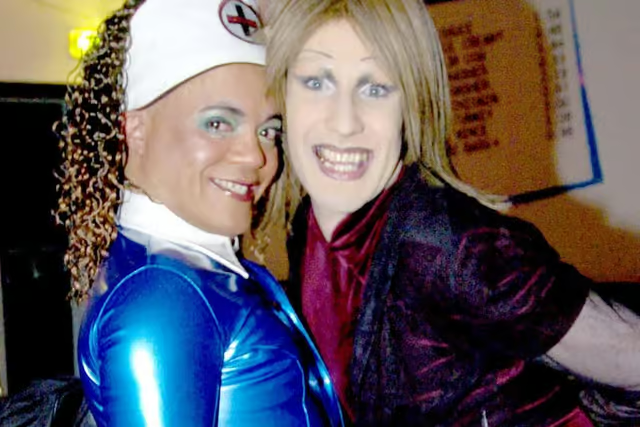
SpeedQueen, The Warehouse, 2006.
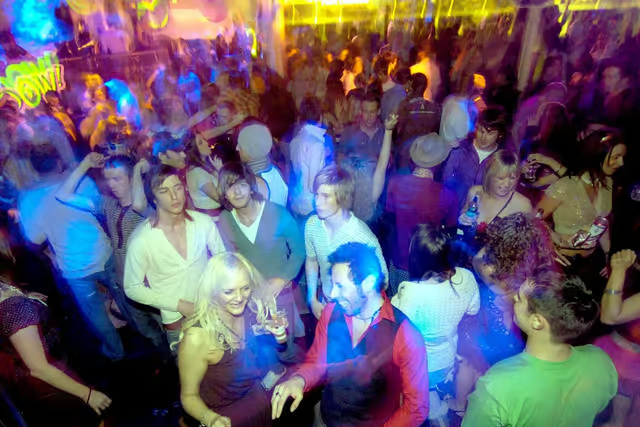
The SpeedQueen dancefloor, 2006.
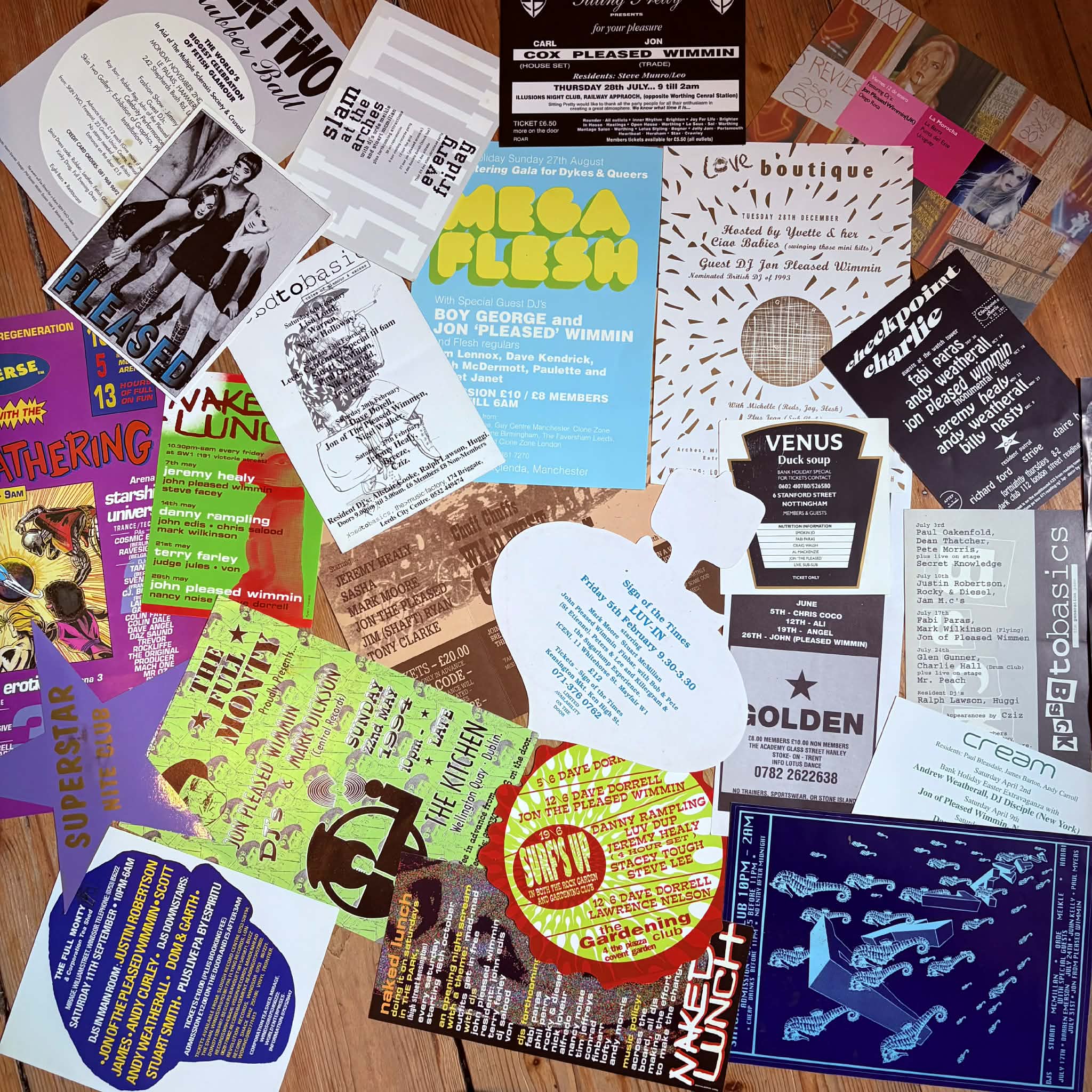
Jon Pleased Wimmin collection of flyers from the 1990s
Sources: DJ Mag, "Back II Basics: the anarchic party that transformed Leeds into a clubbing destination", Kristan J Caryl, December 2021; Back to Basics biography, smugglingduds.com; oral history interview, anonymous, Leeds, 2020s; Suzy Mason and Kas Shaw, founders of SpeedQueen, interview in The City Talking (TCT3), thecitytalking.com; Suzy Mason, full interview, West Yorkshire Queer Stories, wyqs.co.uk, 28 January 2019; Rachel McAlley, JoJo
, Leeds City Magazine, leedscitymagazine.co.uk, March 2019; Vague club, Leeds, Wikipedia, citing Melody Maker (1994), Daily Telegraph, and Gay Times (Richard Smith, 2006); Kevin Almond, Masquerade in Clubland: A Safe Space for Glamour
, Journal of Visual Culture and Gender, vol. 6, 2011, quoting Suzy Mason via Regina magazine (Moller, 1998); Suzy Mason staff profile, Leeds Arts University, leeds-art.ac.uk, 2015; Blayds Bar lesbian following via Maggie Dawkins interview, West Yorkshire Queer Stories, wyqs.co.uk; Hyde Out (1997) and Out With A Bang (1996) via leedspride.com/history and Wikipedia (Leeds Pride); the early picnic Pride and Yvette Lewis's role via We Even Made the Rings
, West Yorkshire Queer Stories, wyqs.co.uk.
Leeds had clustered its bars around Lower Briggate, Call Lane and Bridge End for close to a century, near enough to walk between and dense enough that the pavement outside felt like part of the night. What changed in the 2000s was not where the bars were but who ran them: much of the cluster was now owned and run by people who wanted trans customers inside, not merely tolerated them until last orders.
For a trans person arriving on a Friday in 2006, that was the whole difference. The endless working out of which bar would serve them, which would look the other way, which would turn them out when the regulars came in, was over; a few streets had settled all of it. The Freedom Quarter, the name those streets go by now, would not arrive until 2017, but what the name described was already being built, on purpose, a decade early.
The figure behind much of it was Terry George, last seen in this story spinning records at Confettis while Parliament tried to legislate his customers out of existence. With his partner Michael Rothwell and their friend Shaun Wilson he opened Bar Fibre on Lower Briggate in 2000, none of the three ever having run a bar before; in 2007 Terry and Michael took on the Viaduct across the road, a football pub packed on match days and dead the rest of the week, and turned it into the Viaduct Showbar, where bemused Leeds fans found themselves served by drag queens on a Saturday. Together with the New Penny, Queens Court and Blayds, these made a run of venues where the question of whether the community was wanted had been settled before anyone arrived.
Those same bars, and the people who run them, still keep the night going. Some have kept a corner for Leeds First Friday for twenty years and more, friendships older than almost everything the night is now known for, and a quiet part of what keeps it standing.
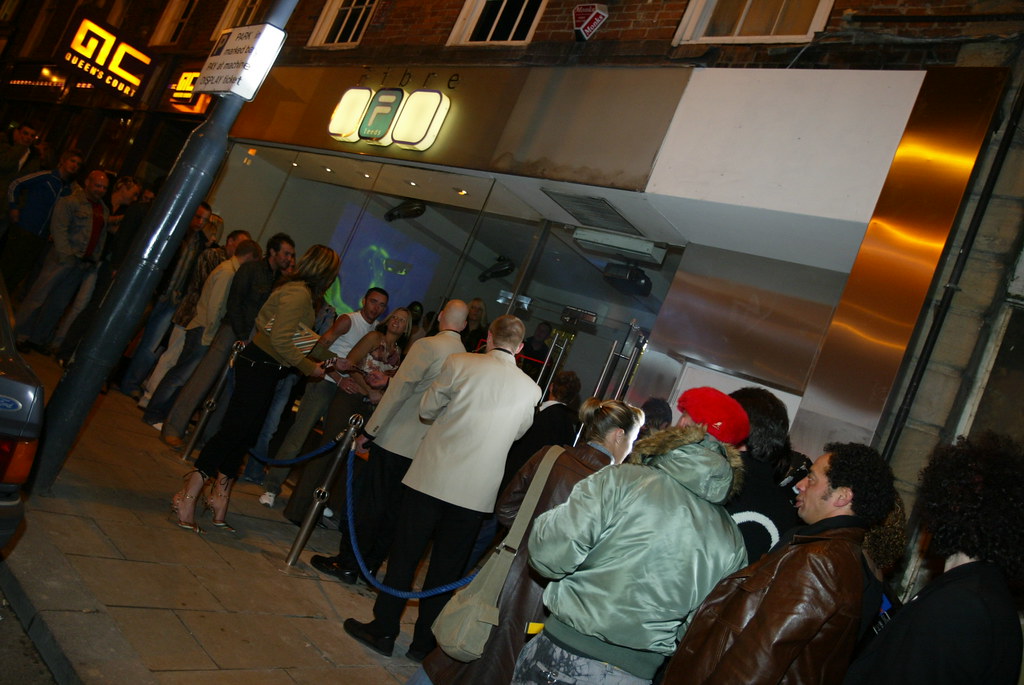
Bar Fibre, Lower Briggate, around 2000. The neighbourhood taking shape.
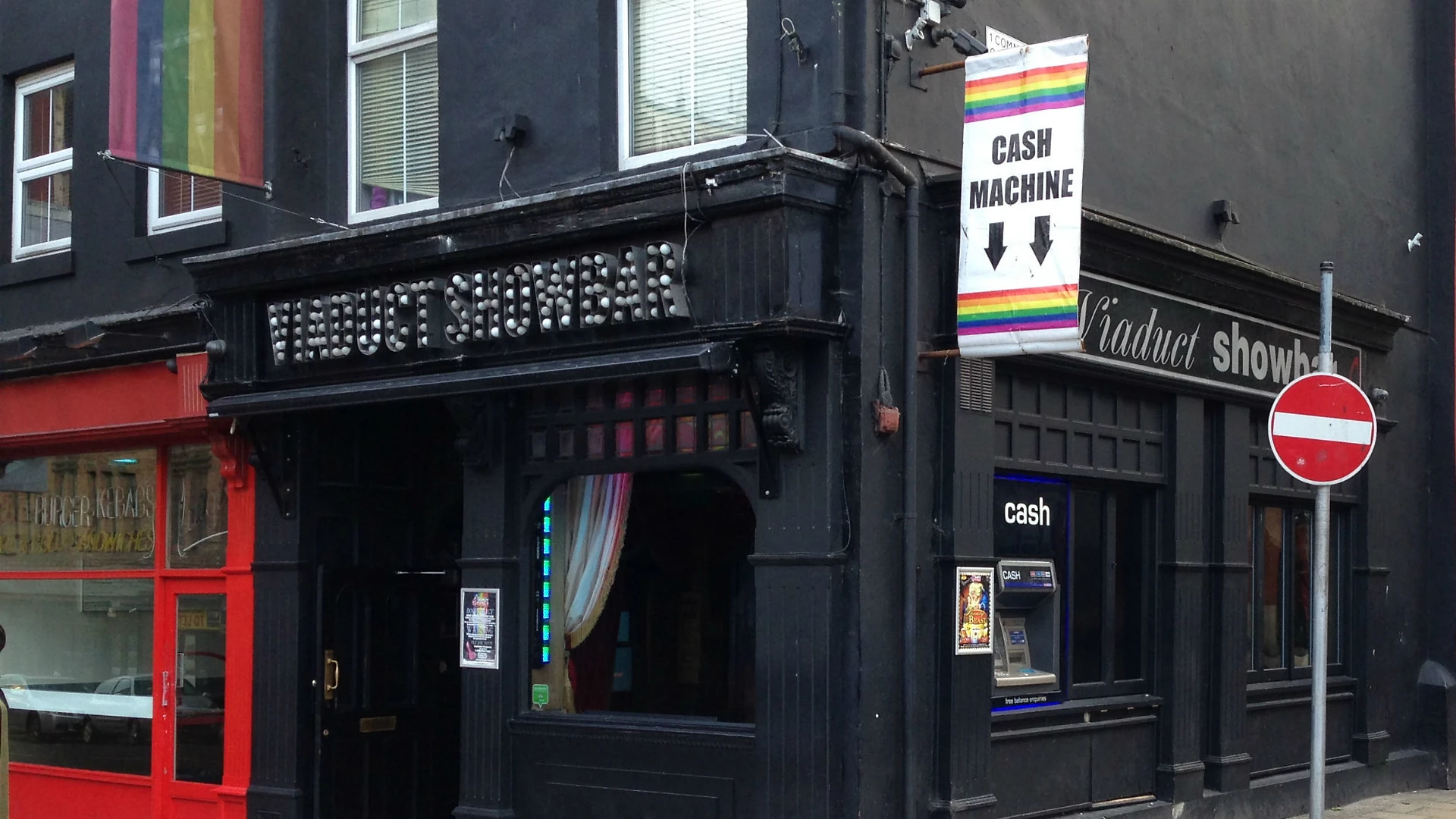
The Viaduct Showbar, 2015. The rough old football pub, transformed.
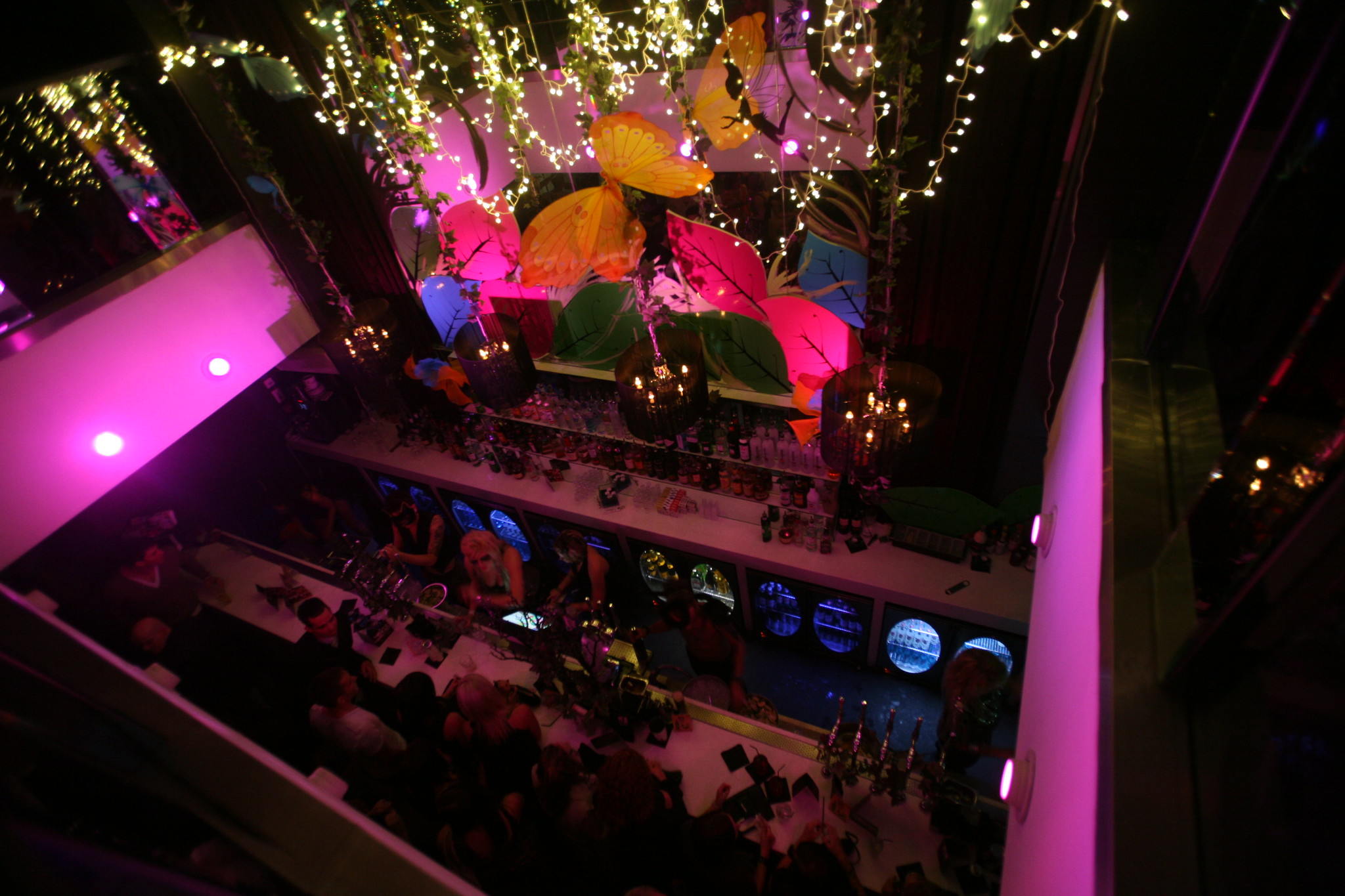
Bar Fibre interior, 2006. The venue LFF called home.
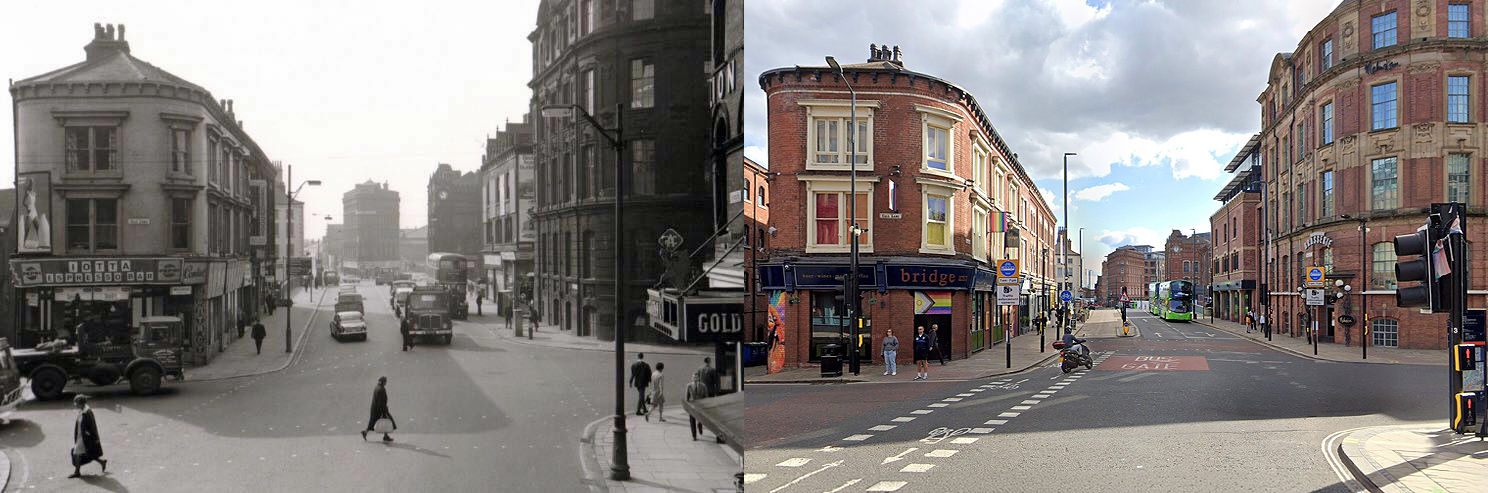
The Bridge Bar corner. The same building across the decades, Georgian under its Victorian shopfront, and a rainbow flag where there wasn't one before.
Sources: terrygeorge.co.uk (full biography); Yorkshire Evening Post, Terry George profile; West Yorkshire Queer Stories; Yorkshire Evening Post, The End (Shaun Wilson) opening, 2022.
 Part Two
"New monthly trans night in Leeds"
Leeds had never had a regular trans night of its own.
In August 2006, Deena Leeds started one.
Officially, Leeds First Friday counts its birthdays from a little later. Unofficially, this is where the story begins.
Leeds First Friday is now a Friday institution, but what it grew from met on a Tuesday night. The Old Red Lion, closed since 2020 and still standing beside Bridge End Social, was a low-key pub on the Leeds gay scene, run by Helen and Jackie while the younger venues chased the trendy market; upstairs, a small crowd of trans people had taken to gathering for the weekly quiz. The community was already there, settled in over pints and pub trivia, when someone arrived to give it a night of its own.
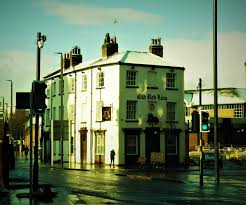
The Old Red Lion. A traditional pub on the Leeds gay scene.
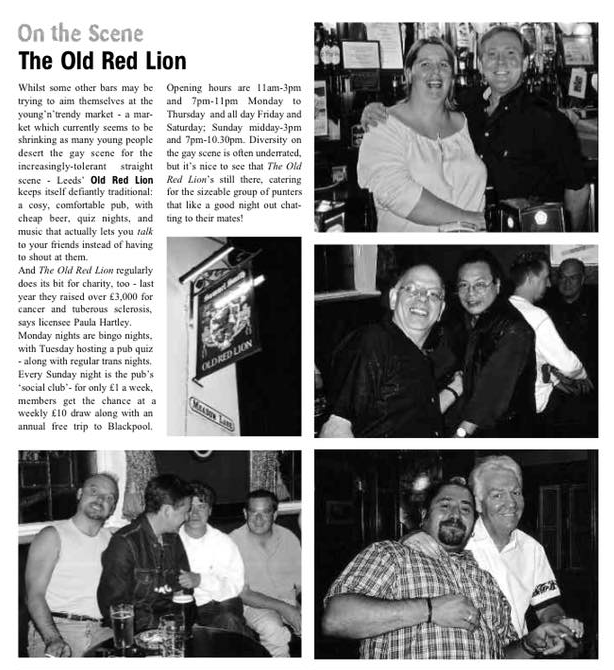
"Tuesday hosting a pub quiz, along with regular trans nights."
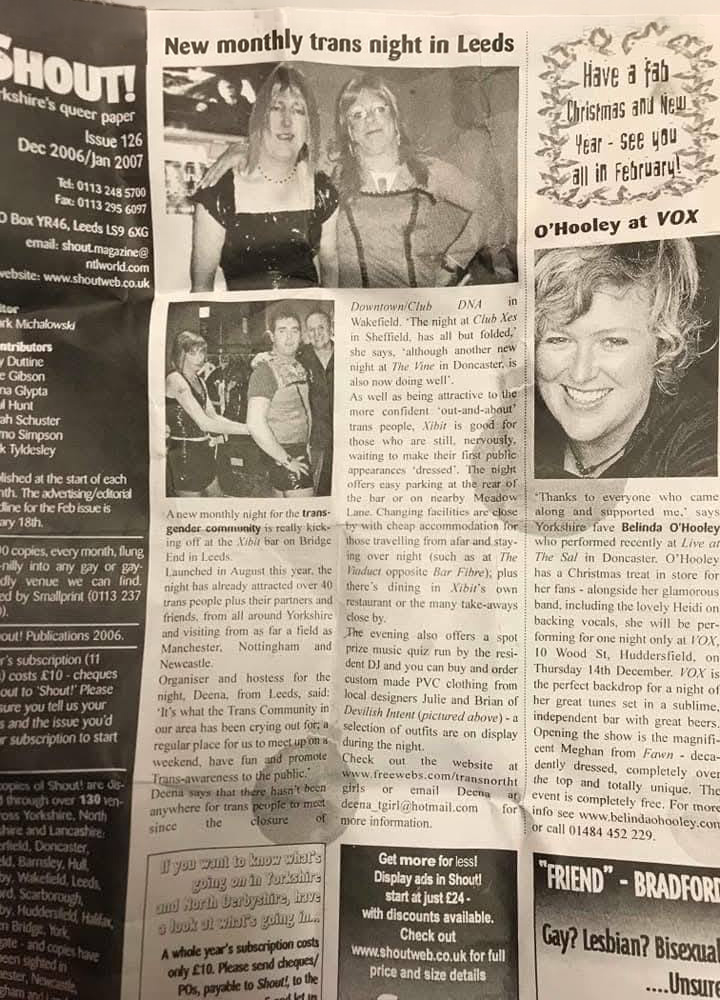
Shout! Issue 126, Dec 2006 / Jan 2007. Deena Leeds is pictured top with Susan Platt.
That someone was Deena Leeds. In August 2006 she started a monthly trans social next door at Xibit, on Bridge End, the same street Leeds First Friday calls home today. She called it Trans North Tgirls, a name that survives now only in the web address she ran it from, freewebs.com/transnorthtgirls, and in the email she signed off as deena_tgirl. By December Shout! magazine had sent a writer. The feature counted more than forty trans people a night, some travelling in from Manchester, Nottingham and Newcastle, for the plainest of reasons: there was nowhere else left to go. Club DNA in Wakefield had closed and Club Xes in Sheffield, which for years had hosted the trans night Les Femmes, had all but folded, and the gap they left across the region was exactly the space Deena had stepped into.
In her own words: It's what the Trans Community in our area has been crying out for, a regular place for us to meet up on a weekend, have fun and promote Trans-awareness to the public.
The night was built to be welcoming, especially to those nervously preparing their first public appearance dressed. That principle, making the first step the safest one, runs in a straight line from Xibit to Made It! today.
Deena was not the only one starting something that summer. In August 2006, after a decade of Hyde Out picnics on Woodhouse Moor, Pride came down off the grass and into the city centre for the first time, and the first official Leeds Pride drew around six and a half thousand people. One event was a parade through the middle of town and the other was a few dozen people in the back bar of Xibit. They wanted the same thing.
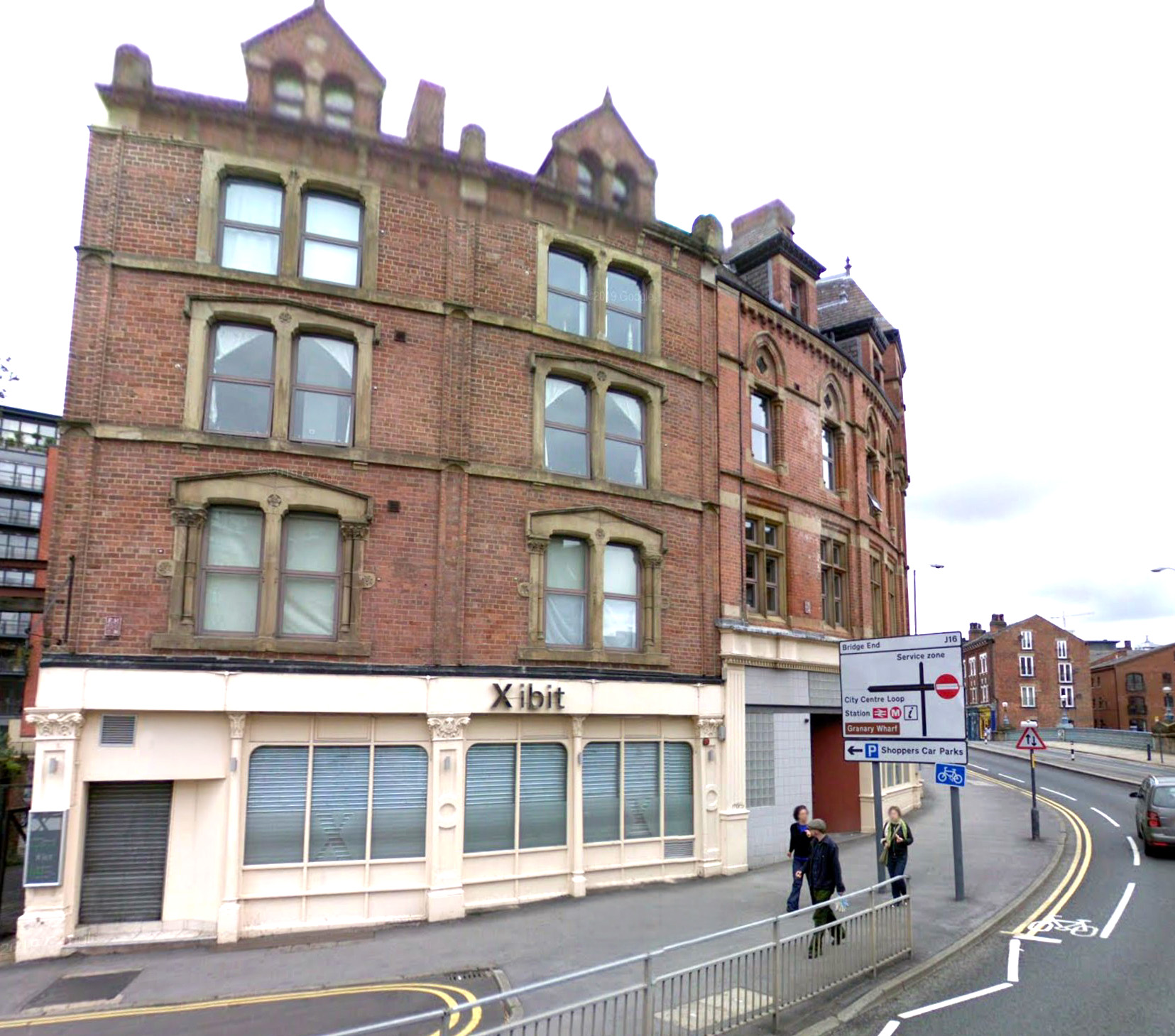
Xibit, Bridge End. The building where it all began, and where Bridge End Social now stands.
Primary source: Shout! magazine, Issue 126 (December 2006 / January 2007), New monthly trans night in Leeds
, recovered via the Internet Archive Wayback Machine. The Trans North name preserved in Deena's web address, freewebs.com/transnorthtgirls. Les Femmes at Club Xes via Northern Concord's archived directory of TV/TS groups (Internet Archive). Leeds Pride first-year attendance via leedspride.com/history and Welcome to Leeds.
Susan Platt had been there from the start, one of the faces in the Shout! photograph, but she could see the night was capable of more, and she set about proving it. She moved the gathering onto a Friday, where it has stayed ever since.
Her real masterstroke was the advertising. She posted the night openly on TVChix, the dating site that had become the noticeboard of the British trans community, so that a stranger in London could read about a Friday in Leeds and be on the train the following month. Almost everything Leeds First Friday would later become is already there in that one decision: a trans night that wanted to be found.
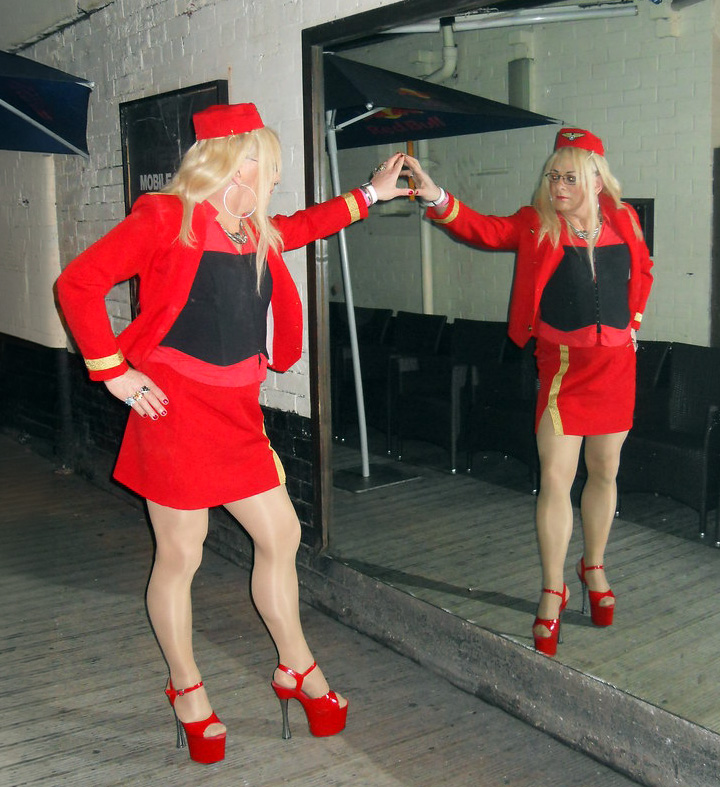
Susan Platt, 2009
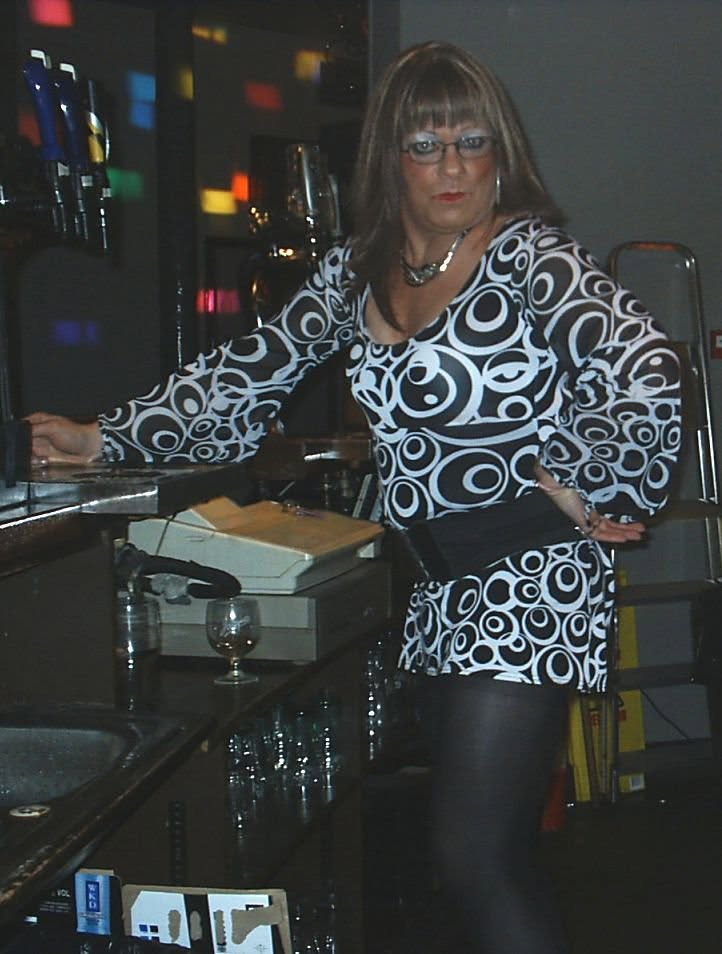
Susan Platt behind the bar at Xibit, 2009.
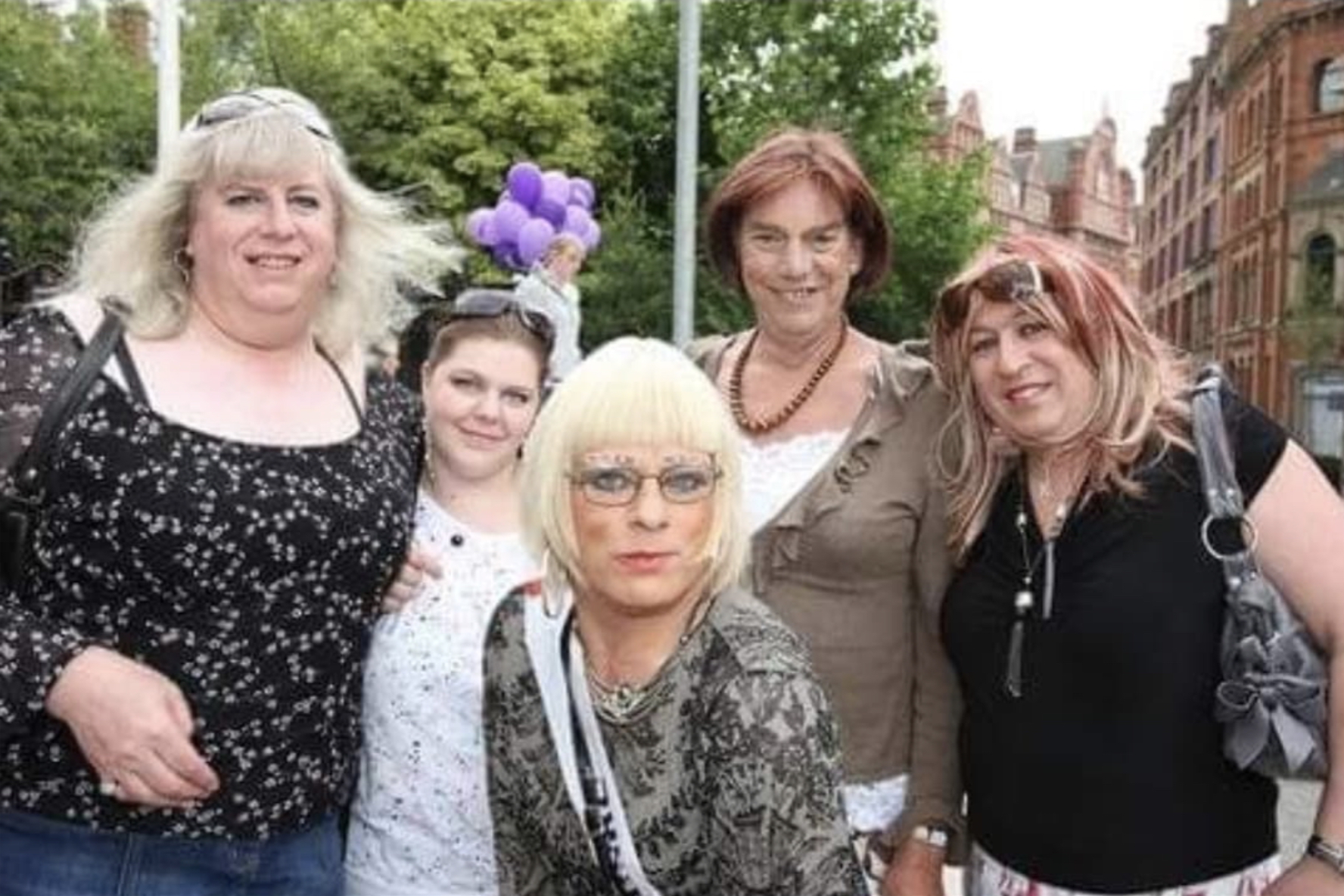
Deena Leeds, Sophie, Susan Platt, Ruth and Kerry, 2009. Deena had started the very first night, three years earlier at Xibit; Susan remembers Sophie as part of that beginning too.
The city noticed. At the Owlies, the annual Leeds LGBT awards voted for by the public, the T-Girls took Best Social Group in 2008 and Best Support Group in 2009; Susan herself won Best Resident DJ in 2011 and was up for Hero of the Scene in 2013. The night that had begun in a back bar was collecting trophies in front of the whole city.
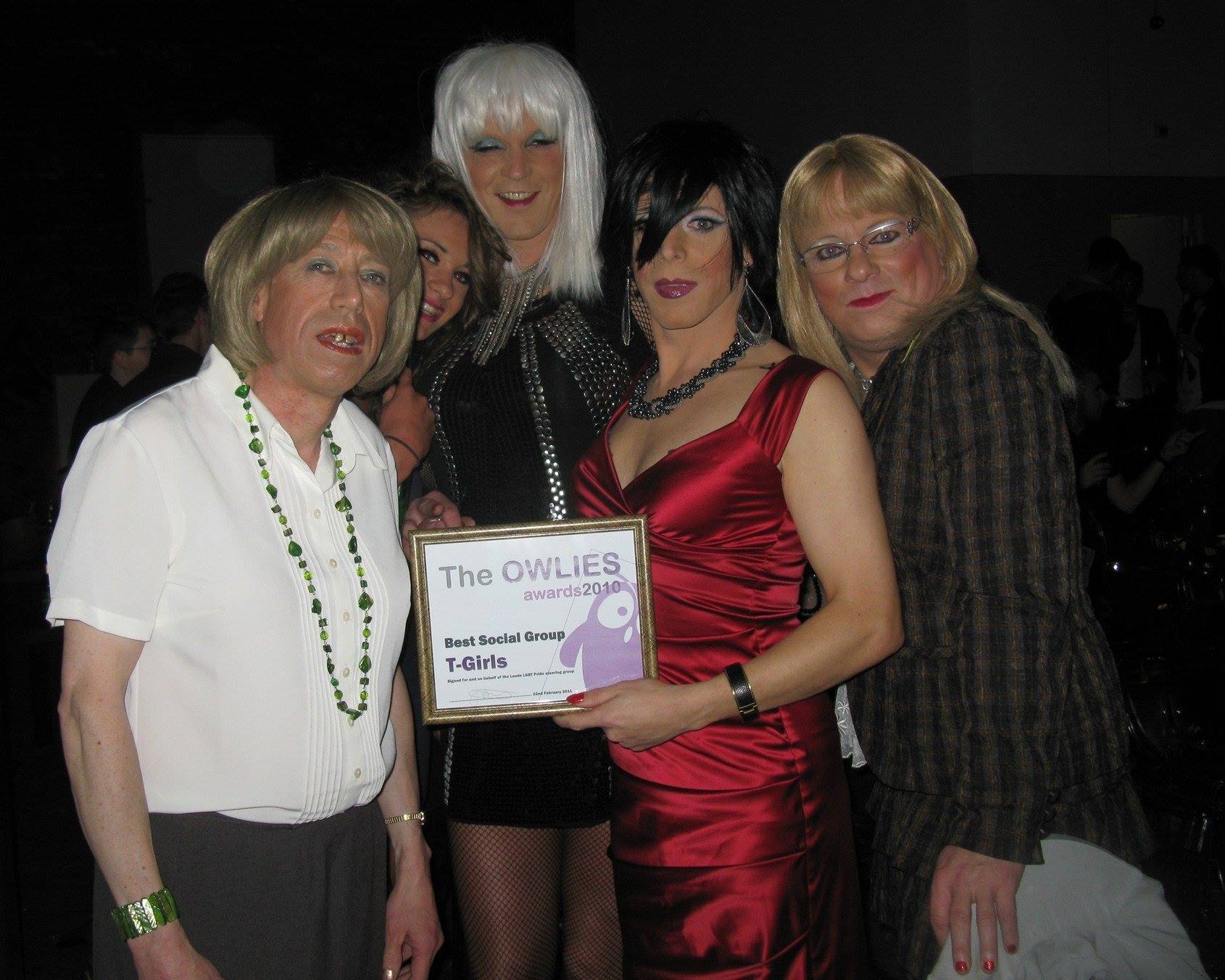
The Owlies 2010. Best Regular Night: Leeds First Friday. The night Susan built up was winning awards.
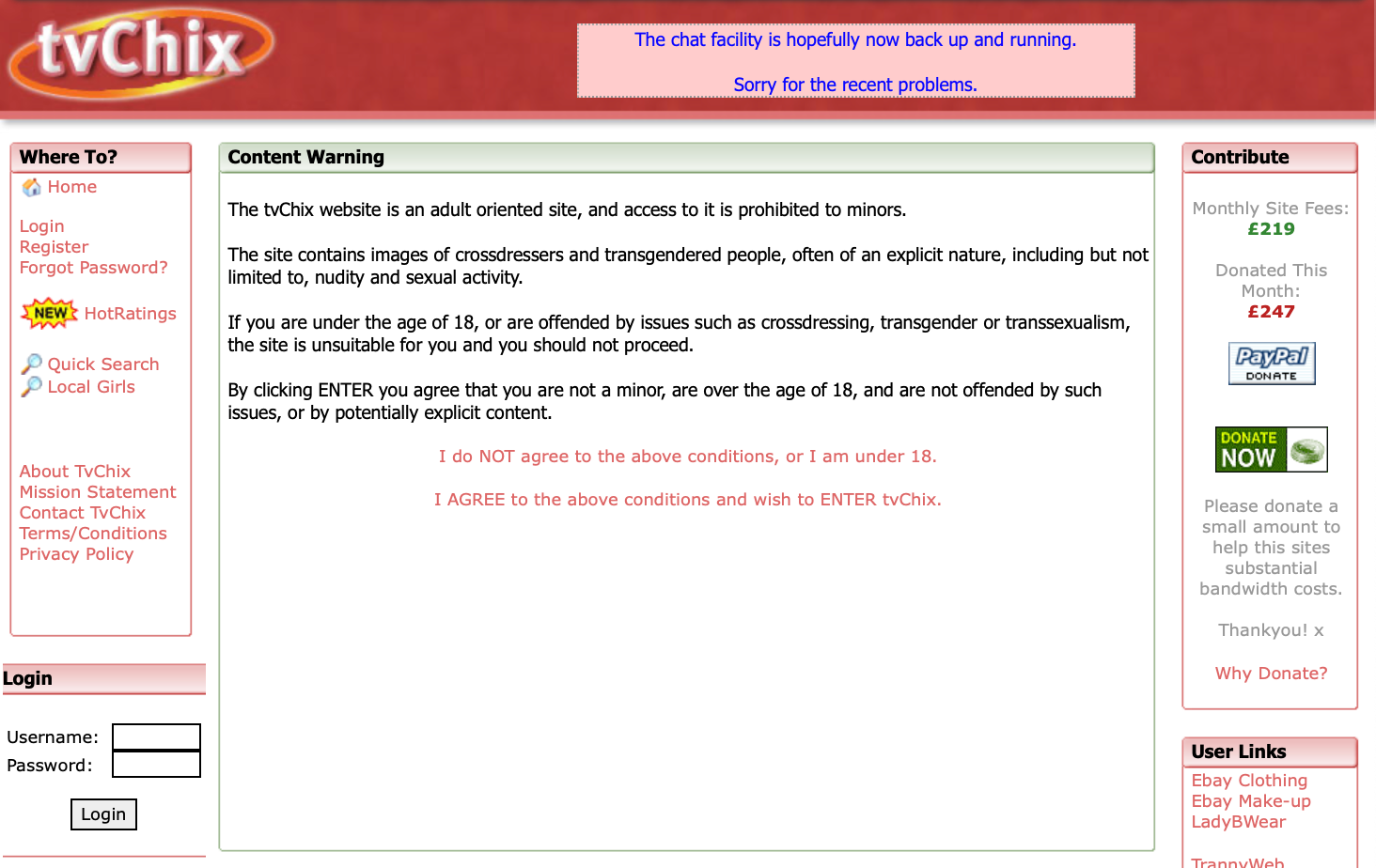
TVChix, 2006. The platform, the noticeboard, the way you found out what was happening. For a generation of trans people, this was where community existed online.
Susan kept the Viaduct decks for more than a decade, hanging up her heels in 2024, and she closed every set the way she always had: Soft Cell, Say Hello Wave Goodbye. The same Soft Cell that had formed a few streets and forty-odd years away, on the Warehouse dancefloor near the start of this story.
Sources: Susan Platt, Facebook (25 May 2008); Owlies results 2008, 2009, 2011, 2013 (theowlies.co.uk, Wayback Machine); community oral history.

LFF logos across the years: 2011, 2016, the 2018 design by Paul Heaton, and 2022 by Grai.
When Susan Platt moved on to new ventures she handed the night to Mandy and Cindy Lopez. It was still a small affair in the back bar of the Viaduct, twelve or fourteen people under the name T-Girls, and the most common question about it was when the next one would be, which was really a sign that the name was doing none of the work a name should.
Cindy's fix was the one that stuck: Leeds First Friday, a name that tells you when it is and never needs explaining. There is no date to look up, because the date is the name.
From there Cindy did the unglamorous work every institution runs on, making the night reliable enough that people arranged their months around it. By late 2009 it had settled upstairs at Blayds, in Blayds Yard off Lower Briggate, and was drawing seventy people a night, some travelling in from Bristol, Kent and Scotland, with three or four making their first public appearance in a given month. She got around the Freedom Quarter on a pink scooter, and would correct anyone who called it a moped. Beside her, doing the recruiting, was her partner Mandy Jameson, known on the scene as Mandy Makeup for the cosmetics she sold on the side. Before social media there was only one way to bring people in, one at a time on the trans forums, and Mandy would set off early to meet nervous first-timers and walk them in. Between Cindy's steadiness and Mandy's welcome, the night ran on personal invitations and the goodwill of a handful of bar staff, the people Mandy would later thank by name: Duncan from Blayds Yard, Stella, and Simon and the staff at Queens Court and Fibre.
When the pair moved on in March 2010, they handed it over in good order to Rachel and Tanya. That set the pattern every coordinator since has kept to: grow it, then give it away intact.
Rachel Lyons's own website, looking back a few years later, credited the take-off of 2008 and 2009 to the hard work of Mandy and Cindy.
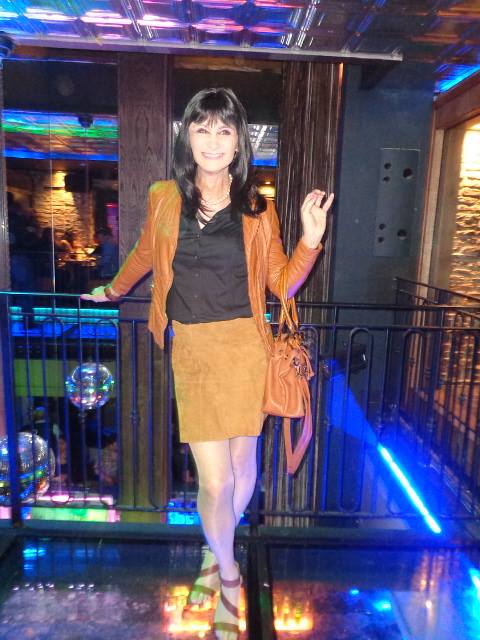
Cindy Lopez at Bar Fibre, 2016. The woman who named Leeds First Friday, still on the scene years after she handed it on.
Sources: Cindy Lopez, direct correspondence, and her own event posts as Cindy_Yorks (Blayds Yard venue, seventy attendees, national reach, first-timers, the pink scooter), tvChix forum, October 2009; Wayback Machine snapshot of lff.racheltv8.co.uk, January 2011; Mandy Jameson (Mandy Makeup): her own recollections and thanks (Duncan, Stella, Simon and the Queens Court and Fibre staff) via tvChix profile; her farewell post confirming the handover from Susan Platt and on to Rachel and Tanya, tvChix forum, 23 March 2010; community tributes to her early outreach via tvChix forum thread, 2012.
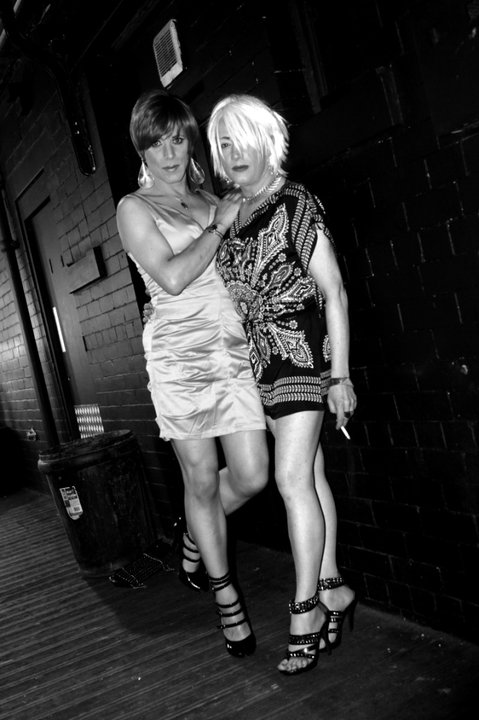
Rachel Lyons and Tanya Carr, 2010. The archway to Blayds Yard.
Rachel Lyons and Tanya Carr took the night Cindy had named and turned it into a destination.
They built the first dedicated LFF website, lff.racheltv8.co.uk, the domain itself a TVChix username, the thread back to where the community first found itself online. They founded the LFF Facebook group, bringing what TVChix had taught them onto a brand new platform. For the first time, there was a permanent public record of what LFF was, where it happened and who it was for.
It worked almost at once. By the spring of 2010 the night was drawing more than ninety people to Blayds, from all over the UK, enough that Rachel and Tanya could call it, not unreasonably, one of the biggest monthly trans nights outside London. They added services to match: professional makeovers from MAC and Nars artists, bookable before the evening began.
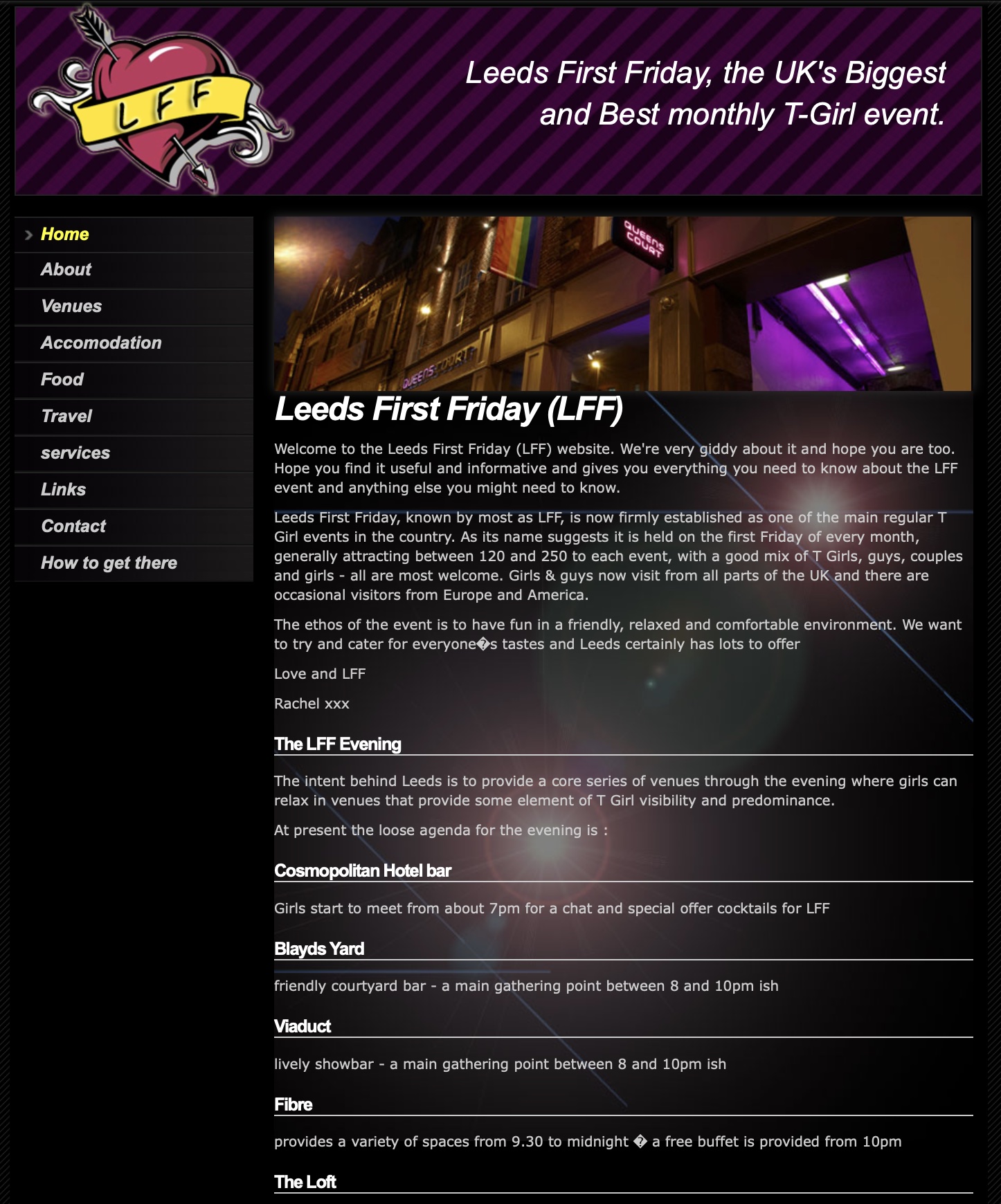
The LFF website Rachel built at lff.racheltv8.co.uk, captured in 2016: a rare primary record of the night's origins in her own words. It signed off, "Enjoy the LFF journey and we hope to see you very soon. Love and LFF, Rachel x x x x"
LFF has been around for a number of years and has evolved through a variety of formats having been hosted in various venues. Organised for a while by Sue Platt, it really started to take off in 2008 / 2009 thanks to the hard work of Mandy and Cindy and the great support from the Leeds LGBT community. Continuing to develop, it is currently organised by Rachel. It is a totally non profit making event with no charges for the evening.
lff.racheltv8.co.uk, History of LFF page, c.2013–2016
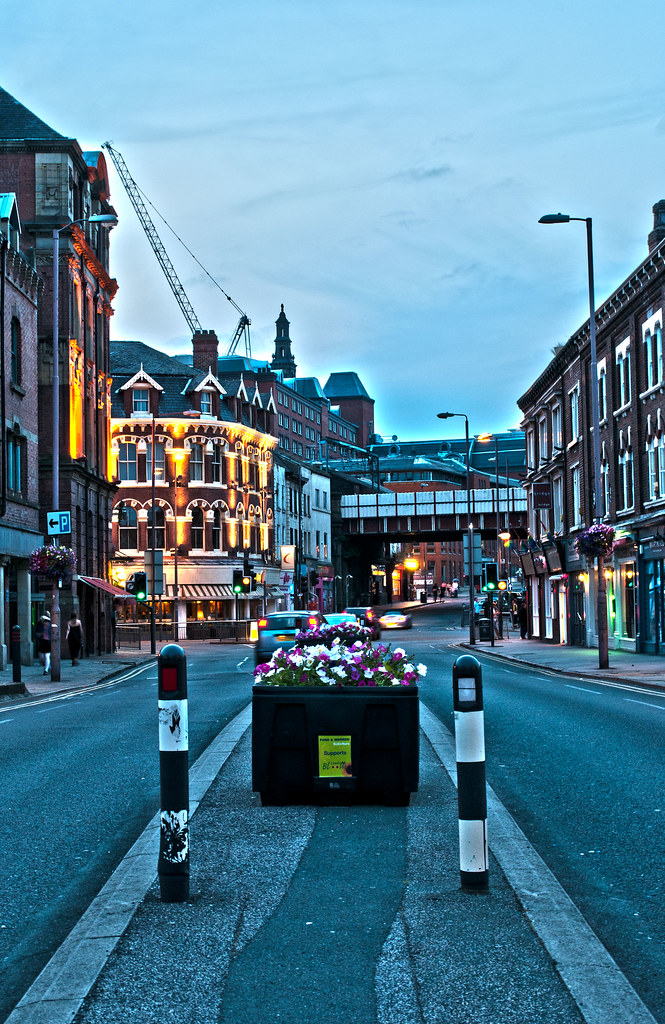
Lower Briggate at dusk, 2012. The Freedom Quarter at the height of the Rachel and Tanya era.
It was a night with real ambition. Across a single evening LFF toured the Cosmopolitan Hotel, Blayds Bar, the Viaduct Showbar, Fibre and The Loft, a structured circuit of the Freedom Quarter that let you build the night you wanted rather than settle into a single venue. Outside London there was nothing else like it: a volunteer-run trans social that billed itself, in the early 2010s, as a destination, and turned out to be right.
The Cosmopolitan (or Cosmo as it was affectionately known) was the heart of it. A grand old hotel on the corner of Lower Briggate and Swinegate, it was the Golden Lion of the 1950s under a newer name, the same address that had kept its quiet welcome half a century earlier; and it came with managers who were genuinely supportive, bar staff who were friends, and a licence until five in the morning that set how the whole night ran: start at the Cosmo, tour the Quarter, come back to the Cosmo till dawn. Time Out covered LFF there in 2015 as one of the UK's biggest regular trans social nights.
The ambition kept showing. In June 2012 came the Leeds Transgender Masquerade Ball at the Cosmopolitan, seventy tickets, a champagne reception, a three-course dinner and a live band, and it sold out. By December 2014 a single LFF passed two hundred attendees, the busiest yet, with Baracoa and Queens Court now added to the circuit.
Among the regulars in those years was a Capital Yorkshire radio presenter not yet publicly known as Stephanie Hirst. She came out in 2014 and has since spoken openly about her transition. At the time, she was simply someone who attended.
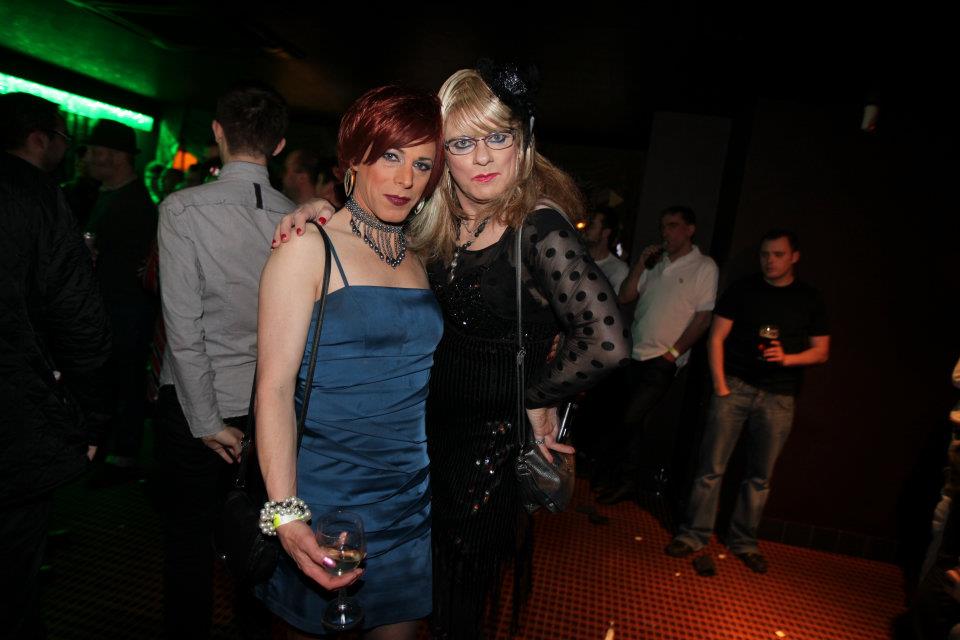
Susan Platt and Rachel Lyons, 2011. The handover generation together.
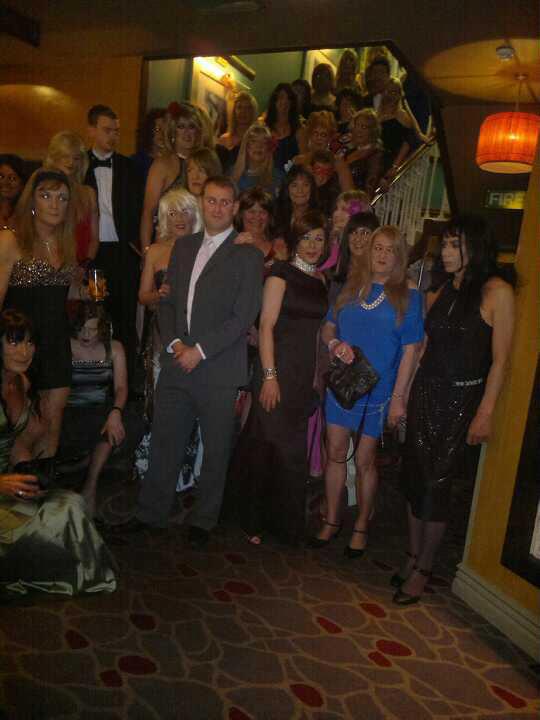
LFF at the Cosmopolitan, 2012. The staircase that became part of the night's identity.
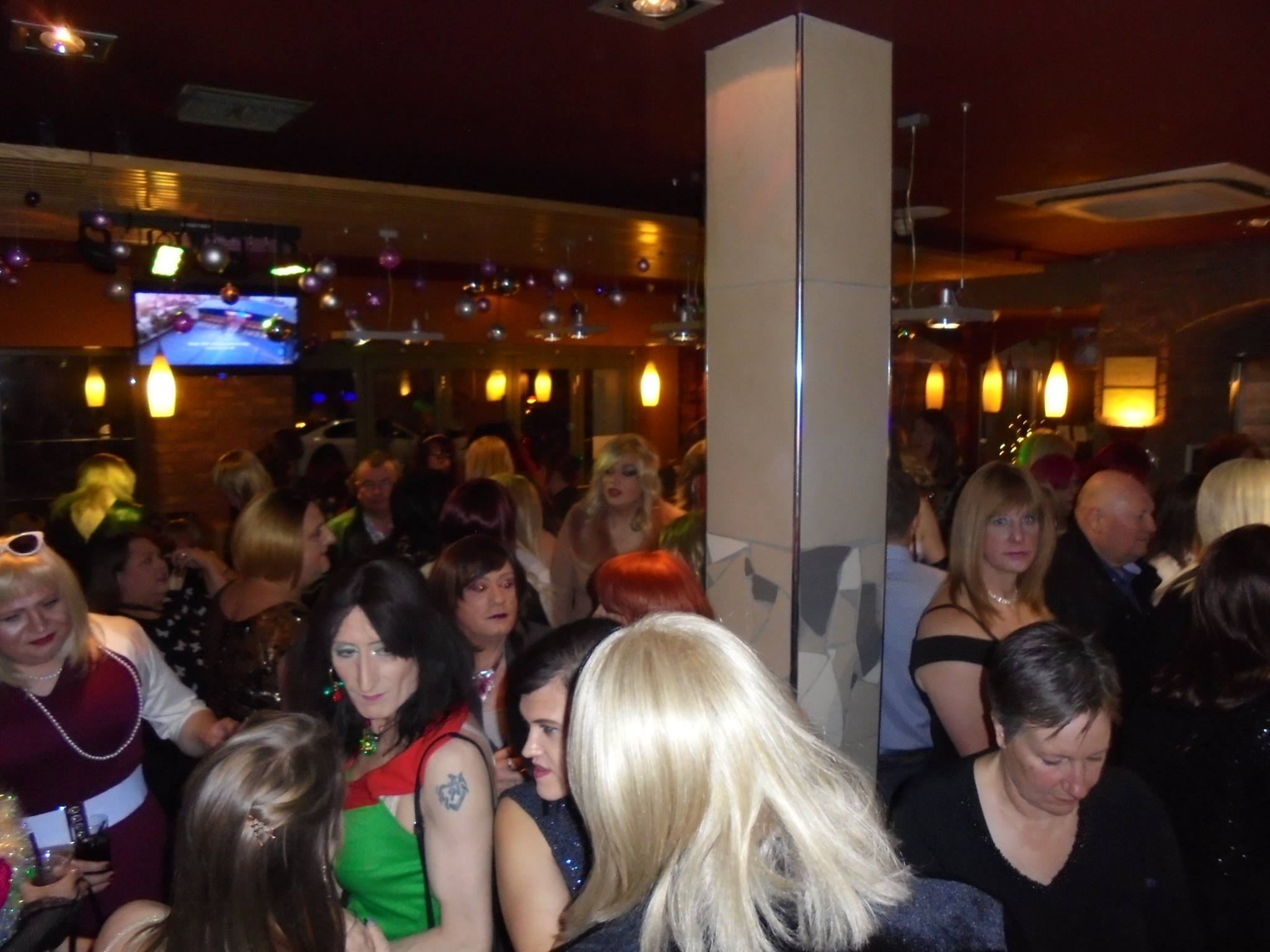
The Cosmopolitan Hotel, heart of LFF's venue circuit through the Rachel and Tanya years. Refurbished and reopened as Hotel Indigo Leeds in 2025.
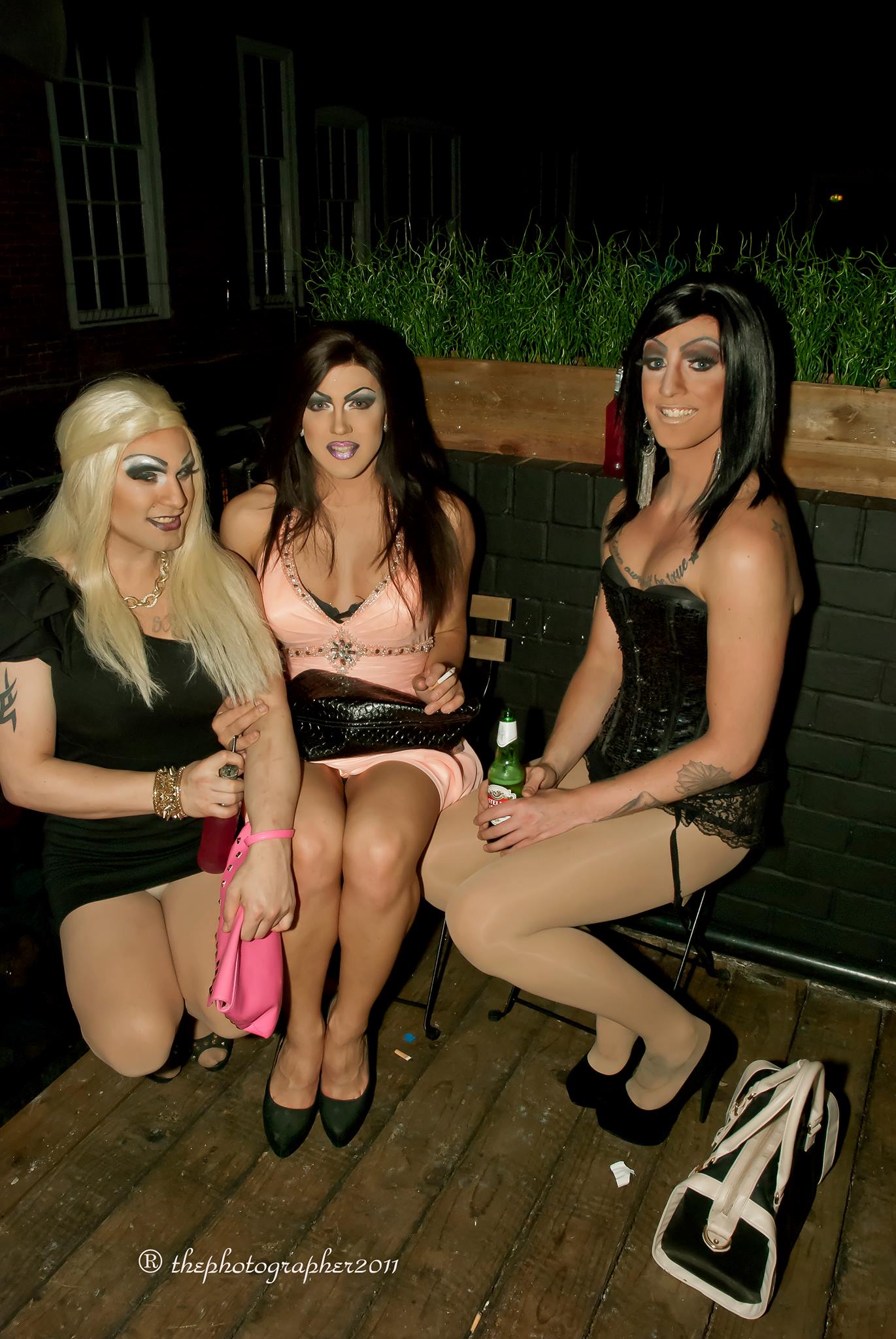
LFF at Bar Fibre, 2011. One of the venues the night called home.
Jenny, Zara Kane and Xara interviewed outside Bar Fibre, 2014.
The Owlies kept arriving: Best Regular Night in 2011 (the same ceremony where Susan won Best Resident DJ), again in 2012, and a double in 2014, Best Regular Night and Best Social Group. In 2013, Rachel and Tanya were nominated for Hero of the Scene. So, in the same category, was Susan Platt. The whole lineage of LFF on a single ballot.
When I attended my first event I have never seen so many girls in one place before. I was so overwhelmed but enjoyed my experience. I was taken in hand so to speak by Lola Rose who was kind enough to take me under her wing and guided me safely throughout my stay. It was great to meet Rachel Leeds, organiser of the event, she put me at ease. I am looking forward to seeing you all next month. Thanks to all xxxx
Anonymous, first visit to LFF, 2014
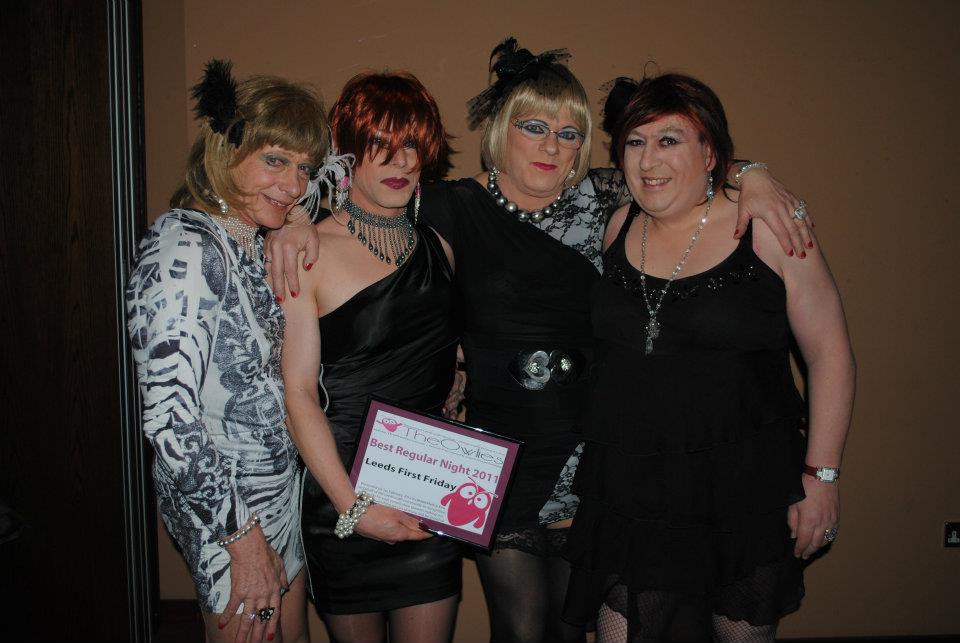
Owlies 2011: Best Regular Night, Leeds First Friday. Susan Platt won Best Resident DJ the same night.
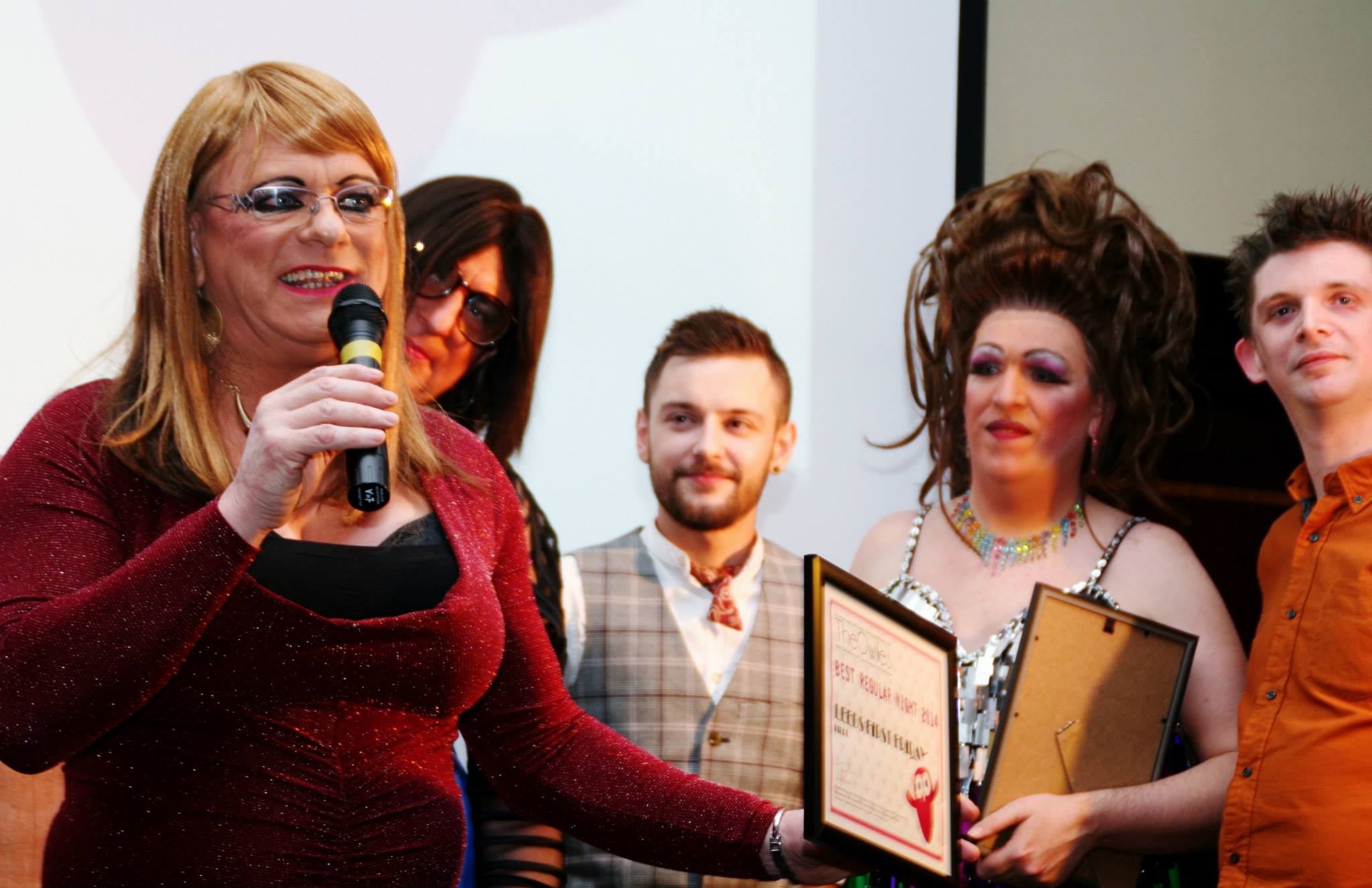
Owlies 2014: Best Regular Night. That year LFF took both Best Regular Night and Best Social Group.
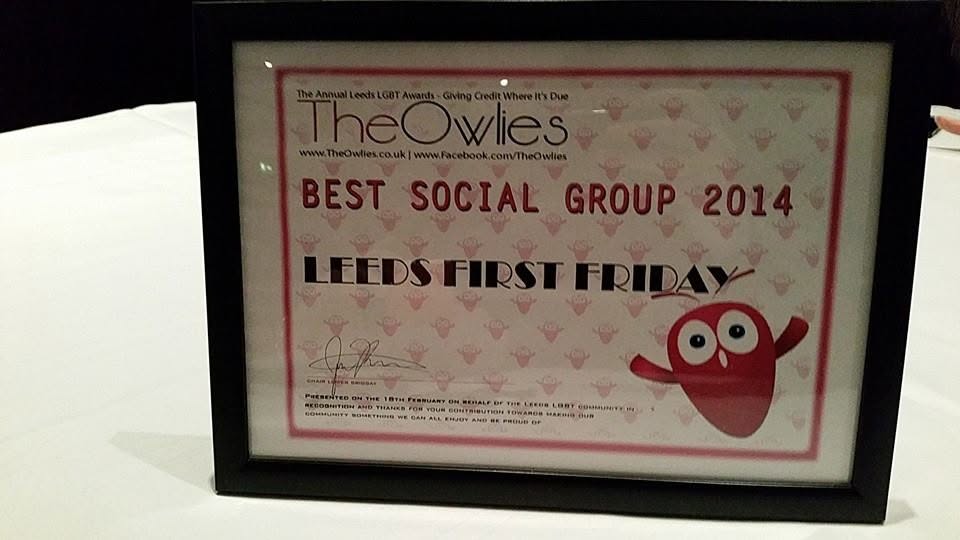
Owlies 2014: Best Social Group. The other half of that year's double.
Tanya stepped back in August 2012, and Rachel ran it solo until December 2016, the longest coordinator tenure in LFF history. When she stepped down she named what she had spent those years protecting: a free, open to all, friendly and fun social event.
In six years it had grown from a back bar to two hundred people across six venues.
Primary sources: lff.racheltv8.co.uk Wayback Machine snapshots (2011–2016); Rachel Lyons, Facebook, 20 December 2016 and 31 December 2016; Janie Marie Swann, Facebook, 31 December 2016; Tanya Carr, Facebook, 6 December 2011, 15 February 2012, 22 February 2012, 8 December 2014; Rachel and Tanya's own LFF event listing (ninety-plus attendance, the MAC and Nars makeovers), tvChix, 2010; Owlies results 2010–2014 (theowlies.co.uk, Wayback Machine); Time Out Leeds, February 2015; Yorkshire Evening Post (Cosmopolitan refurbishment).
On New Year's Eve 2016, Rachel announced the handover on Facebook. Janie replied: I will do my best to continue the fantastic job that you have done over the last 5 years. I feel privileged to be a part of this amazing event.
For the next six years, Janie Marie Swann kept Leeds First Friday together. For a generation of attendees, LFF and Janie were simply the same thing, not because she dominated it, but because she was its constant. She brought stability, humour and great kindness, and under her watch LFF grew into the UK's largest trans social. Hundreds have since said it was Janie who welcomed them into a life they went on to flourish in.
She built a community, not just a night. She knew who was new, she kept track of people, and she liked to ask how many LFFs she had ever missed, answering it herself: None
. In her hands, the Facebook group became where LFF lived between events: listings, news, jokes, the daily warmth that turns a group into a place. Even the pandemic, the only pause in the night's entire history, lasted just a breath; the community Janie had built online kept it going until the doors reopened.
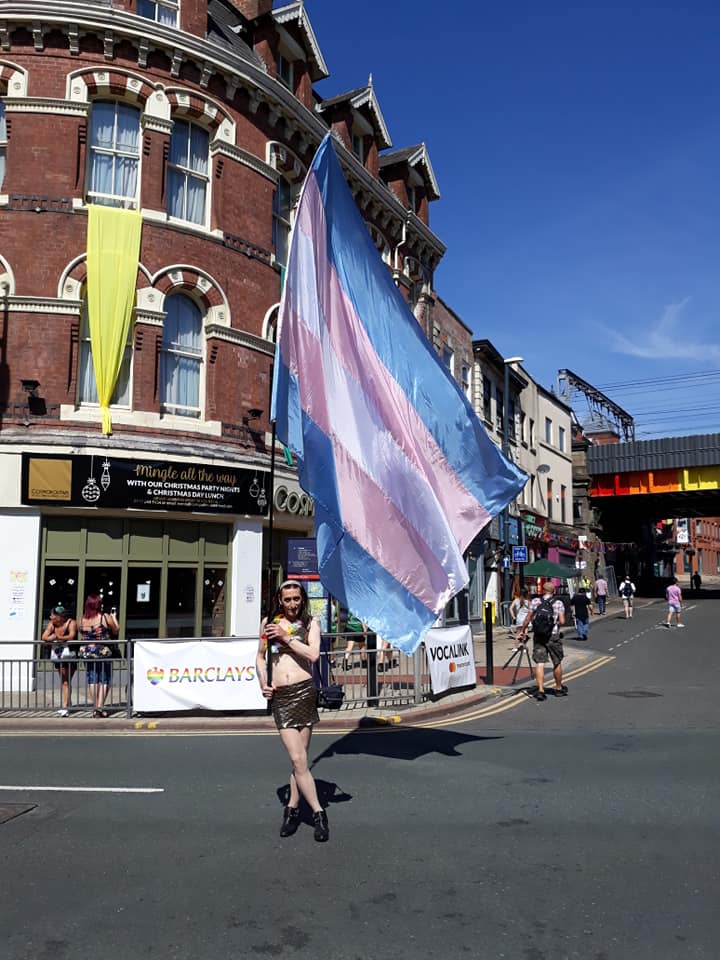
Janie proudly at Leeds Pride 2018.
The high point of Janie's stewardship came on Friday 6 April 2018, the night she billed as Leeds First Friday's tenth anniversary. The Cosmopolitan opened a function space and laid on a buffet, Antonia Bee played her first ever DJ set en femme, and at half past eight the Lord Mayor of Leeds, Jane Dowson, arrived in full civic chains to a crowd of 200 to 250, a night that had started in a pub upstairs and now had the city on its guest list. Janie's only instruction to the group beforehand was pure Janie: a few girls were coming for the first time, so look after them as we always do.
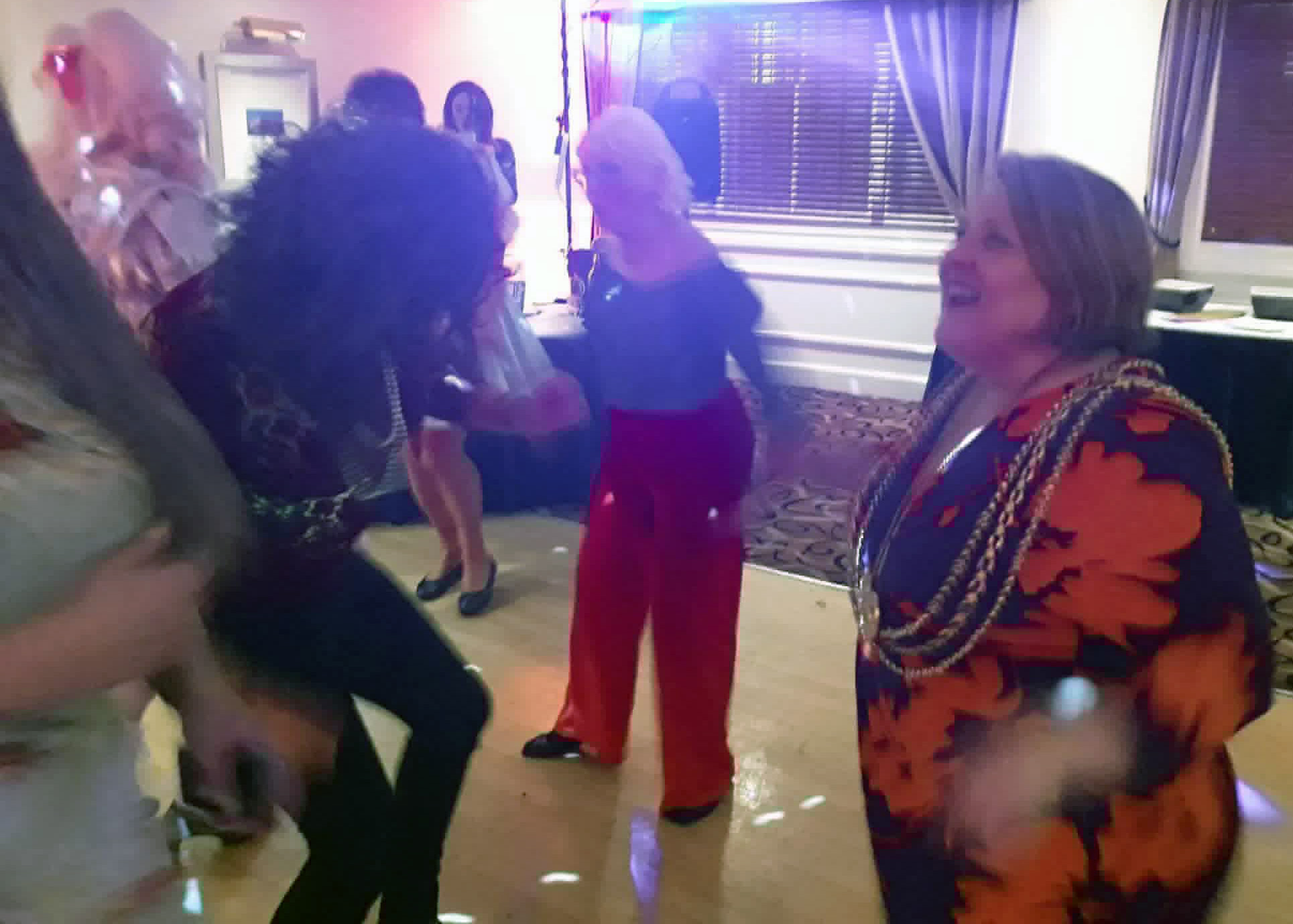
The Lord Mayor of Leeds, Jane Dowson, on the floor at Leeds First Friday's tenth birthday, April 2018.
Officially, that anniversary is the birthday Leeds First Friday keeps: the count Janie celebrated, marked ever since with parties and civic guests, turning eighteen in 2026 and reaching its twentieth in 2028. Unofficially, the first night ran two years before that, at Xibit in 2006. Both are true, one the birthday the community celebrates, the other where the story actually starts.
The night's reach was widening beyond the city, too. Juliette Noir, a trans YouTuber with a sizeable following, came three times across 2018 and 2019 and brought it to a new audience through her channel.
Juliette Noir at Leeds First Friday, 2018.
Makeup artists have been part of the night from the start. On any given first Friday, somewhere in the Freedom Quarter, you could find a professional helping someone achieve a look they had only imagined. Drew Ashlyn was among the first to be regularly part of the night; Jack Tyson followed, then Neil Maydew. Gordon Fawcett became a long-time favourite before stepping back from attending. Victoria Marley, Kate Worthington and Gill Springgay have all been part of it at different points. In recent years, for those travelling in from Manchester, Patti Baston and Charlie Asquith have been providing the same welcome from that end. Paul Heaton, also Manchester-based, has done both: LFF makeup artist, and in 2018 the designer of the LFF logo itself.
The Leeds First Friday Facebook banner, designed by Paul Heaton. A fixed presence throughout Janie's years.
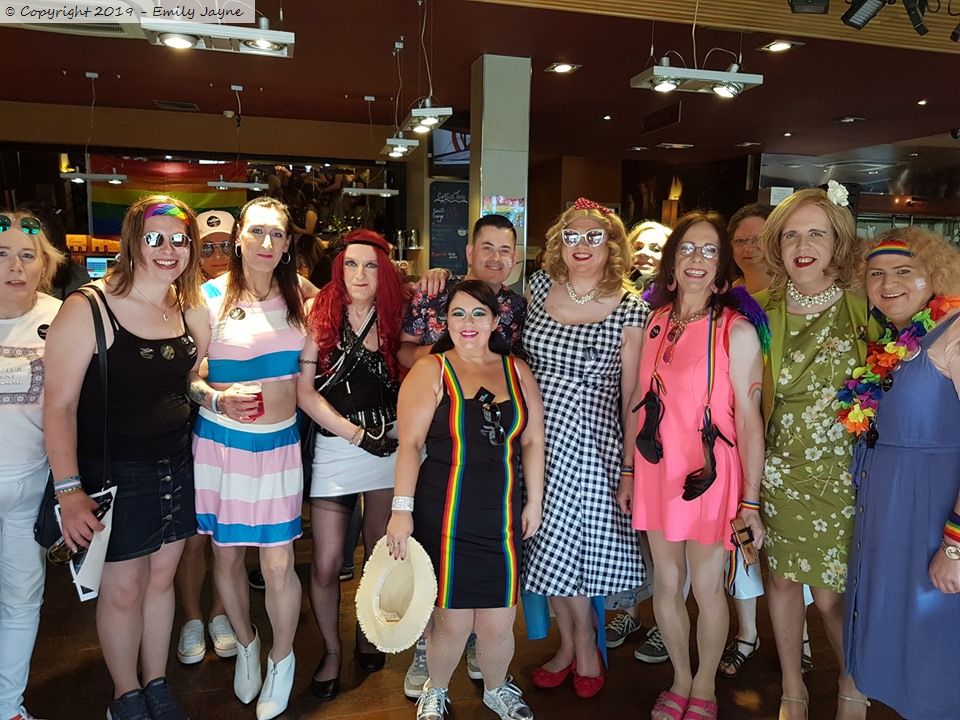
LFF at the Cosmopolitan, August 2019. Photo: Emily Jayne Donoghue.
She steered the night through its first great upheaval, too. The Cosmopolitan, the heart of the circuit for years, closed in 2020. Losing your anchor venue is the hardest thing that can happen to a night like this. Janie navigated it without fuss, establishing a new start point at the Leeds Marriott and holding everyone together through the move.
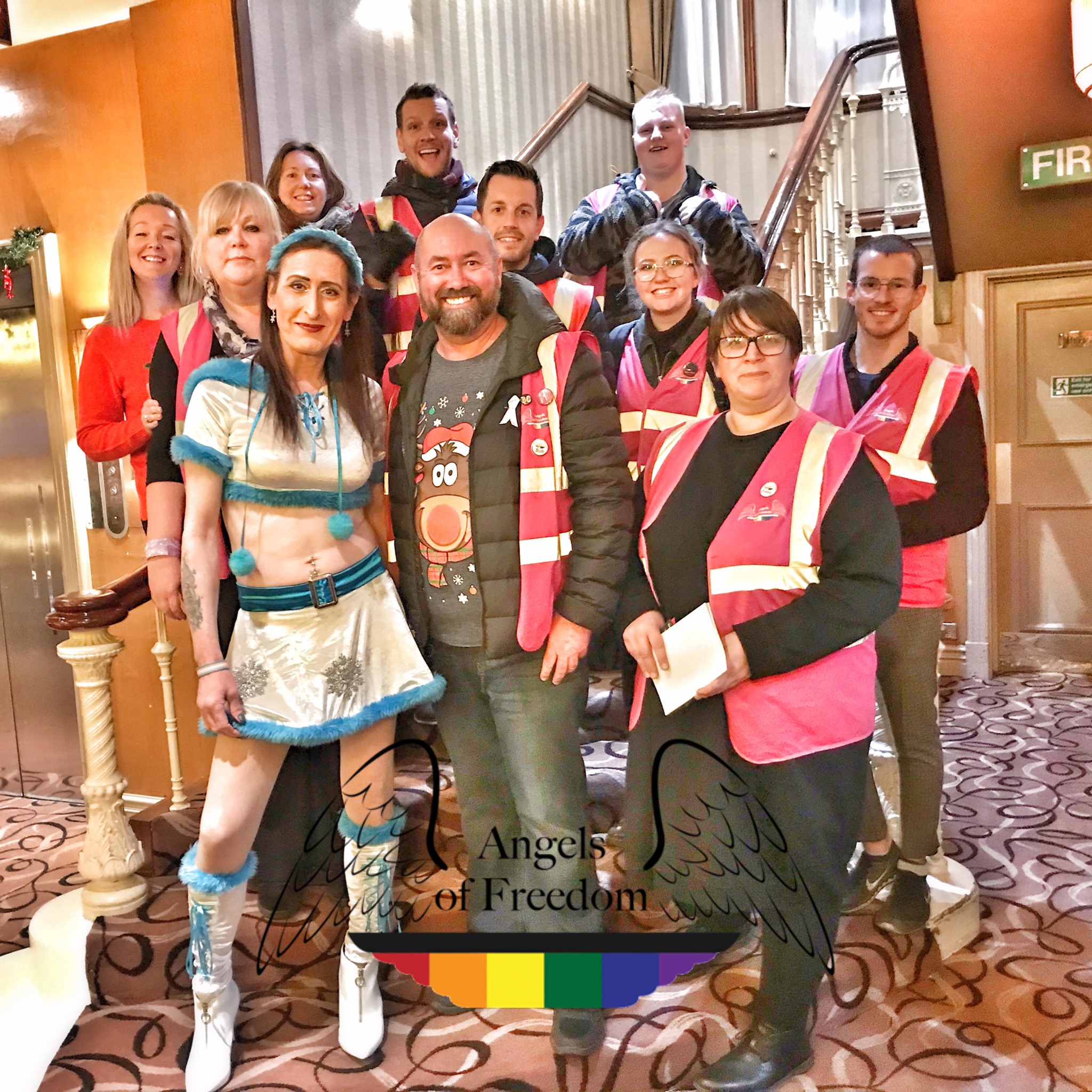
Janie with Rob Wilson (founder, Angels of Freedom) and the Angels team at the Cosmopolitan, the partnership that kept Lower Briggate safe every Friday night.
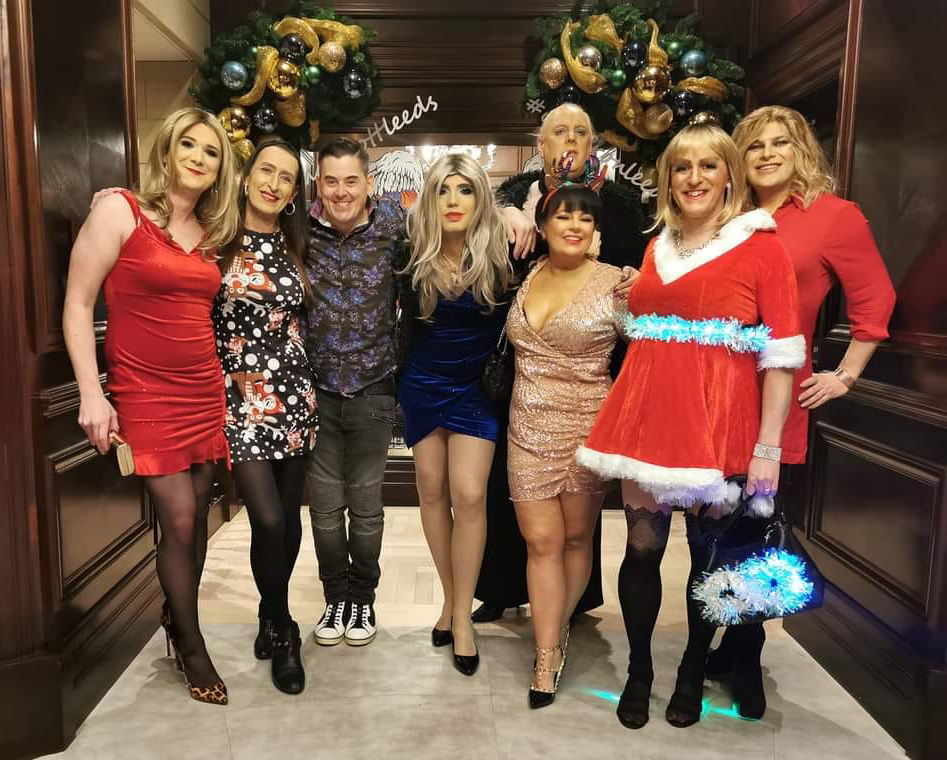
LFF at the Leeds Marriott lobby, Christmas 2021. Janie's last Christmas at the helm.
She was a wholehearted champion of Leeds Pride, making sure LFF always had its place in the parade. I love Leeds Pride,
she said, as it's such a big and friendly weekend that everyone can enjoy.
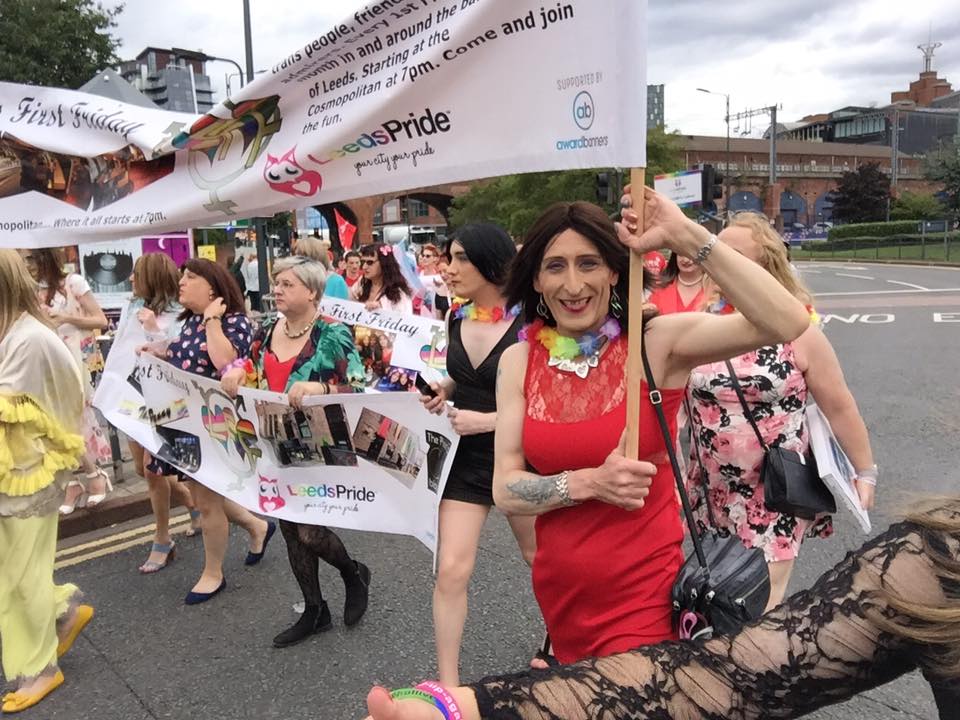
Leeds First Friday at Leeds Pride 2017, marching under the LFF banner. Starting at the Cosmopolitan at 7pm.
The city was changing around the night, too. In February 2017, after years of campaigning by Wakefield activist Thomas Wales, Network Rail painted the railway bridge over Lower Briggate in rainbow colours, funded by donations from the city's LGBT+ community and Leeds City Council. Activist Ross McCusker gave it its name: the Leeds Freedom Bridge. That same year the area around it was formally named the Freedom Quarter. The streets LFF had been walking for a decade now had a name that said what they were. And in 2018, Trans Pride Leeds marched for the first time, the first trans pride celebration not just in Yorkshire but anywhere in the North of England, DIY and community-led, two hundred strong on Trans Day of Visibility. The city LFF had been quietly building in was becoming, visibly, a trans city.
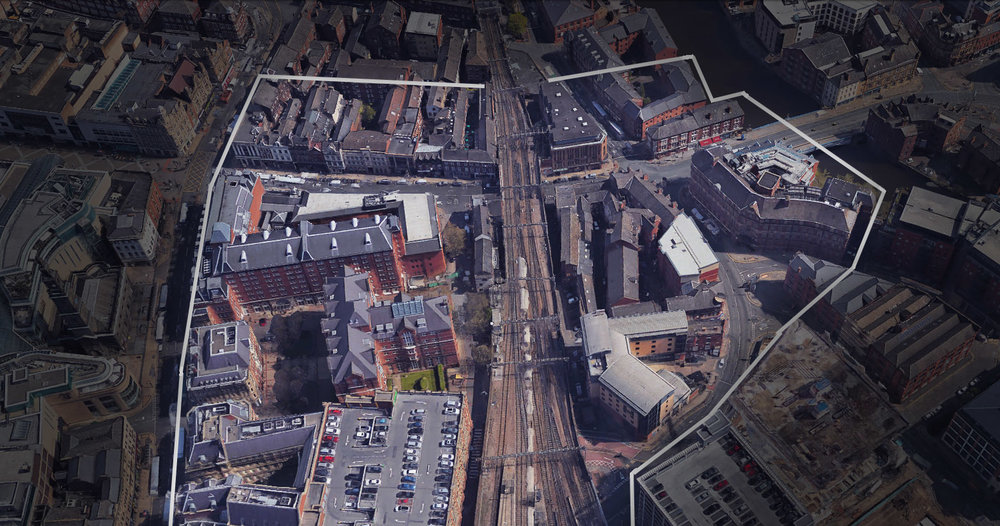
The Freedom Quarter, as designated in 2017. The railway tracks and Freedom Bridge run through the centre. The boundary has been kept loose since, but this is where it began.
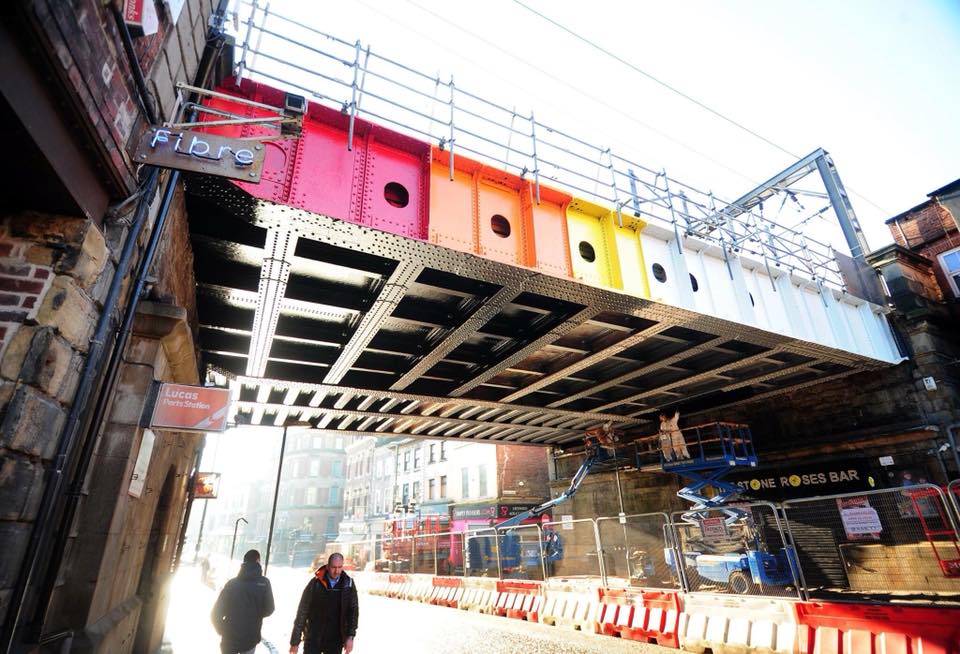
The Freedom Bridge being painted, February 2017. Network Rail. Thomas Wales. It used to be grey.
The community's verdict came the usual way: Best Social Group at the Owlies in 2017, Best Regular Night in 2019 and 2020, with Janie personally nominated for Best Volunteer and Best Organisation Worker.
My first outing to LFF last Friday was just the best. Soooo many lovely people, so many amazing outfits, great venues. I was living the dream and haven't stopped thinking about it since. I loved every minute from the first terrifying step [out] of my room to the time I had to change back. You are ALL fab!
Anonymous, first visit to LFF, 2016
Janie Marie Swann died in July 2022, from cancer. It was a private matter she had kept to herself, and a profound shock to the community that loved her.
What she built did not die with her.
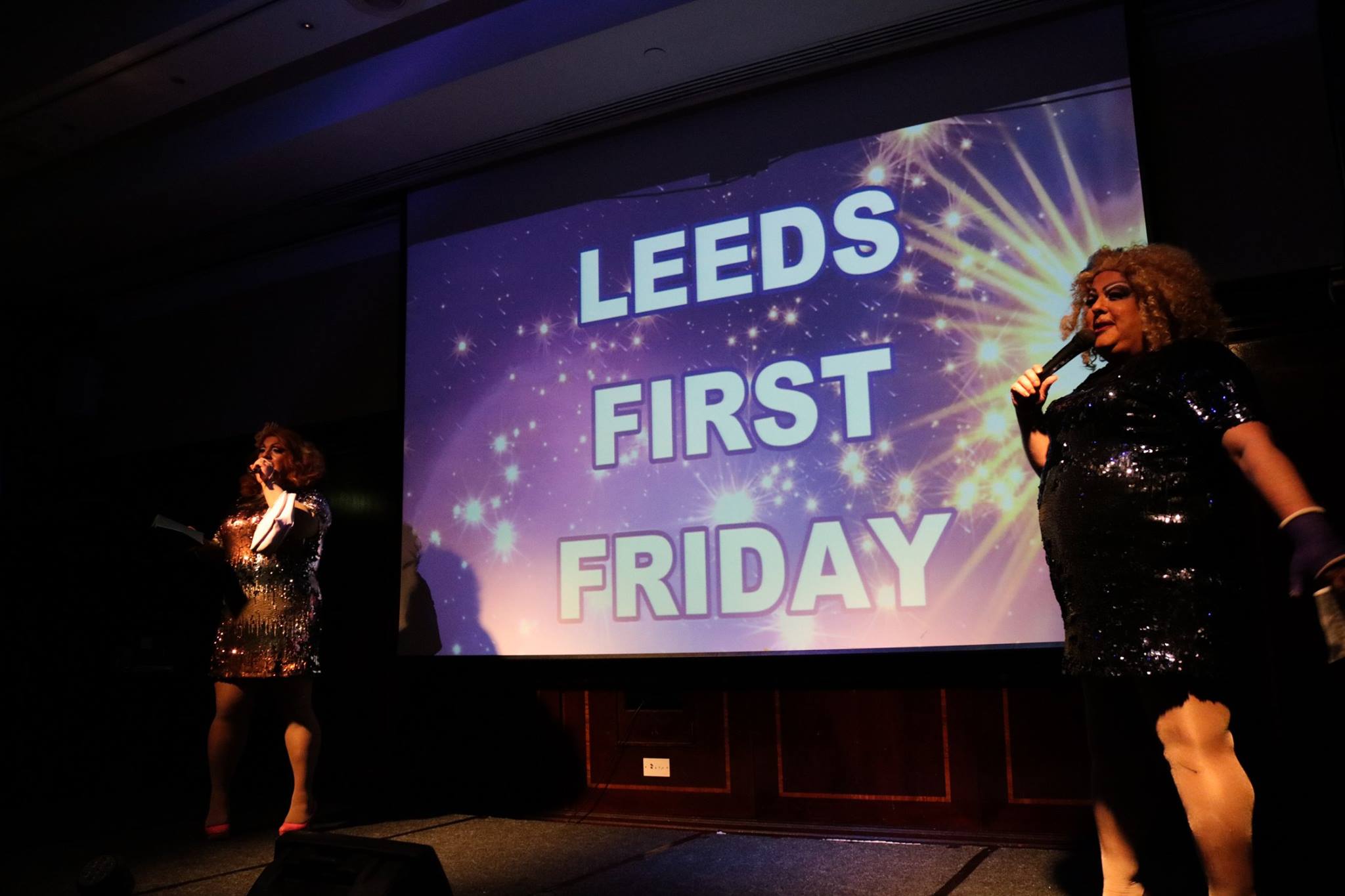
Owlies 2017. Leeds First Friday on the big screen.
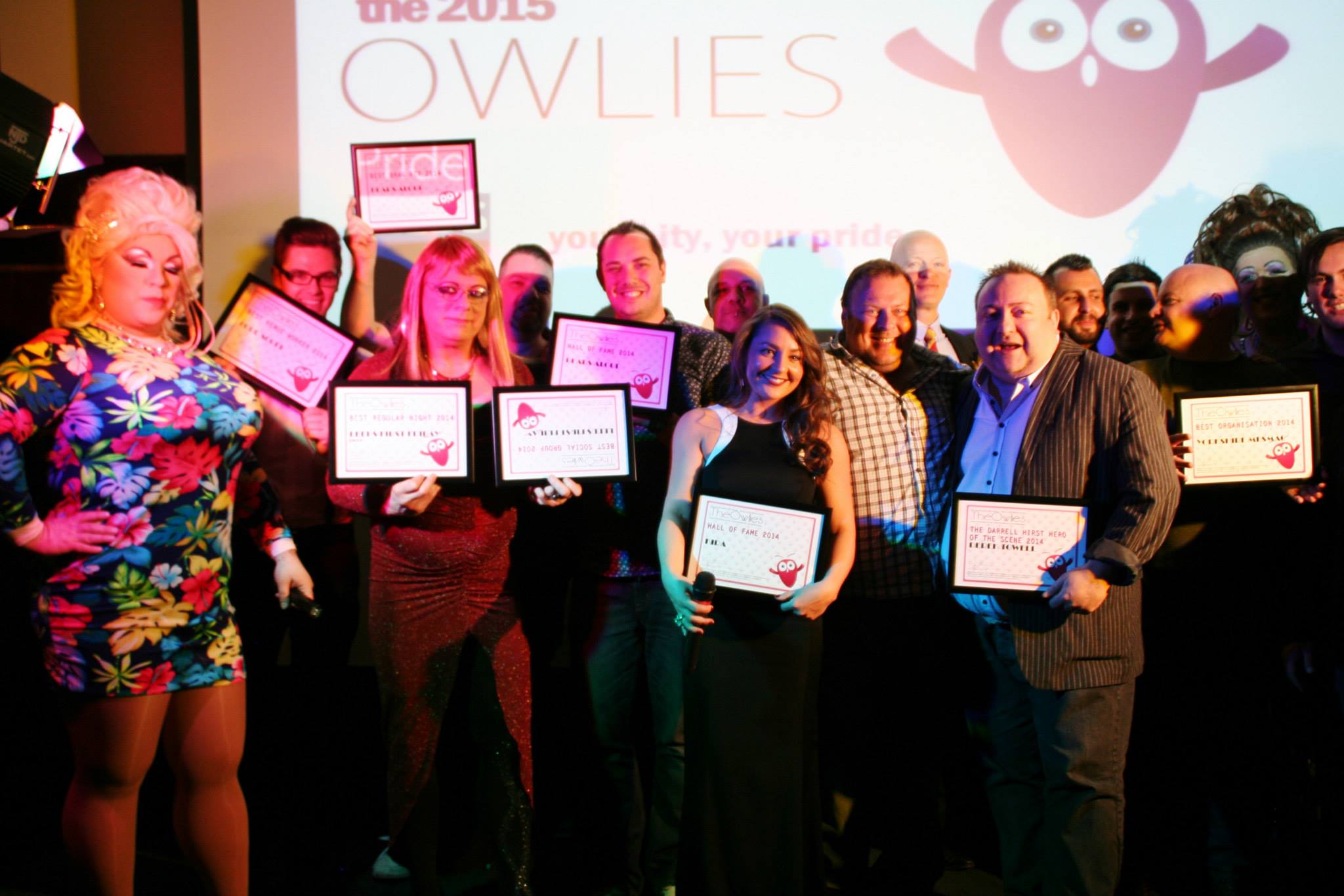
Owlies 2015 ceremony.
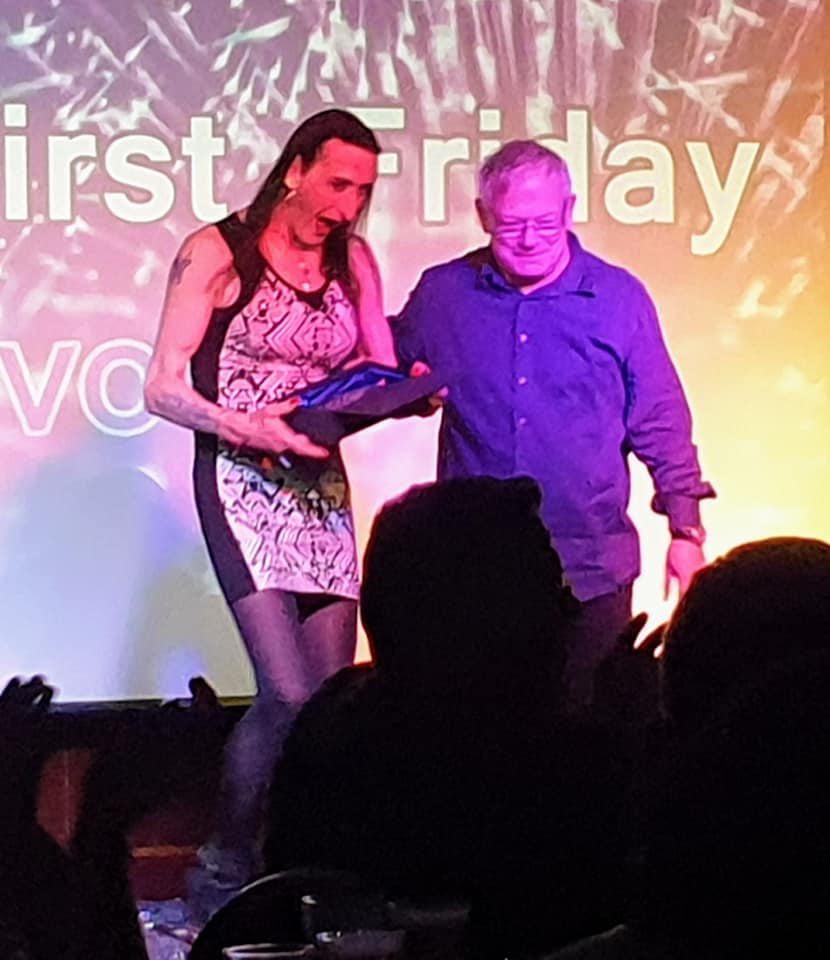
Janie collecting the 2019 Owlies. Presenting the award is Ian Platt, Susan Platt's male persona, and the person who had been part of this community since the very beginning.
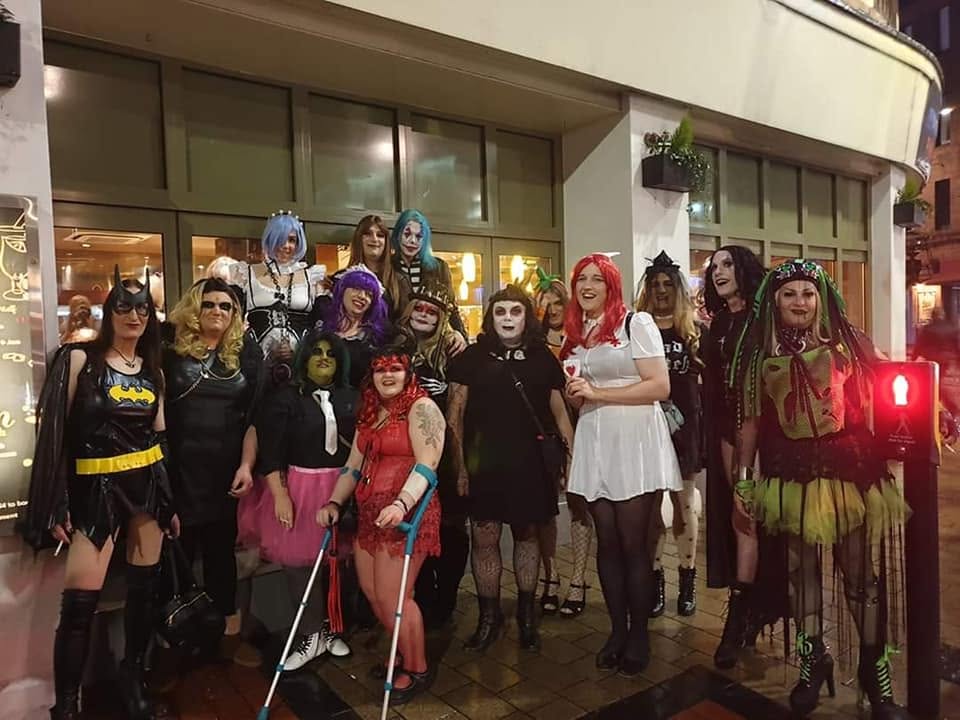
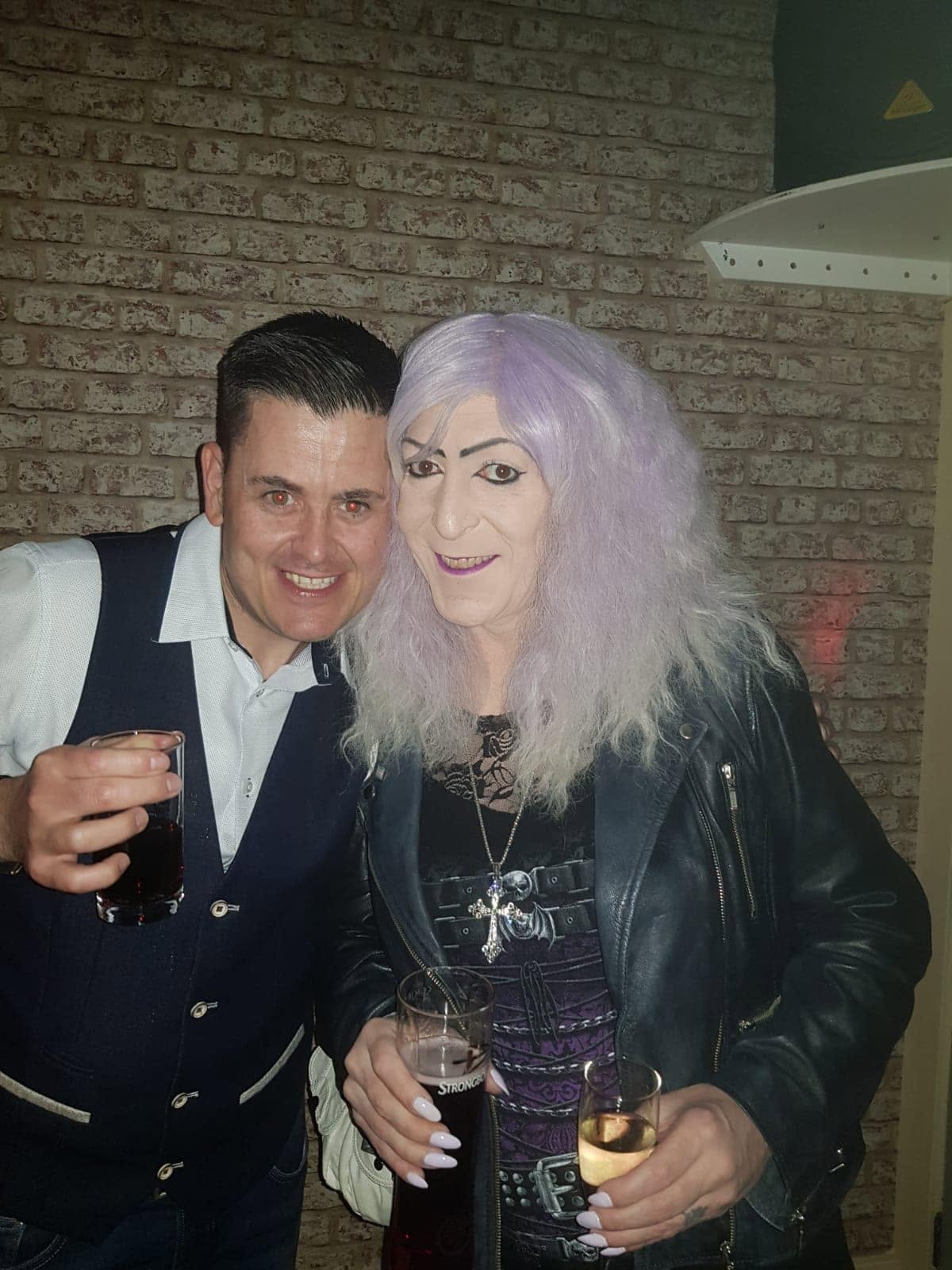
Sources: Memorial bench for Janie fundraiser (2022); LFF Owlies results; community oral history; Janie Marie Swann, Leeds First Friday Facebook group, 22 March and 2 April 2018 (tenth-anniversary announcements). Memorial bench delivered with support from Leeds City Council.
Nobody had planned for LFF without Janie. At the end of 2021, Janie had brought Grai in to help moderate the Facebook group, one practical task handed over with no thought of what would follow. When Janie passed away the following July, Grai was already there. She took on coordination, and by the end of 2022 Sophie Scott and Kandice Fox had joined as co-coordinators. What LFF was had never been in doubt. The harder question was who else it could reach, because the trans+ world had broadened enormously since the TVChix era, and there were people who could have found a home in LFF who didn't know it existed, or didn't yet feel it was for them.
Leeds First Friday had grown up transfeminine, out of the crossdressing and T-Girl socials of the TVChix years, and that inheritance runs through most of this history. Not everyone now finding their way to LFF shared it. Non-binary people arrived quickly and in numbers; trans men more slowly, and reaching them is work LFF still counts as unfinished.
The answer was structural: stop being a single night, become a framework. A core monthly event, surrounded by autonomous sub-events, each run by people building something of their own under the LFF umbrella.
Made It! came first. Nikki Dee Angel built the newcomer hour, 7 till 8, before everyone walks down to Bridge End Social together. The welcome team would walk a nervous first-timer over from their hotel and stay beside them all night. For a lot of those people it was the first time they had ever walked through a city dressed as themselves, the most frightening thing they had ever done turning, within an hour, into the best thing. Newcomer attendance went up tenfold, and the old complaint that LFF was cliquey quietly died.
First time at LFF, but not the last. Thanks to Grai and everyone else who made me feel welcome. I think me and Leeds are going to become friends x
Lucy Hutchinson, first visit to LFF, 3 September 2022
That same Lucy Hutchinson then launched Cocktails at 9, later, looser, a different crowd. Alice Thorpe, Ann East and Isobel Fox launched Pints N Straws, LFF's first ever daytime: a taproom crawl for eating, drinking and taking it easy. A daytime pint asks none of the things a glamorous night does, no outfit to plan and no crowded floor of strangers, and that turned out to be exactly why it reached people the evening never had. Each new event drew a crowd the organisation had never seen before, younger, broader, more reflective of what the trans+ community has become, while the original first Friday night continued unchanged, the same evening and the same welcome in the same corner of Leeds.
What became Leeds First Friday had started as a dozen trans people over pints and a pub quiz at the Old Red Lion, then spent twenty years turning into the loudest night of anyone's month. Pints N Straws, and the calmer events now being planned around it, bring it back round to where it began, a drink and a table and no spectacle required.
And the night sat, deliberately, inside a wider ecosystem. TransLeeds runs the peer support, the advocacy, the binder library and the quiet Monday groups across the month; LFF brings the joy. Different jobs for the same community, and the months work better because both exist.
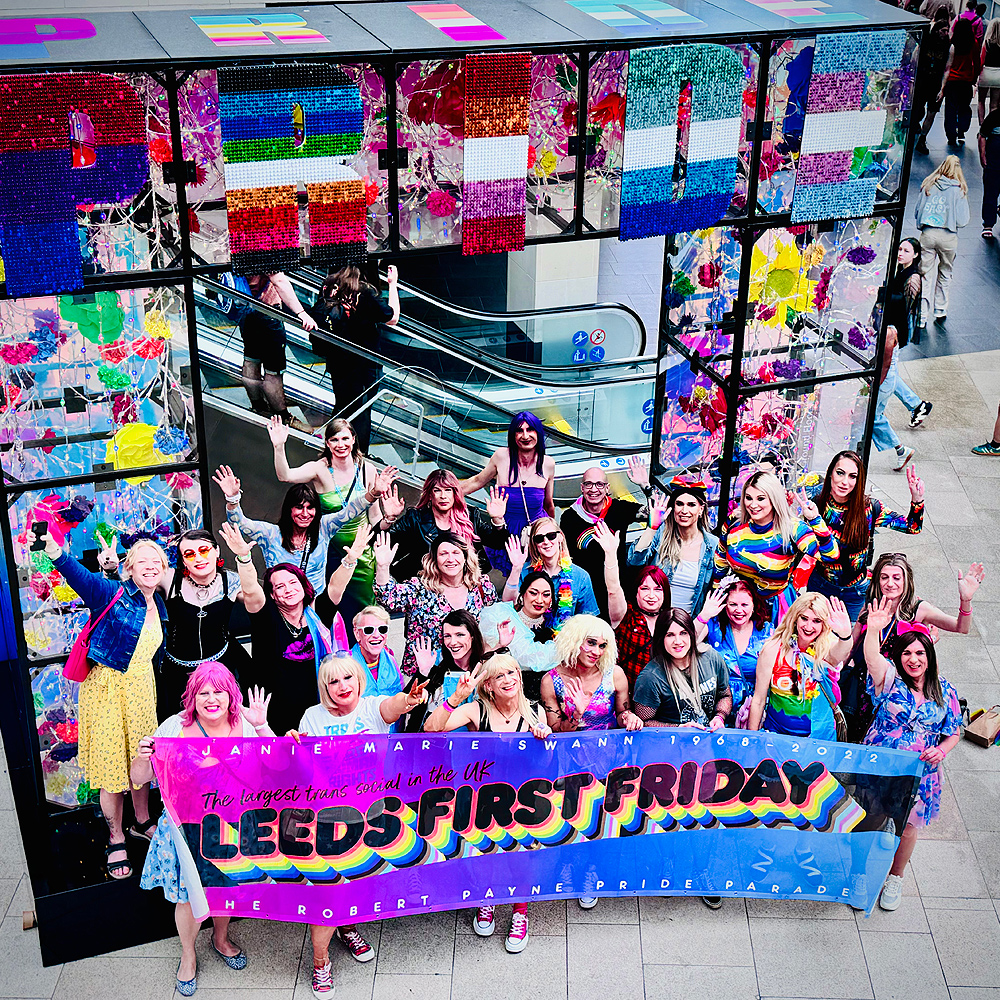
The Leeds First Friday group at Leeds Pride, July 2023, inside Trinity Leeds.
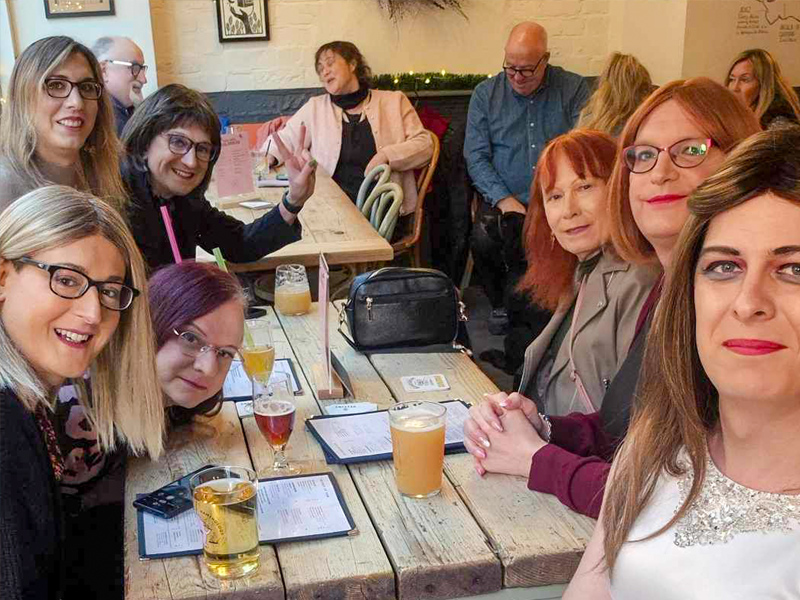
Pints N Straws, January 2025.
The framework produced something LFF had never had: a team. Where the night had always depended on one or two coordinators carrying everything, by 2024 there were twenty volunteers, running events, managing socials, welcoming newcomers. The digital home grew with it, built by Grai from the ground up: a rebuilt website, a Discord, an app, a map of the Freedom Quarter, and new Instagram, YouTube, TikTok and Mixcloud channels, with Janie's Facebook group still at the centre. Nearly all of LFF's online presence in these years was Grai's work.
Kandice Fox was the engine. She brought the operational rigour that turns a good idea into a running event, and lived knowledge of transition that quietly shaped every decision about inclusion: what a newcomer actually needs at the door, what a welcome has to feel like before it works. Anyone can launch a sub-event; it was Kandice who kept a whole programme of them running, month after month, year after year.
The mix below is Roberta Borelli's studio set for Leeds First Friday, recorded for Trans Day of Visibility 2024. From 2026 Roberta took over from Toni as resident DJ at The End Bar, a trans DJ with a regular slot in a major Freedom Quarter venue, which five years earlier would have been a pipe dream and is now simply how things are.
The safety net grew too. The long-standing partnership with the Angels of Freedom, the volunteer presence on the Quarter every Friday since 2017, was joined by the Women's Night Safe Space bus, which began attending Lower Briggate on first Fridays specifically for LFF's community. A safe place to wait, a charged phone, a calm word, help getting home. For someone out in public presentation for the first time, that is everything.
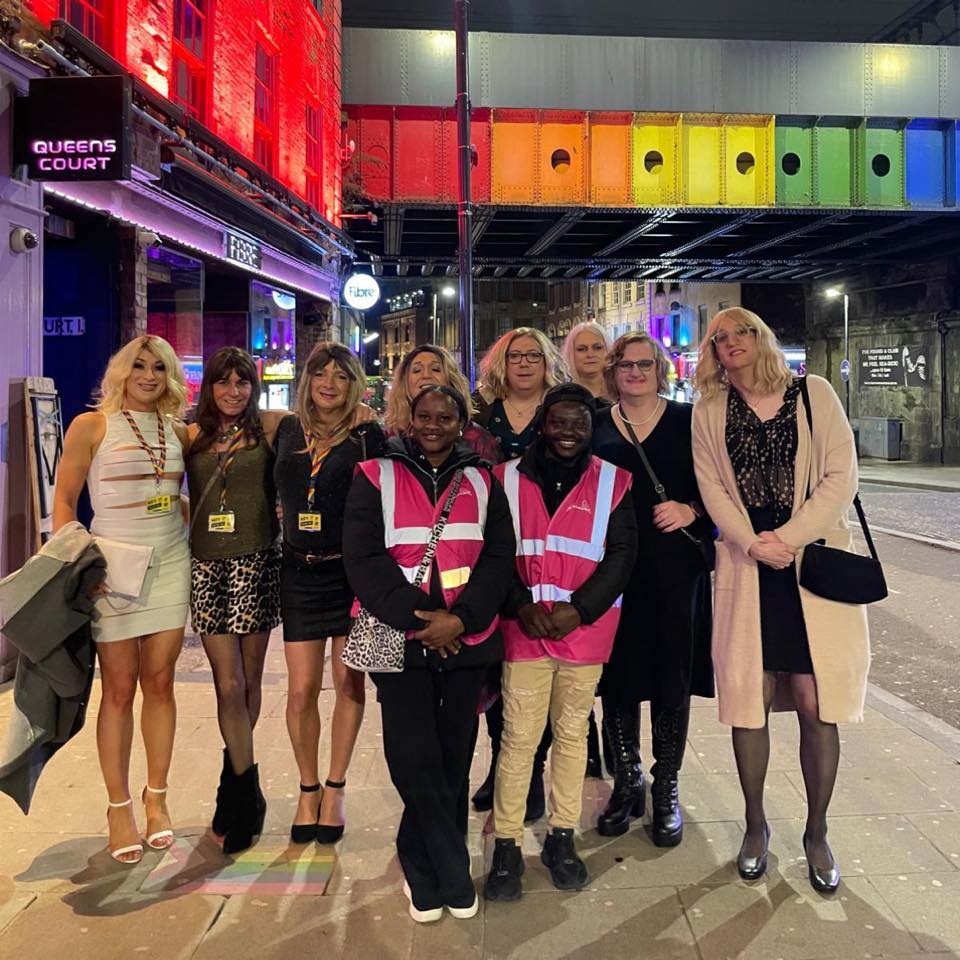
The Made It! Newcomer Team (Heidi, Jennifer, Nikki and Laura) with Angels of Freedom on Lower Briggate, 2026. The rainbow bridge, Queens Court, Fibre, the Freedom Quarter at night.
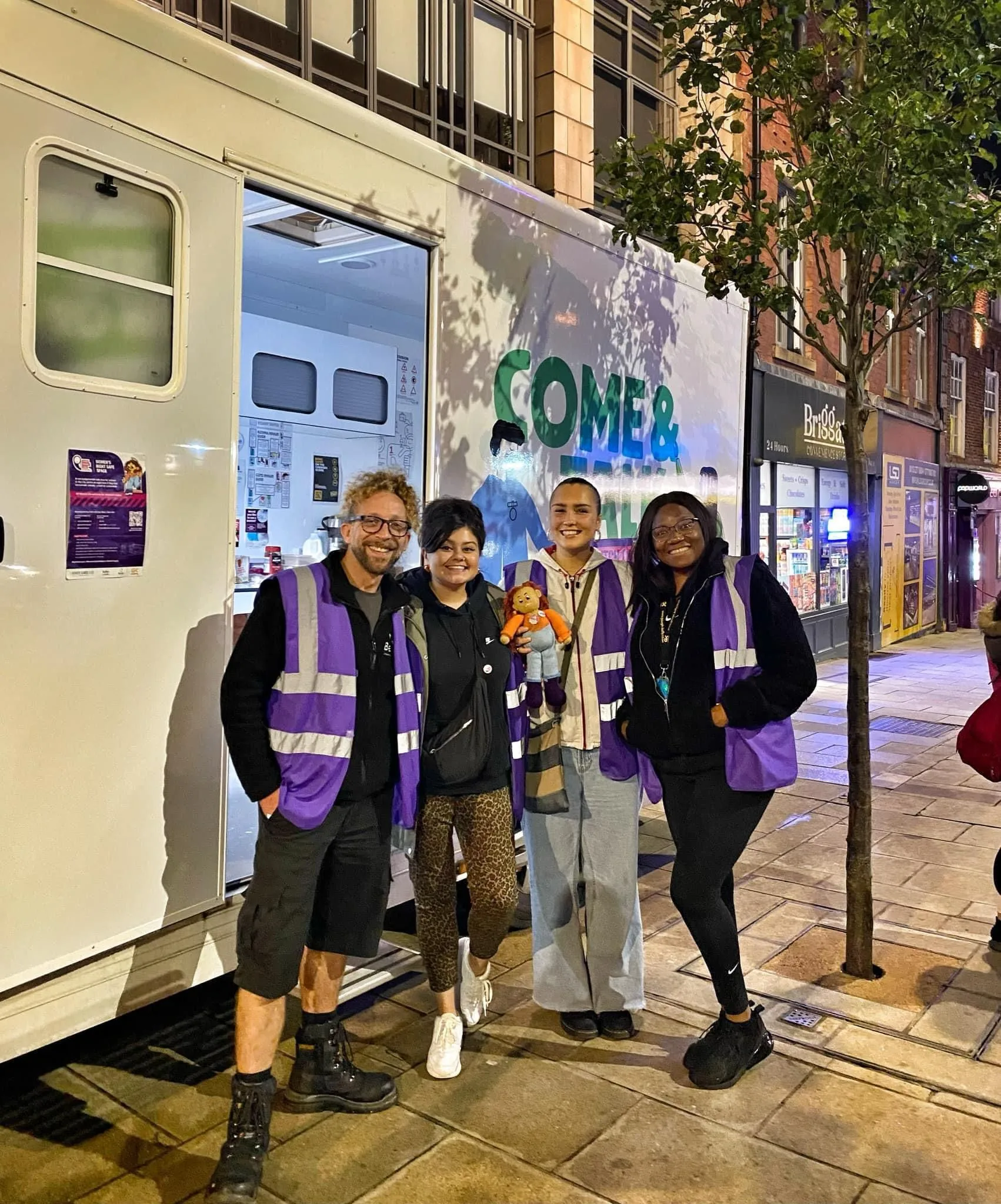
The Women's Night Safe Space bus on Lower Briggate, 2025. Attending first Fridays for LFF's community.
Janie's bench, Lower Briggate, 2023.
In 2023, the community fundraised, Leeds City Council came on board, and a permanent memorial to Janie was unveiled at LFF's 15th birthday: a metal bench painted in the Progress flag stripes, on Lower Briggate outside Westrow House. The building had another life once. As the Royal Hotel, it was one of the discreet queer venues of 1950s and 60s Leeds, a place where those who did not fit could be quietly met. Janie's memorial now sits where that careful, half-hidden welcome used to be, seventy years on and hidden from no one. Grai hosted the unveiling, with words from Sophie Scott, Michelle Anne Moorhead, and Councillor Lewis, the same councillor who had unveiled the New Penny plaque seven years before, back again on the same street for the same community. Its plaque names her as the inspirational voice of the LGBTQ+ community and the kind heart of Leeds First Friday. It has never once been defaced. It has only ever been lovingly photographed.
Janie's bench unveiled on Lower Briggate, 2023. Grai hosted, with Sophie Scott, Michelle Anne Moorhead and Councillor Lewis. Grai and Cindy Lopez are seated on the bench.
Janie's Bench, Lower Briggate, unveiled 2023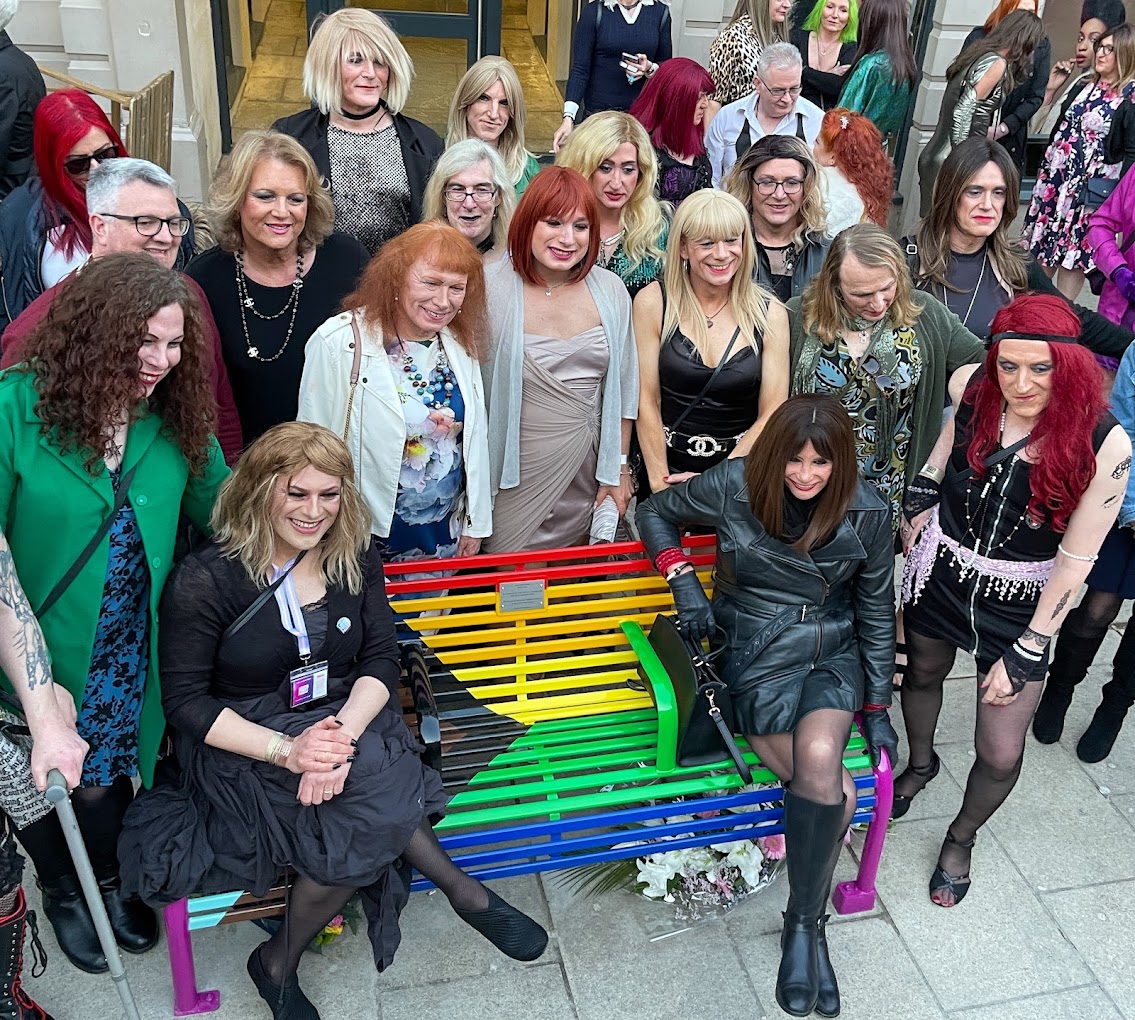
The unveiling was the quiet half of the day. LFF's fifteenth birthday continued that evening up to the penthouse at Fibre, and the two halves belonged together: the bench in the afternoon, the party after dark. It felt less like a birthday than a line drawn under Janie's passing, the community grieving and dancing in the same day.
There was a venue journey too, and it ended somewhere remarkable. After the Marriott's bar became a restaurant, and a year starting at the Viaduct, LFF found its permanent home: Bridge End Social, the same building that housed Xibit, where Deena Leeds started the whole story in 2006. After years of moving, Leeds First Friday came to rest in the very building where it began. And the map kept growing even then: The End joined the circuit, run by Shaun Wilson with Roberta Borelli on the decks. The welcome there was not new, though. Shaun had opened Bar Fibre alongside Terry and Michael in 2000, and had roped off an area of their club Mission for Leeds First Friday years before; now he was doing it in a venue of his own. The newest venue on the route, and one of the oldest welcomes.
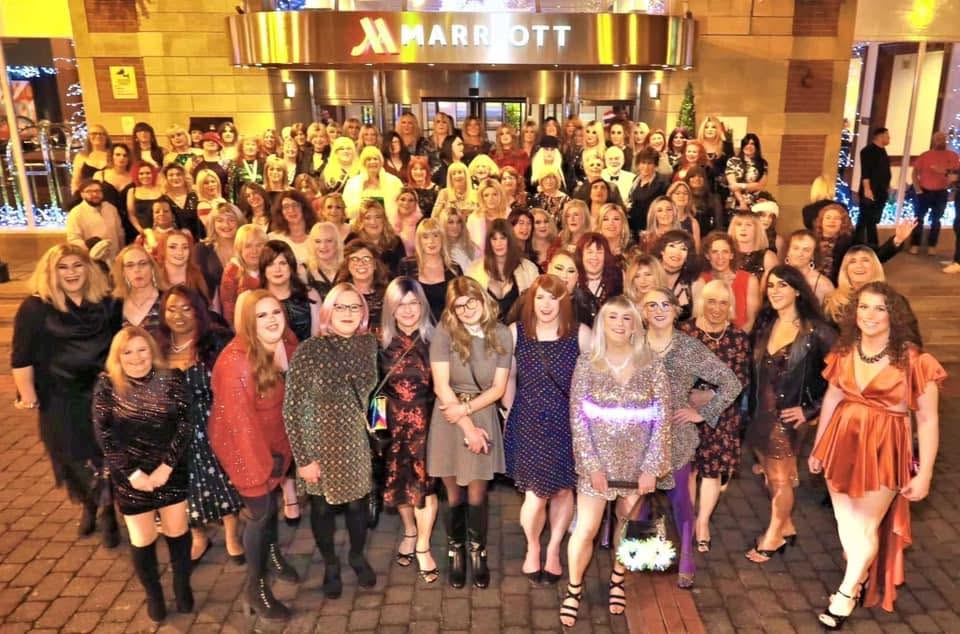
Leeds First Friday at the Leeds Marriott, December 2022. The new team's first Christmas, with the Marriott still the start point before the move to Bridge End Social.
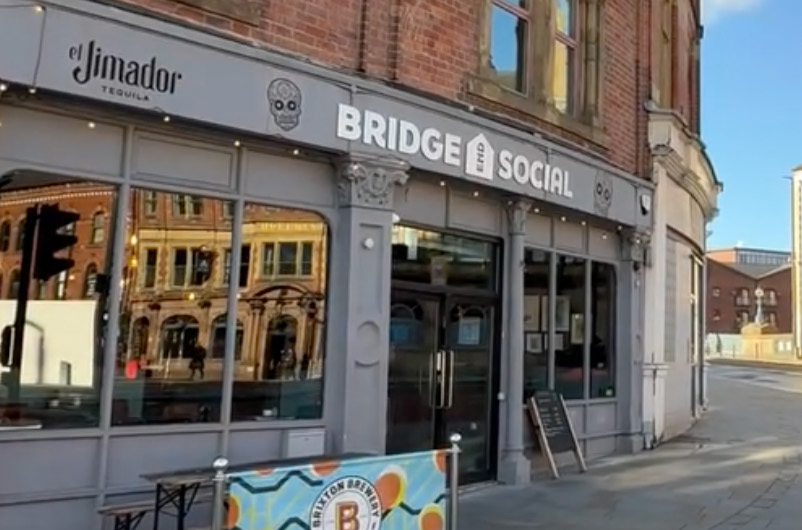
After years of moving from venue to venue, Leeds First Friday came back to the building where it started.
Bridge End Social, the same building that housed Xibit in 2006And the night stepped into the mainstream's field of vision, Sophie Scott's doing. She took a community event that had spent fifteen years known mostly to its own and put it on the national news, bringing ITV and ITN cameras to the Freedom Quarter. She connected LFF with high-profile trans figures who wanted to lend their reach: Ash Palmisciano, the Emmerdale actor and one of the most visible trans men in the country, fronted LFF promos and the submission video for the National Diversity Awards. For a trans person somewhere in Britain who had never heard of Leeds First Friday, the most likely way to discover it now was on television, something that had never been true before, and it was Sophie who made it so.
For all the cameras and main stages, on a first Friday Sophie was also the one who spotted the nervous newcomer at the edge of things and went over, every month, without exception, for four years.
Of everything she was part of, Sophie names Janie's Bench as the contribution that matters most to her. The bench unveiled on LFF's fifteenth birthday has been photographed thousands of times since; it has never been defaced. She sees it as a monument to everyone who has ever given something to this night, and she is right that it is. What she does not say, but is also true, is that the connections she spent years building are part of what made it possible.
The recognition kept scaling up. In 2024, LFF was shortlisted for the National Diversity Awards at Liverpool Cathedral, a volunteer-run social night with no paid staff, no offices and no institutional backing, shortlisted alongside the most established LGBTQ+ organisations in the country, and belonging there.
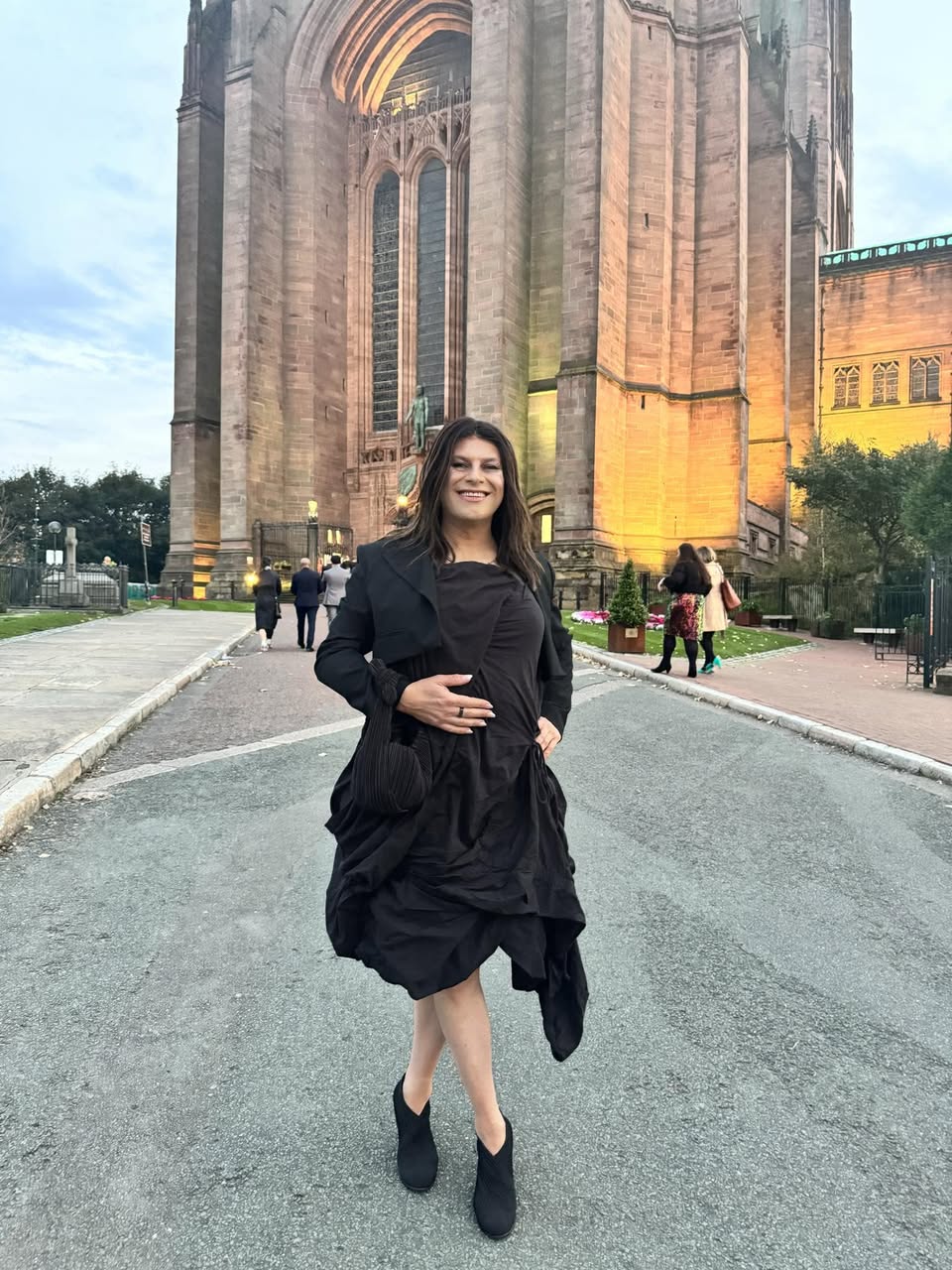
Grai outside Liverpool Cathedral, National Diversity Awards 2024.
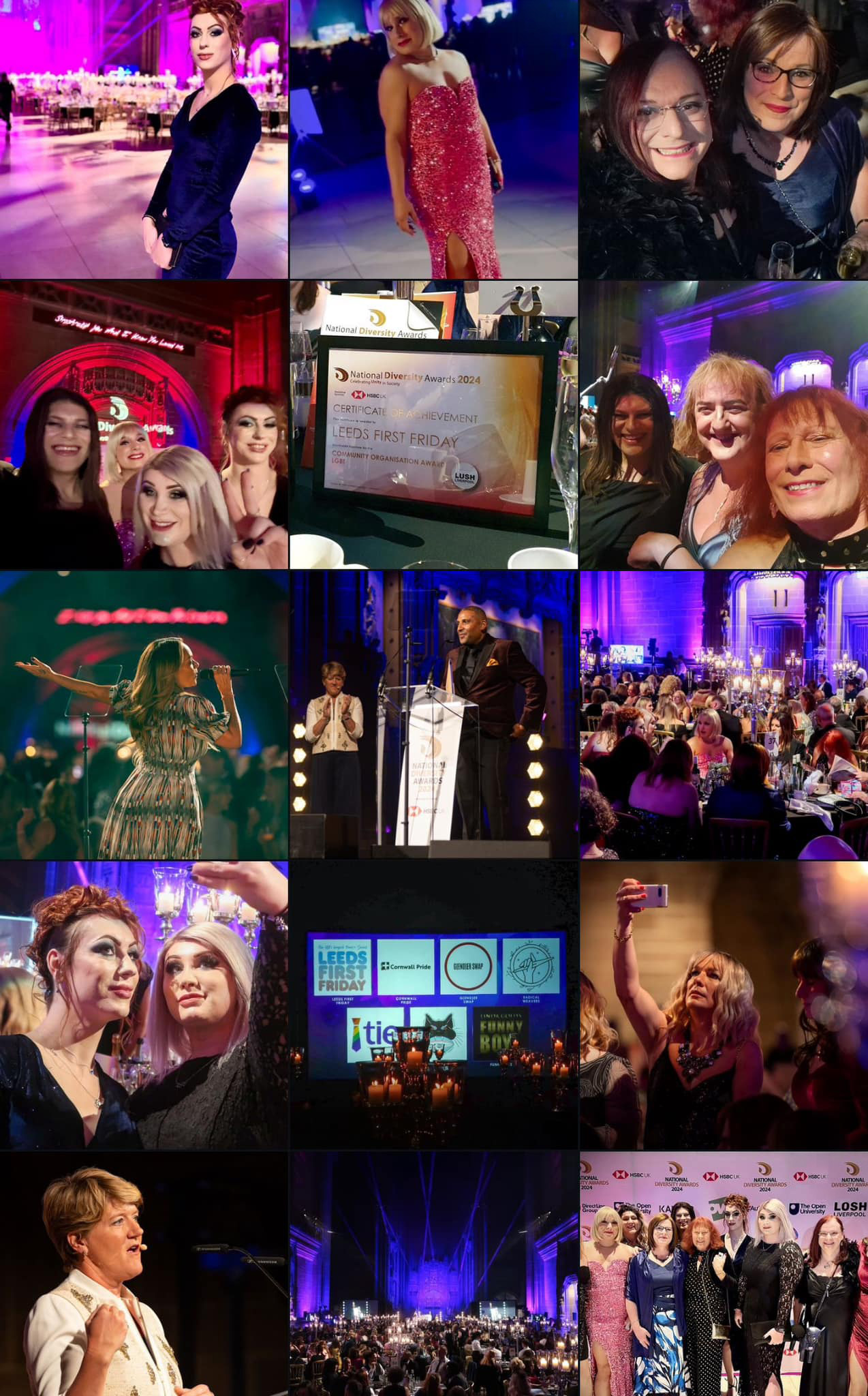
The evening at Liverpool Cathedral. Leeds First Friday on the screen, Clare Balding at the podium, the community that made it happen.
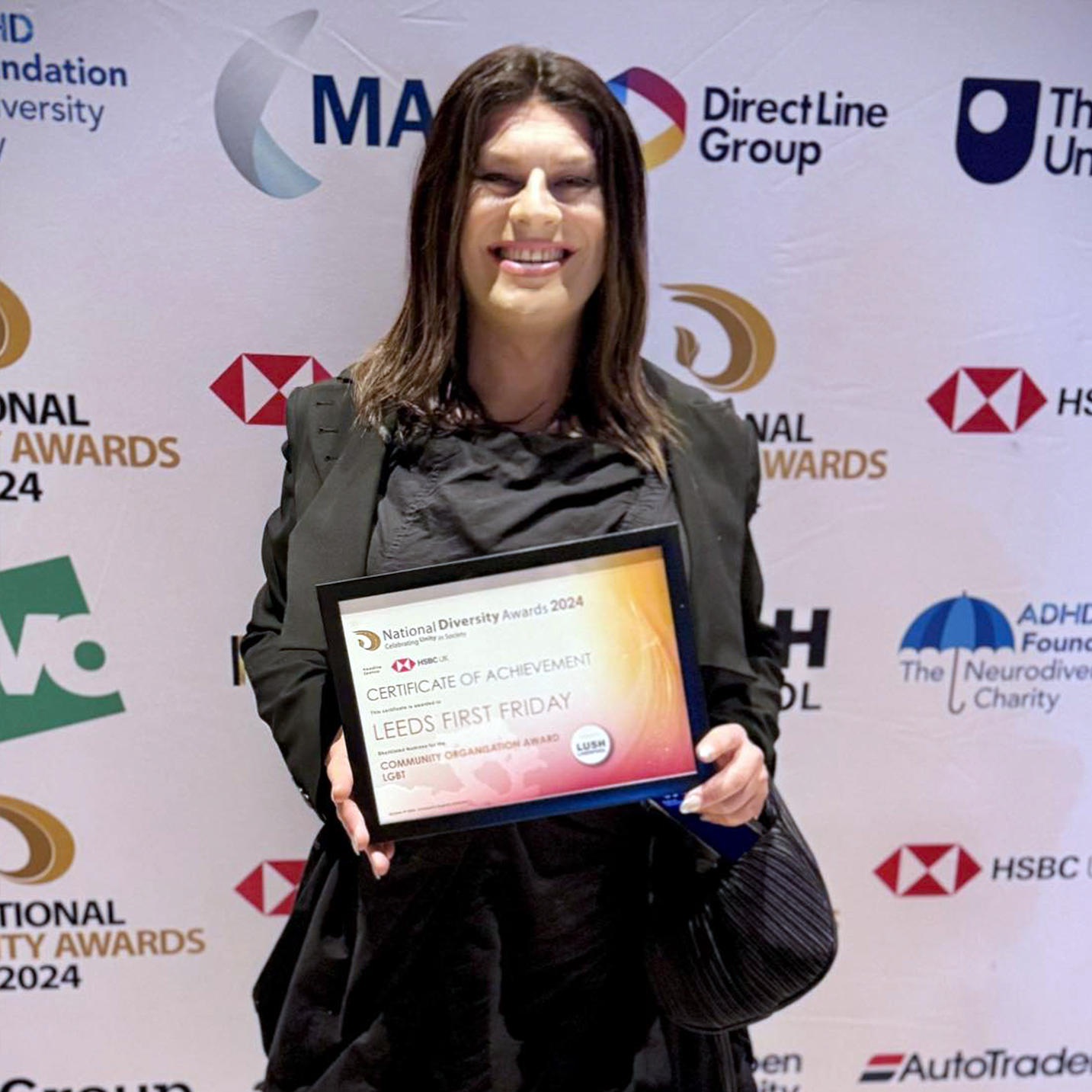
Grai, National Diversity Awards 2024.
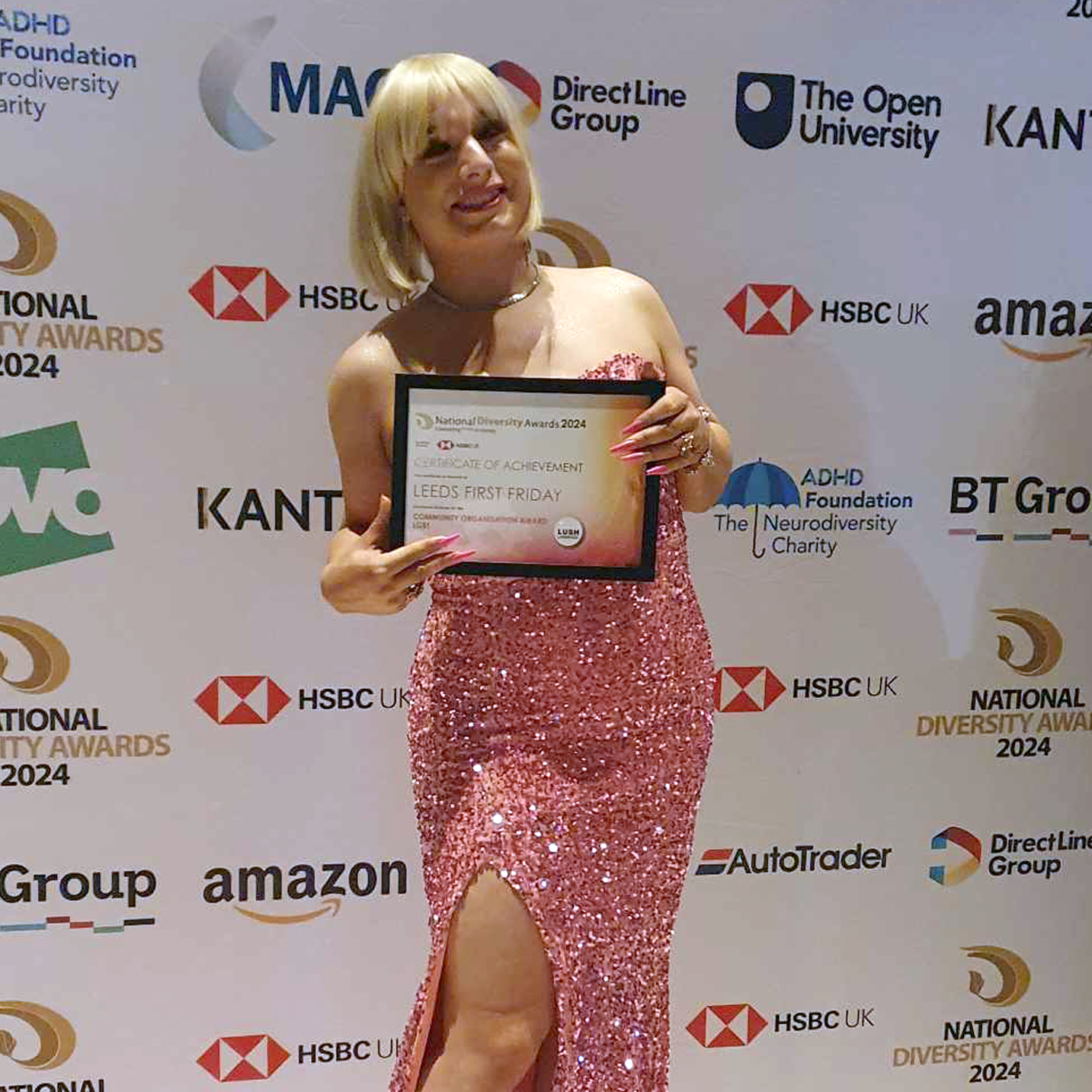
Sophie Scott, National Diversity Awards 2024.
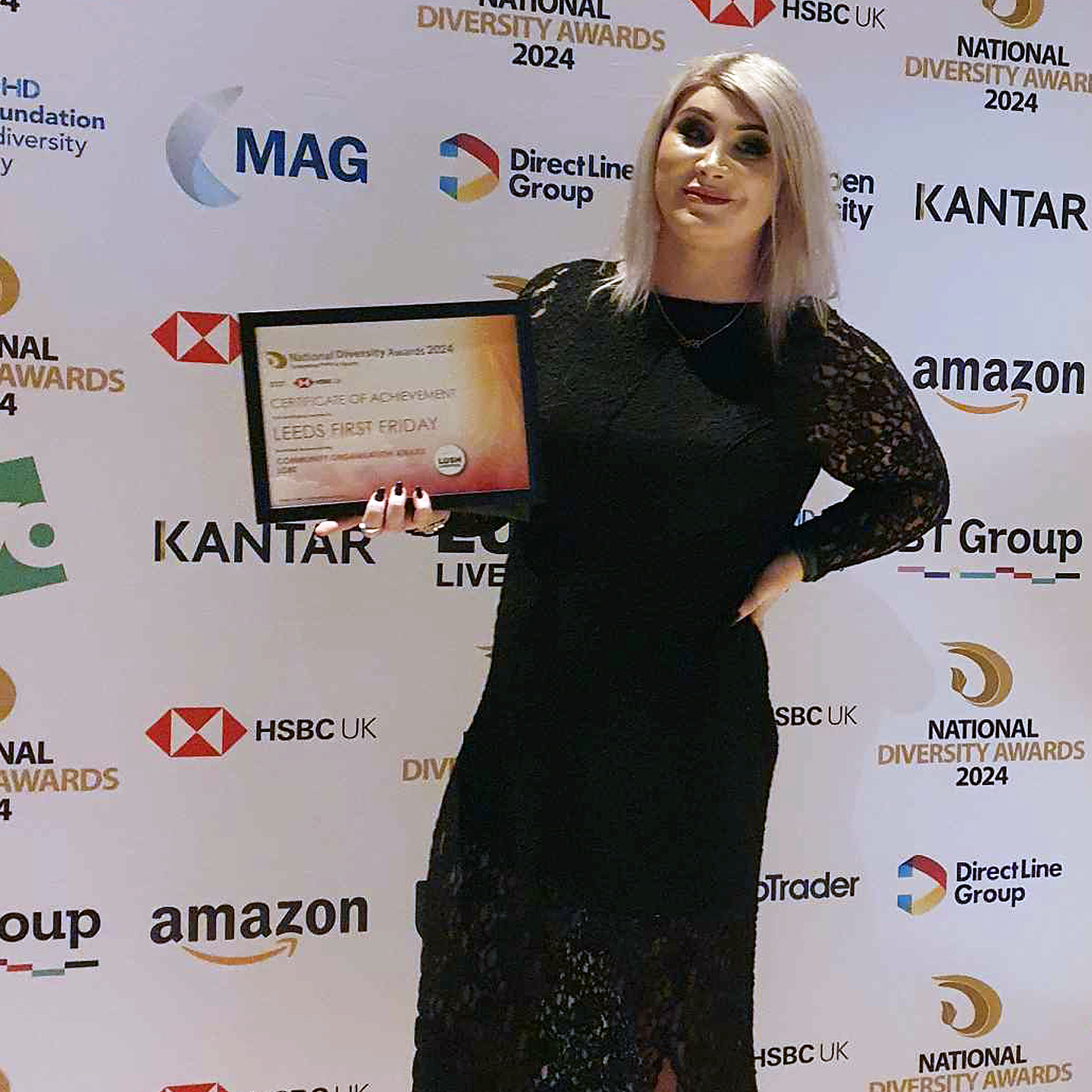
Kandice Fox, National Diversity Awards 2024.
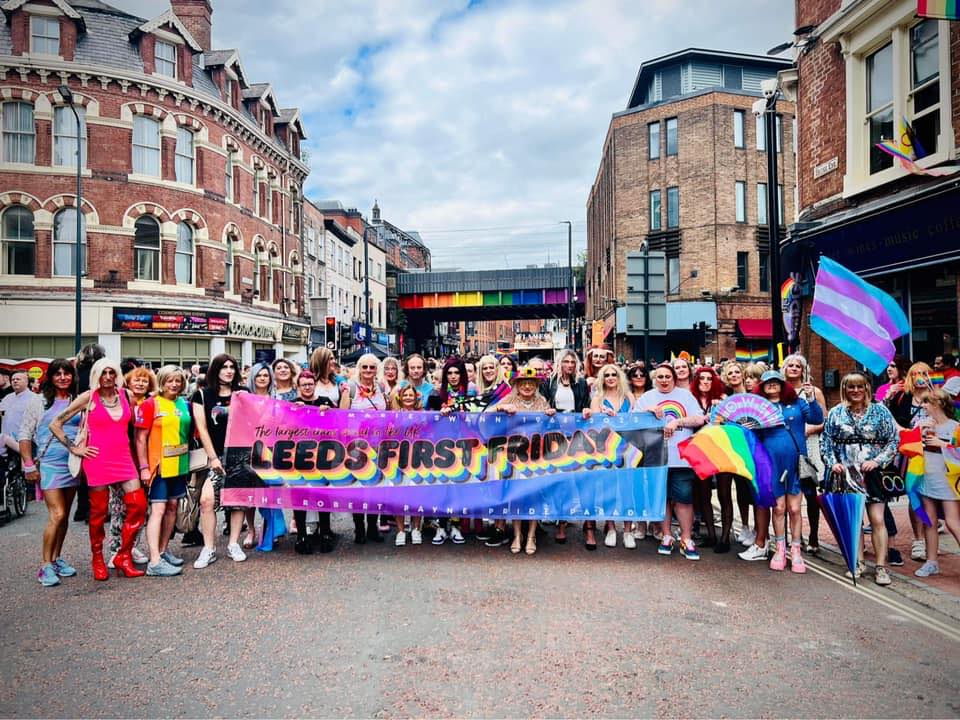
Leeds First Friday at Leeds Pride 2023. The group, the banner, the rainbow bridge. The Robert Payne Pride Parade.
Sophie Scott recaps the LFF Leeds Pride Weekender 2023.
In 2025, for the first time, Leeds First Friday was invited to speak on the Community Stage at Leeds Pride. Kandice Fox gave the opening speech. She and Lizi Bell walked at the front of the parade. Behind them, the LFF walking group followed under a new banner.
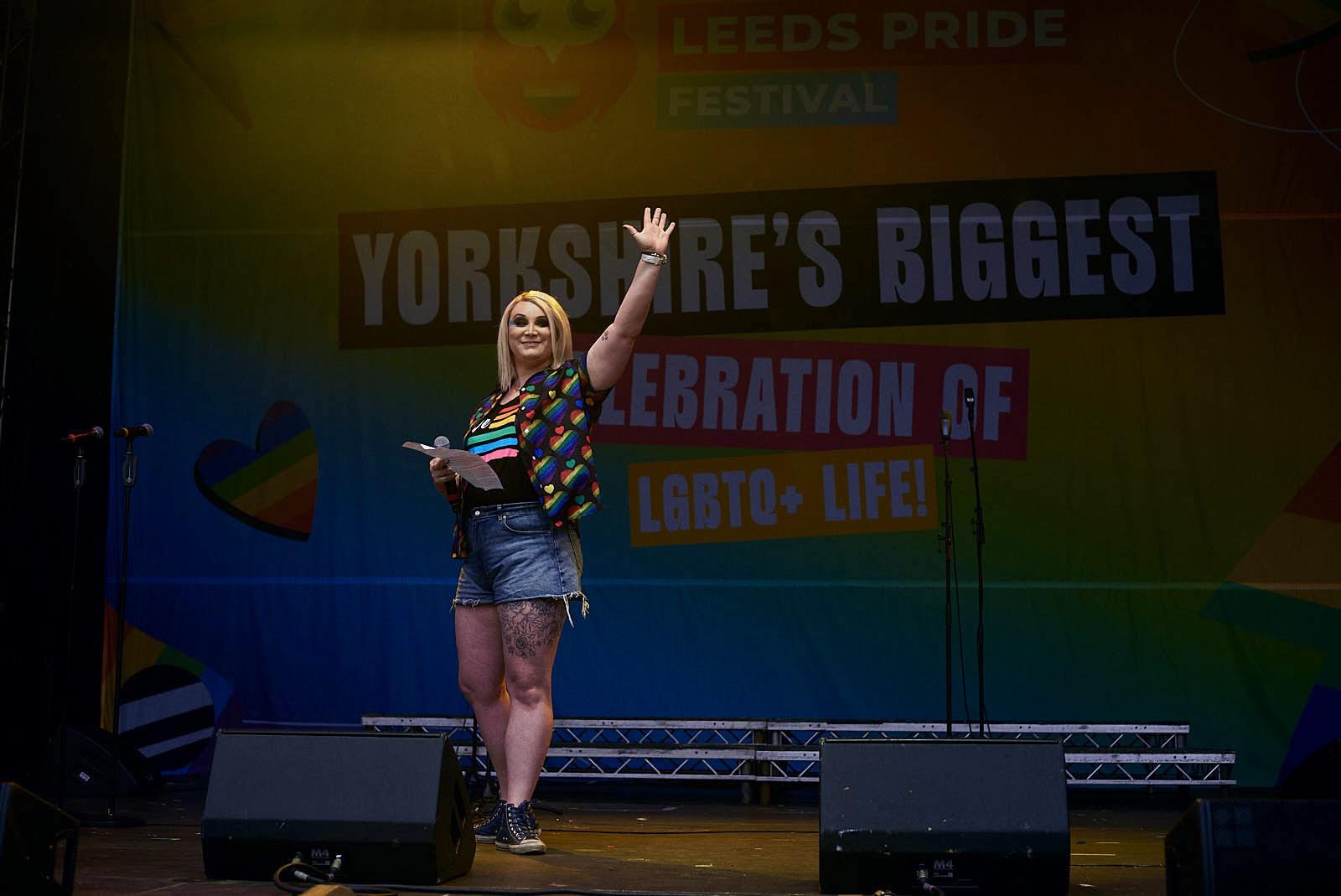
Kandice Fox on the Community Stage, Leeds Pride 2025. The first time Leeds First Friday spoke from that stage.
Standing on the Community Stage to give the opening speech was an enormous honour, not just for me personally, but for Leeds First Friday as a whole. It marks how far we have come. Our joy is unshakable. It burst through the grey skies, the puddles and the wet socks. We were soaked and we were still smiling. This year, we were not just part of the day, we helped shape it.
Kandice Fox, Leeds Pride 2025
The political weather turned colder through these years. Gender-critical campaigns gained mainstream traction, and in April 2025 the UK Supreme Court ruled that woman
in the Equality Act means biological sex, a judgment with immediate, practical consequences for trans people. LFF's response was what it has always been, practical rather than declamatory: it went to every venue on the circuit and asked for a commitment that LFF attendees could use the facilities matching their presentation. Not one said no.
LFF has never been a political organisation. The whole point is that it is not a protest, it is a floor full of people having a good time. But everyone on that floor knows exactly what the weather is outside.
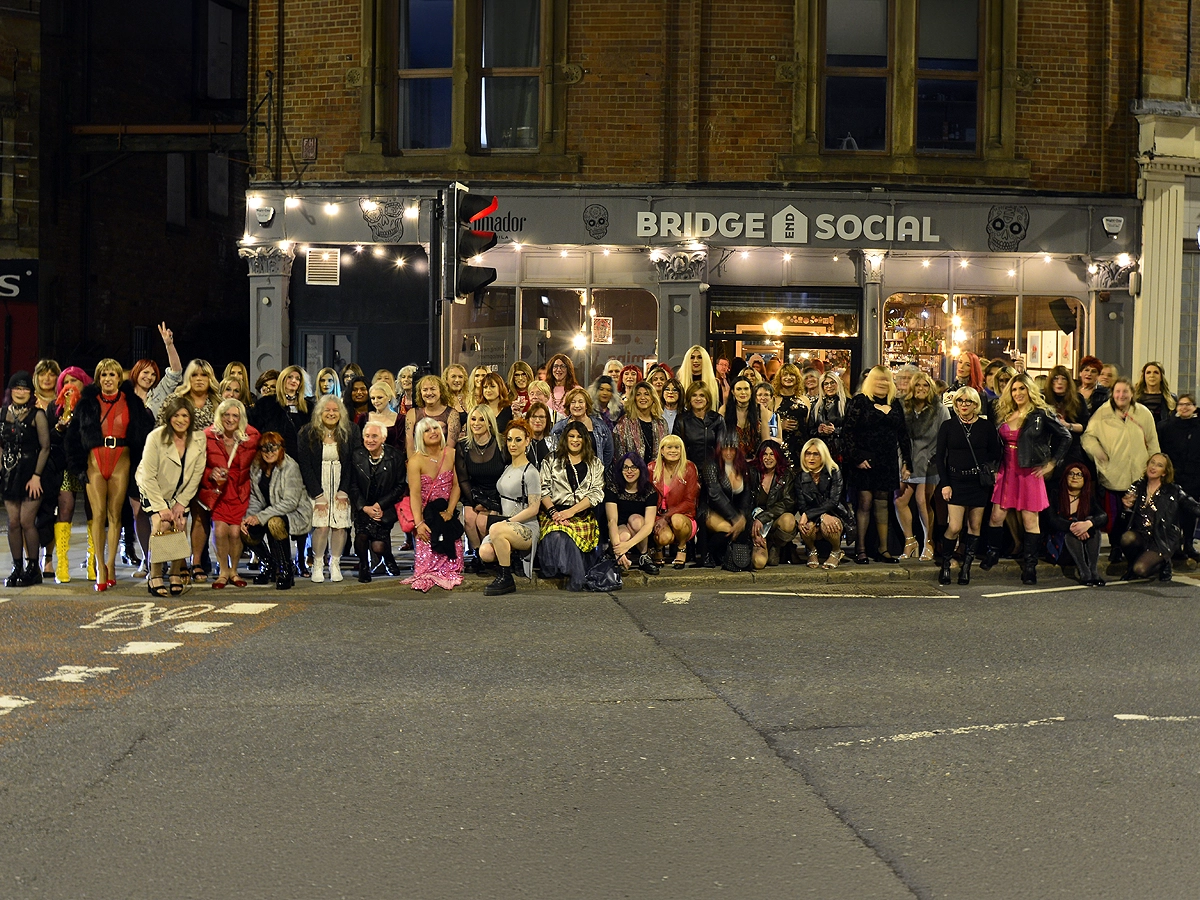
The 18th birthday group photograph, outside Bridge End Social. April 2026.
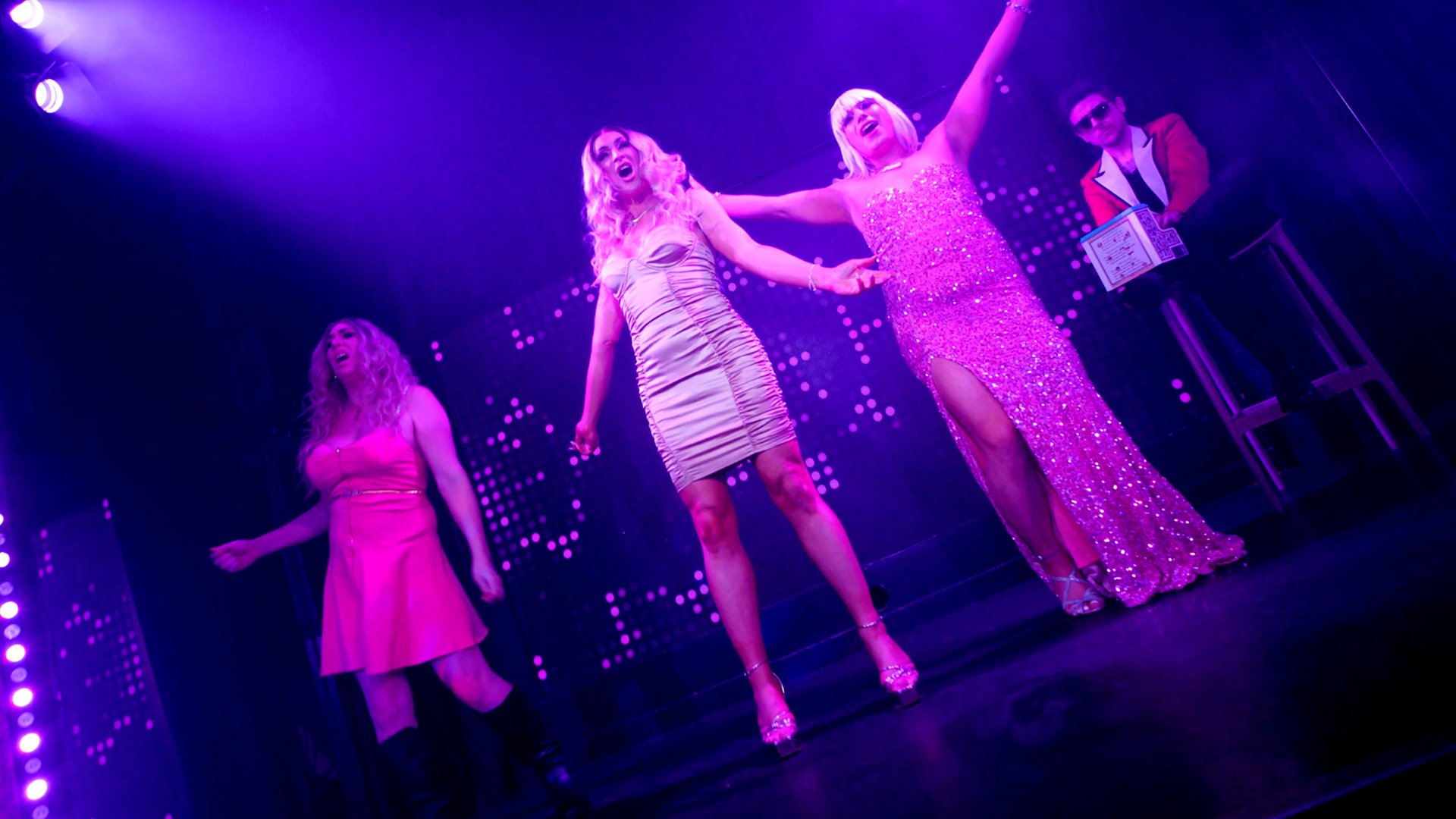
The Fabulous mime video, filmed with BAFTA-winning cinematographer Nicola Bennett across the Freedom Quarter.
In April 2026, Leeds First Friday turned 18. The celebration was themed Fabulous: a mime video shot across the Freedom Quarter with BAFTA-winning cinematographer Nicola Bennett and featuring Ash Palmisciano, the connection Sophie built, still paying forward, a group photograph outside Bridge End Social, a full multi-venue evening. And that same year, the organisation formalised what every handover since Cindy had promised: the LFF Society was ratified by community vote, with Co-Chairs Kandice Fox, Ann East and Lizi Bell taking the night into its next chapter.
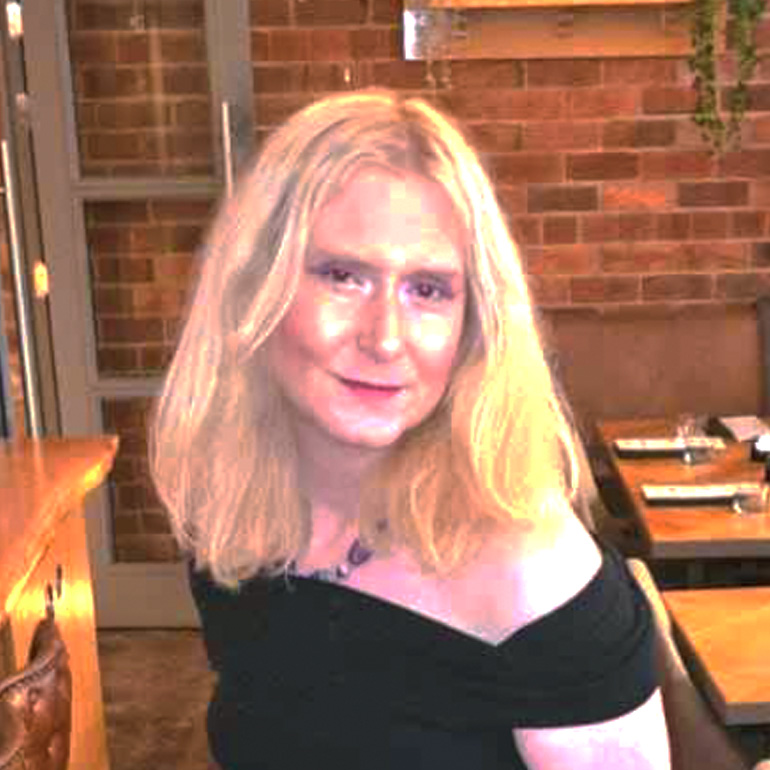
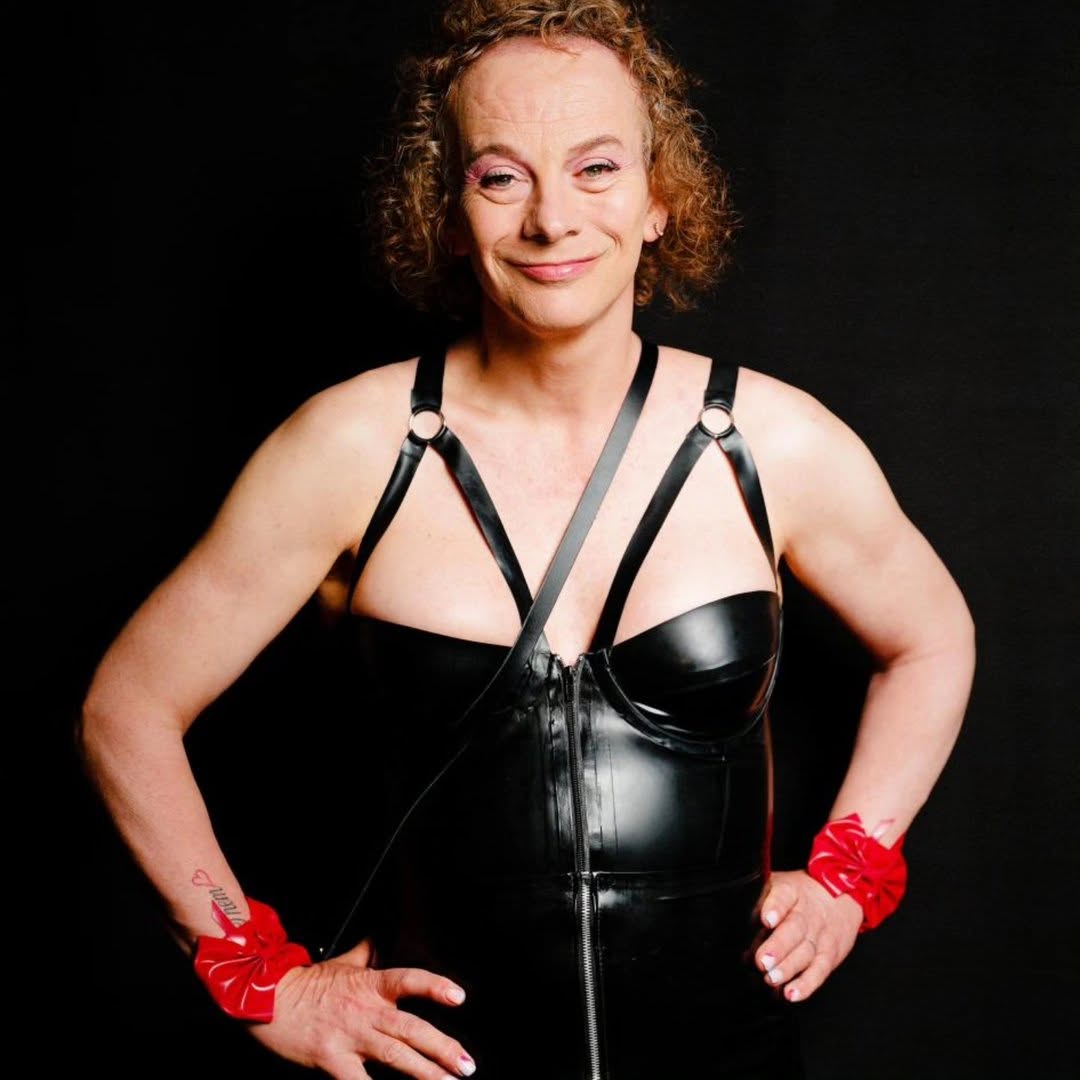
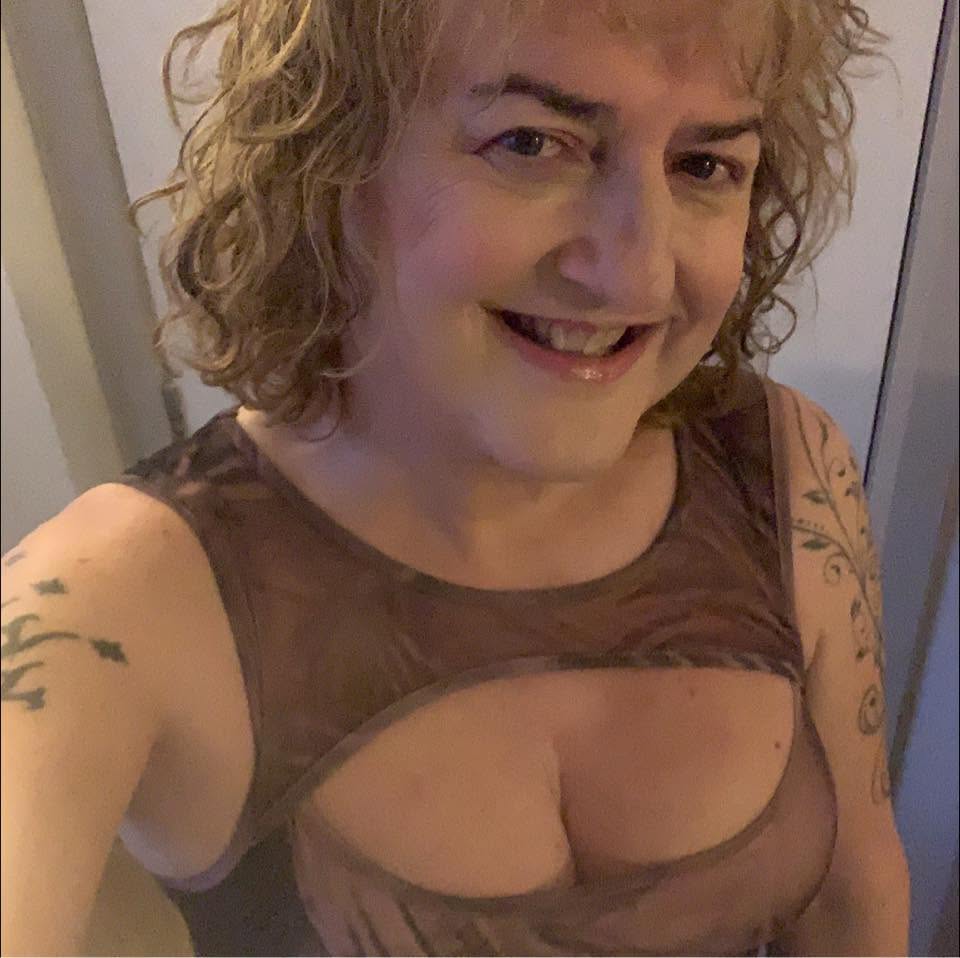
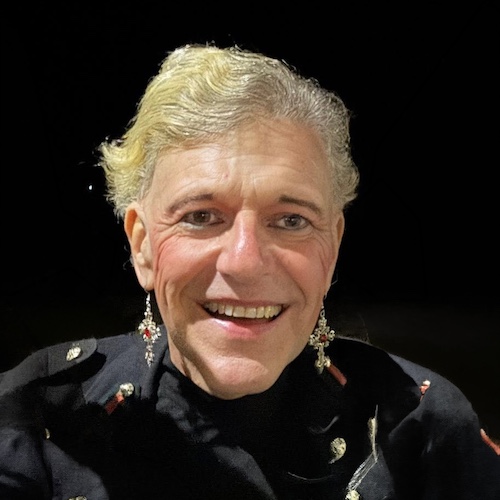
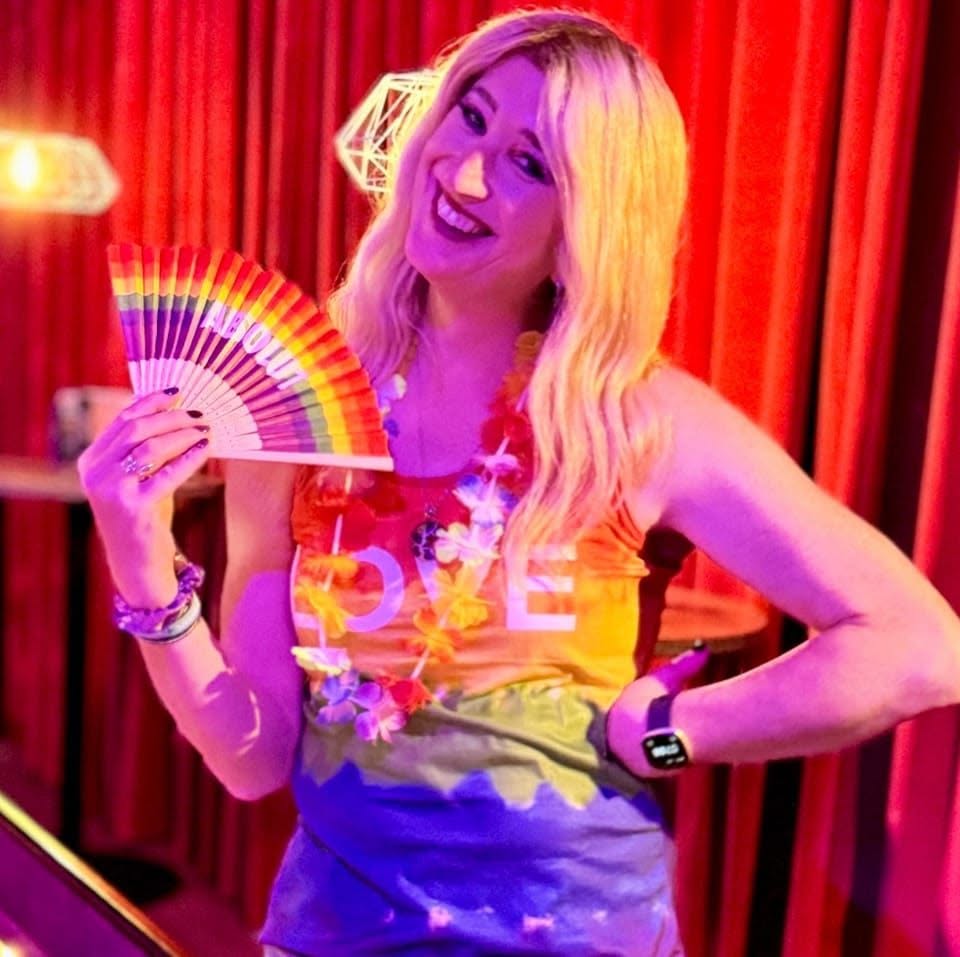
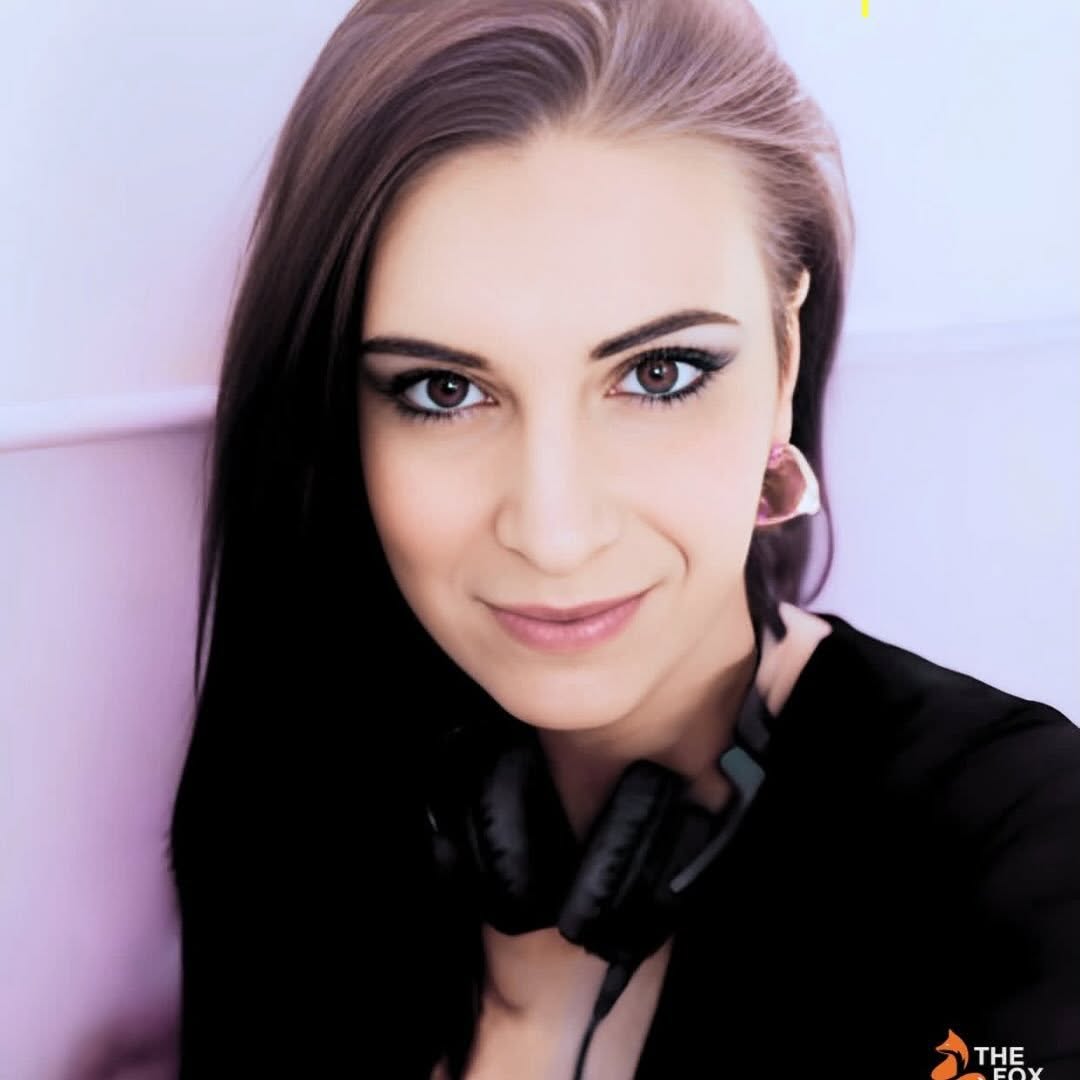
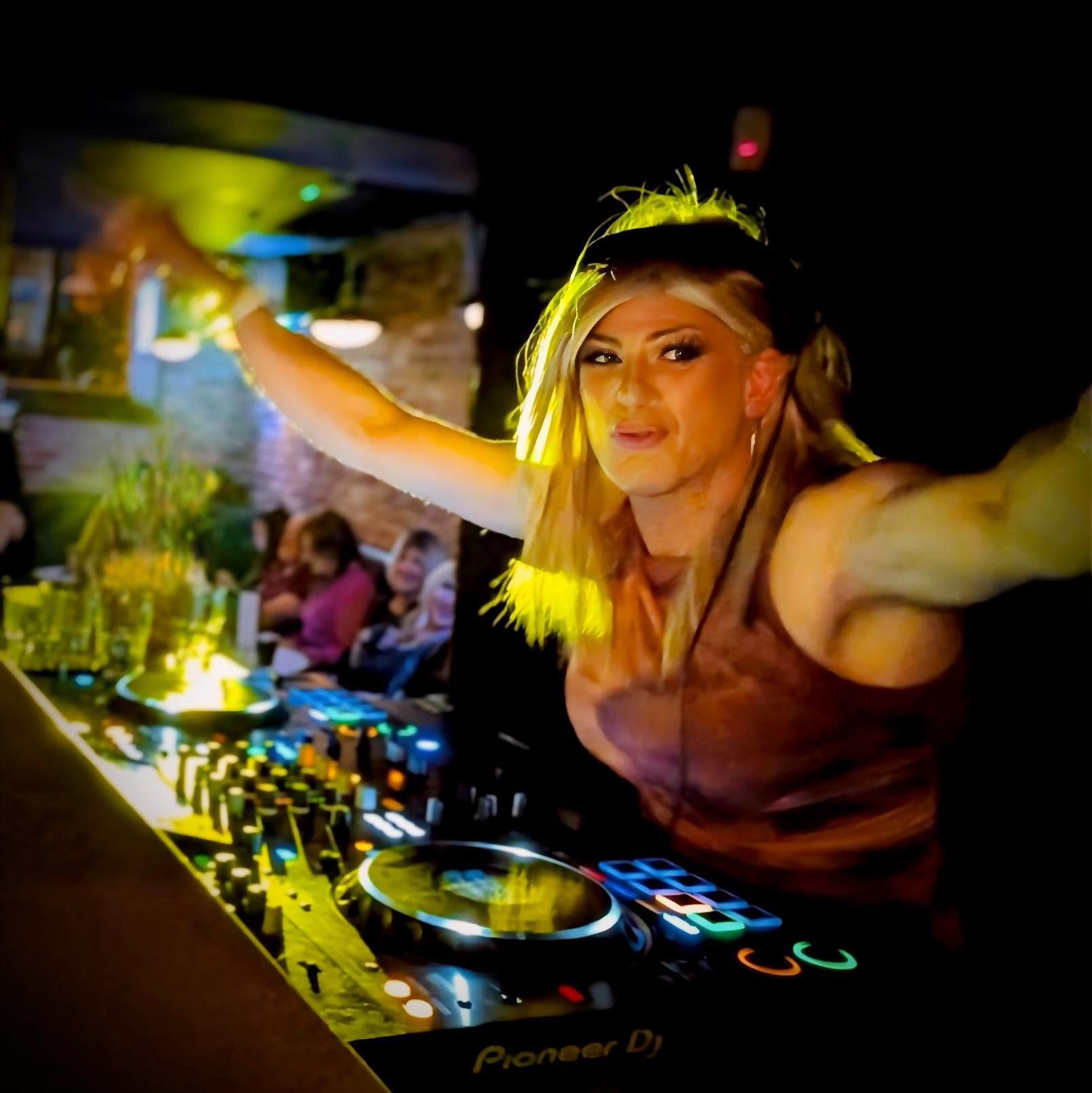
The team, 2022–2026
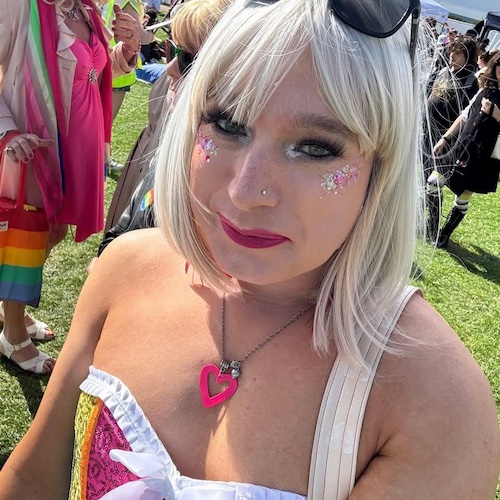
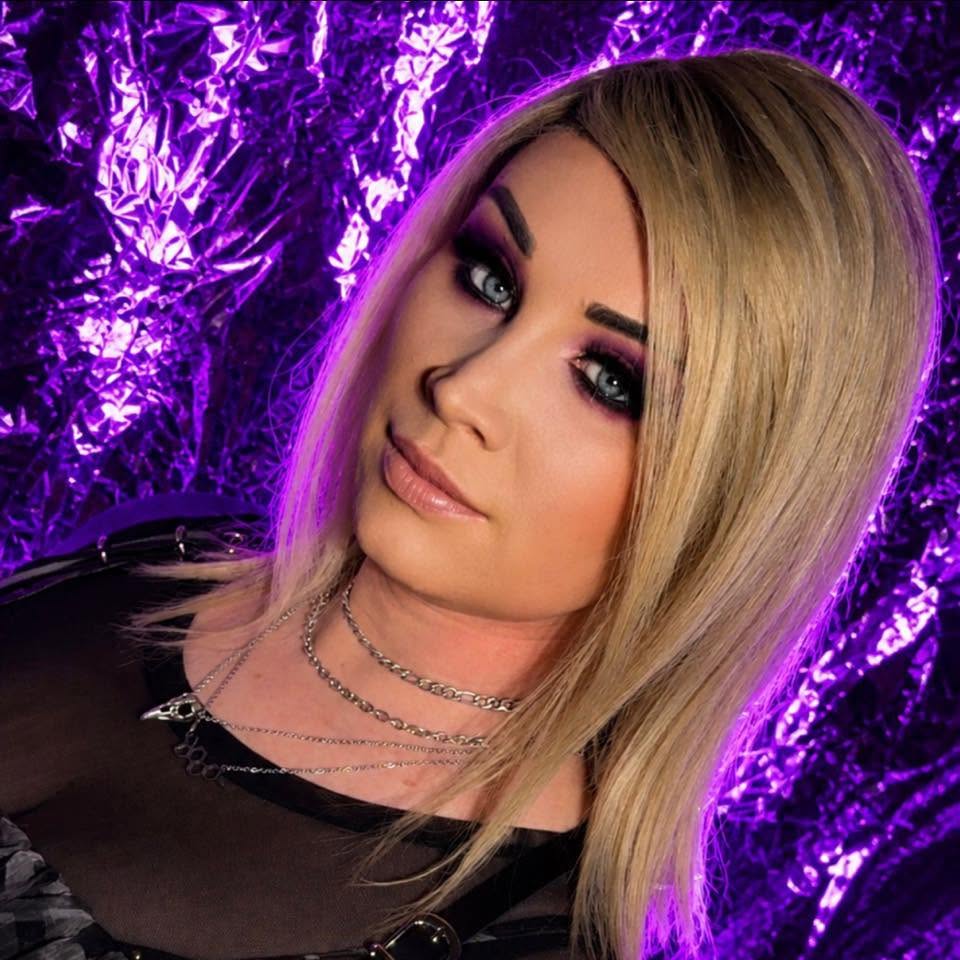
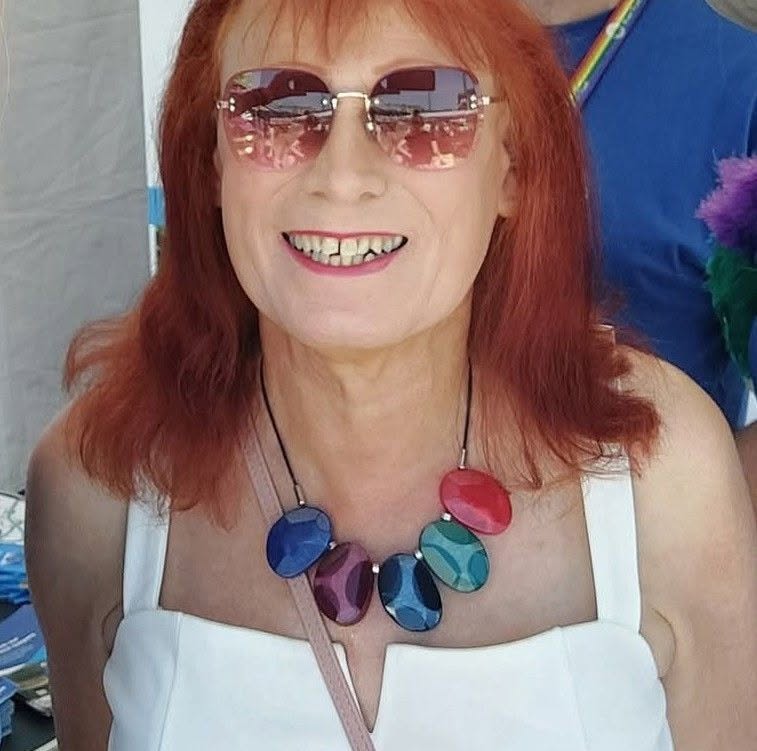
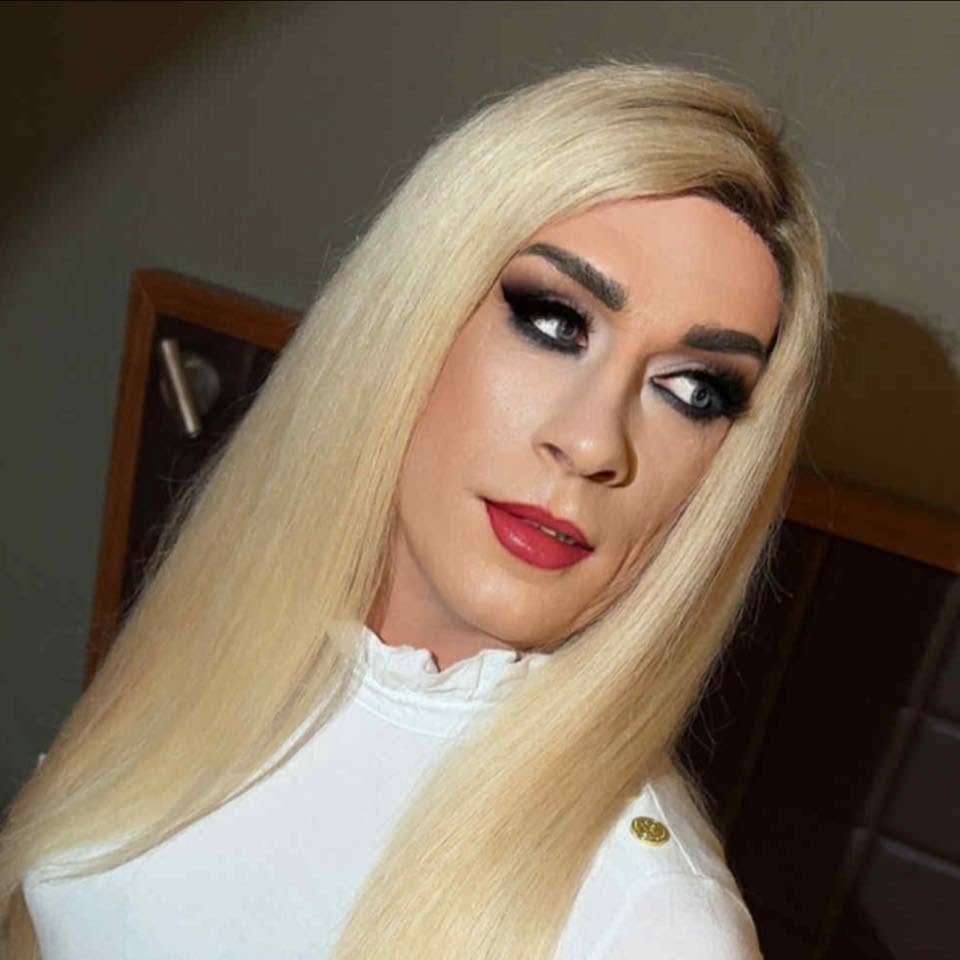
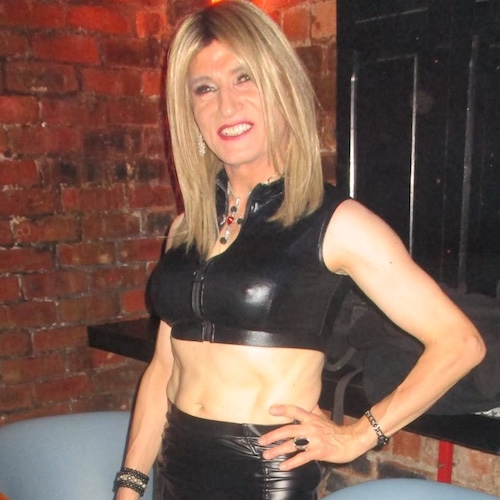
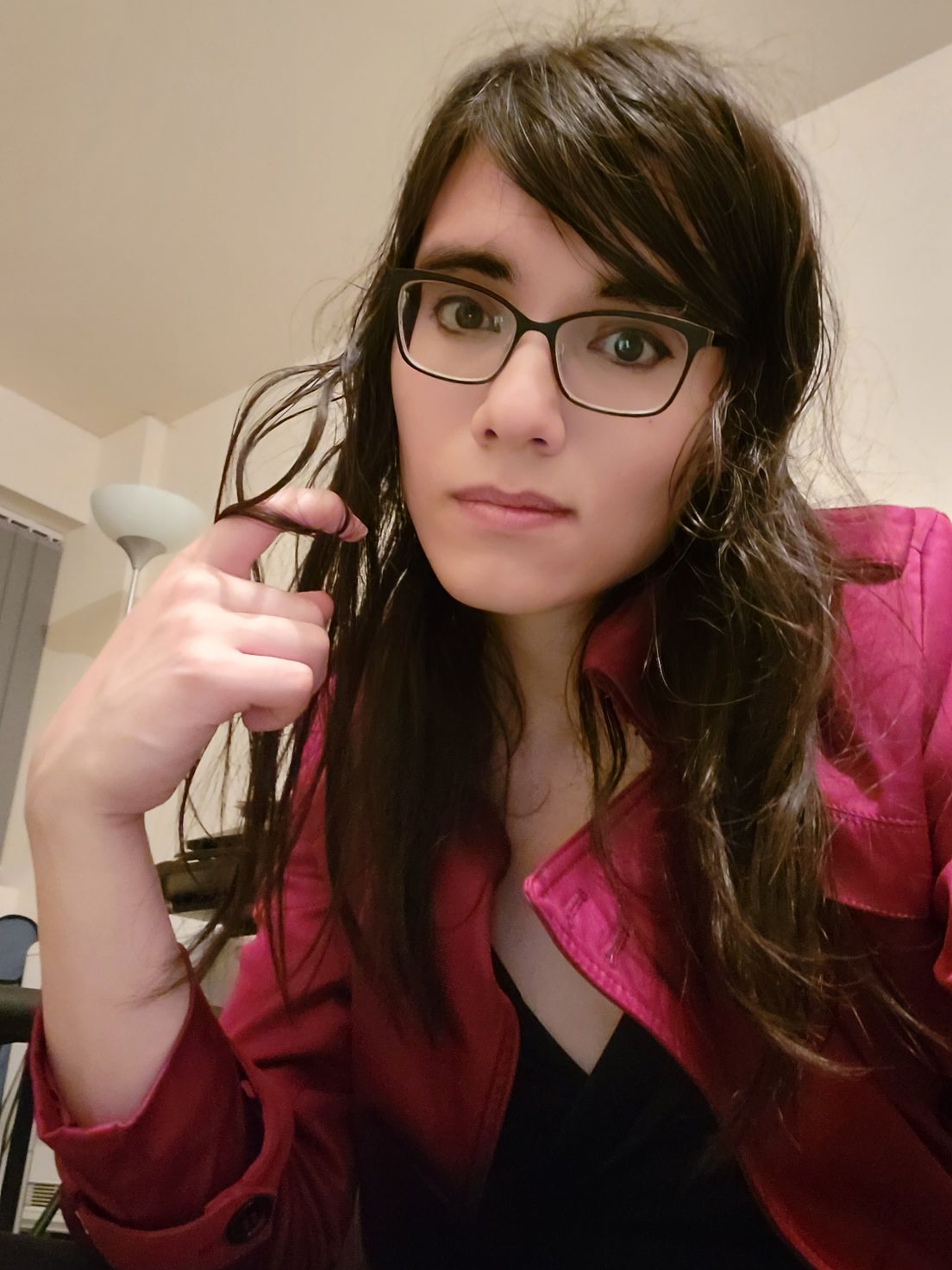
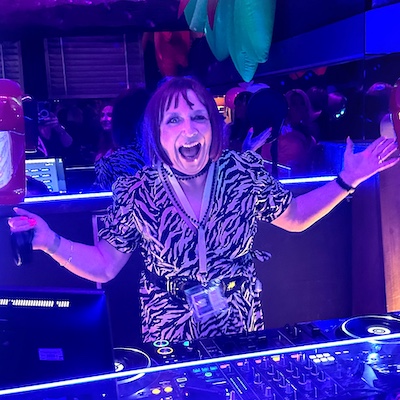
From one to many. These are the people who kept Leeds First Friday running through the framework years, the ones still here and the ones who have since moved on. This is everyone who made these years happen.
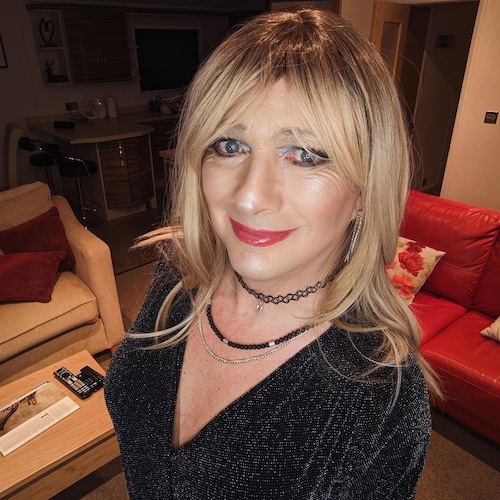
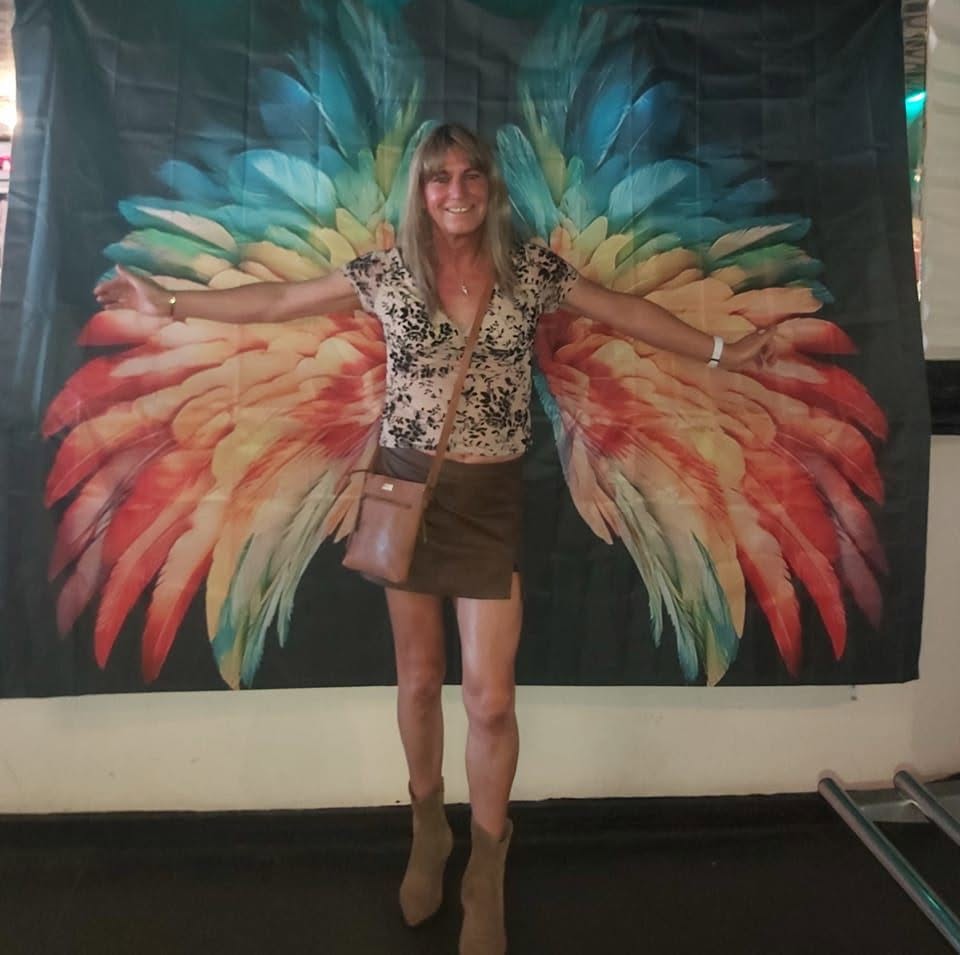
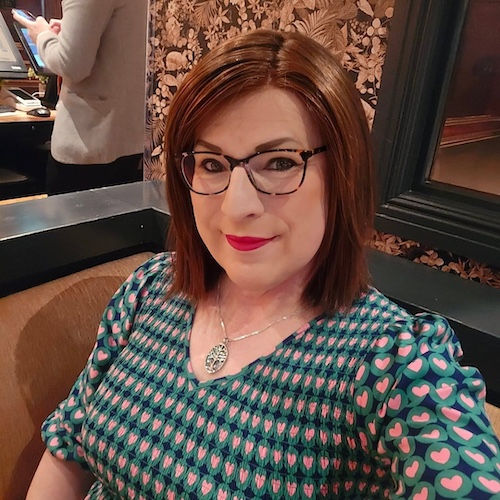
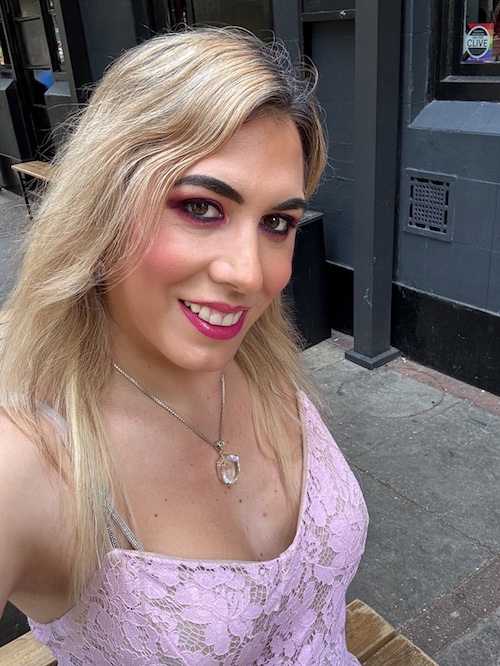
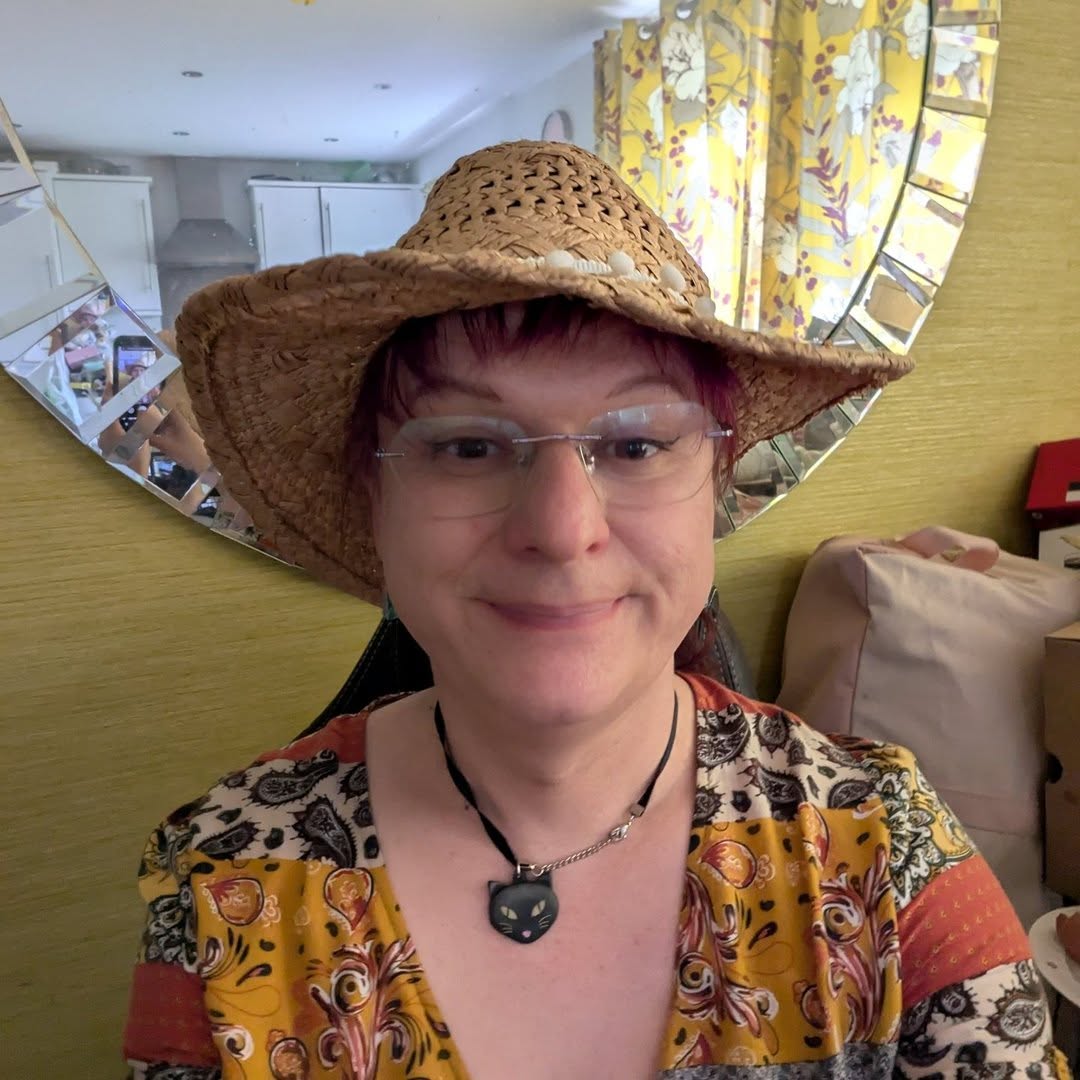
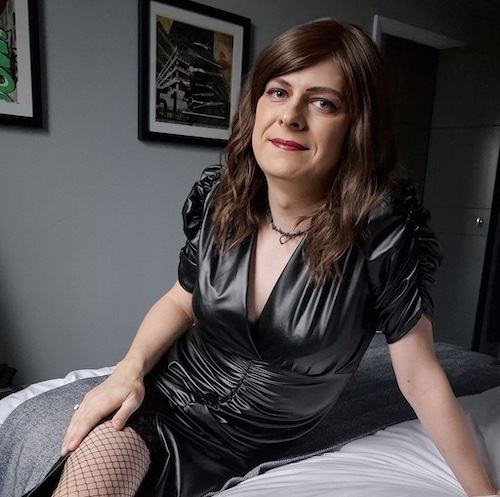
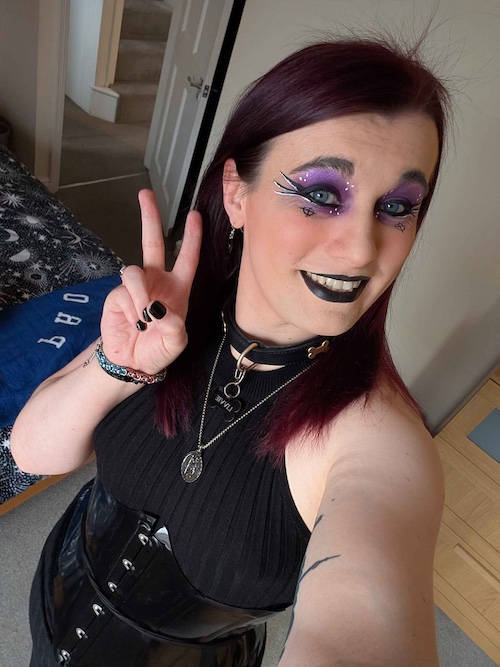
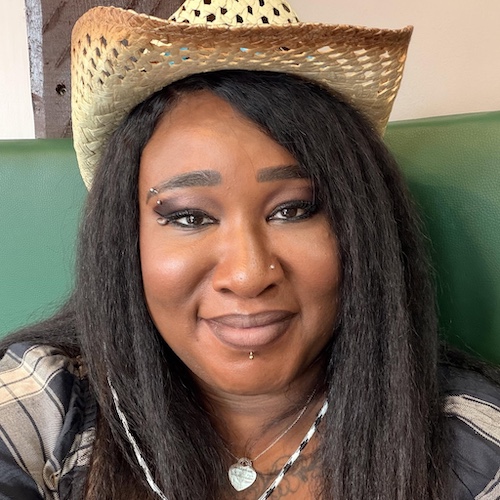
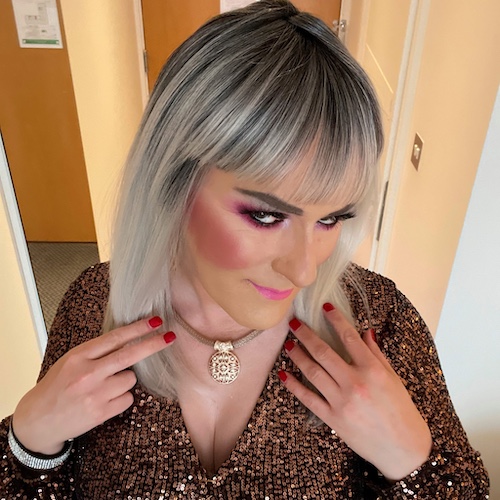
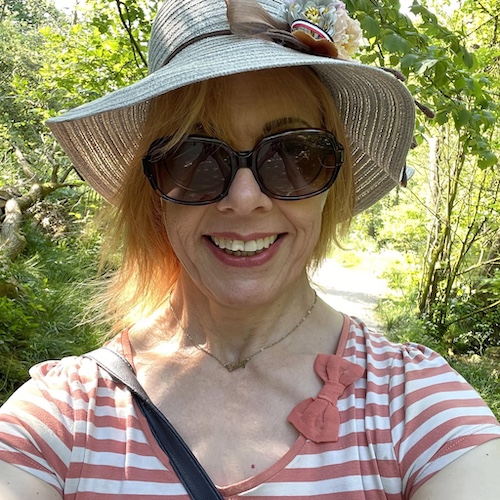
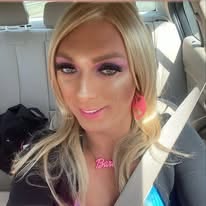
Trans people have always been here. A grave at Catterick, seventeen hundred years old. The Pelican Social Club in Blayd's Yard. The New Penny, open since 1953. A conference disco in 1974. The front of the queue at SpeedQueen. A Tuesday in the Old Red Lion, a Friday in Xibit, the back bar of the Viaduct, the Cosmopolitan staircase, the Marriott lobby, the Viaduct again, and now Bridge End Social.
It would be easy to read all this as a story about nightlife, a run of bars that opened and closed. It is not. The venues change; what people come for never has. Find somewhere to be yourself. Come dressed. Stay as long as you want.
For two decades and counting, it has had a name and a date: Leeds First Friday. Built by Deena, Susan, Cindy, Mandy Jameson, Rachel, Tanya, Janie, Grai, Sophie and Kandice, and everyone alongside them. Grown from a dozen people in a back bar to the UK's largest trans+ social. Handed on, every time, intact and bigger than before.
A new team takes the baton in July 2026. The next chapter is theirs, and yours.
The first Friday of the month in Leeds as always.
In July 2026, the LFF Society comes into effect, with Kandice Fox, Ann East and Lizi Bell taking over as Co-Chairs. The history continues. This page will too, updated as new material comes in.
If you were there for any part of this, as an attendee, a volunteer, or someone who ran a venue, we would like to hear from you. Photographs, corrections, or anything we have not covered here: message us on any of our socials below.
